

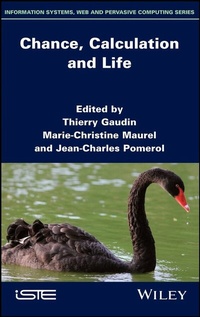
Chance, Calculation and Life
1st Edition
Published on 26. March 2021
304 pages
978-1-119-82396-4 (ISBN)
Description

Chance, Calculation and Life brings together 16 original papers from the
colloquium of the same name, organized by the International Cultural
Center of Cerisy in 2019.
From mathematics to the humanities and biology, there are many
concepts and questions related to chance. What are the different types
of chance? Does chance correspond to a lack of knowledge about the
causes of events, or is there a truly intrinsic and irreducible chance?
Does chance preside over our decisions? Does it govern evolution? Is it
at the origin of life? What part do chance and necessity play in biology?
This book answers these fundamental questions by bringing together
the clear and richly documented contributions of mathematicians,
physicists, biologists and philosophers who make this book an
incomparable tool for work and reflection.
colloquium of the same name, organized by the International Cultural
Center of Cerisy in 2019.
From mathematics to the humanities and biology, there are many
concepts and questions related to chance. What are the different types
of chance? Does chance correspond to a lack of knowledge about the
causes of events, or is there a truly intrinsic and irreducible chance?
Does chance preside over our decisions? Does it govern evolution? Is it
at the origin of life? What part do chance and necessity play in biology?
This book answers these fundamental questions by bringing together
the clear and richly documented contributions of mathematicians,
physicists, biologists and philosophers who make this book an
incomparable tool for work and reflection.
More details
Other editions
Additional editions
Thierry Gaudin | Marie-Christine Maurel | Jean-Charles Pomerol
Chance, Calculation and Life
Book
08/2021
ISTE Ltd
€164.50
Article not available at the moment
Persons
Thierry Gaudin is an engineer at MINES ParisTech and holds a doctorate in
Information Sciences and Communication from Paris Nanterre University,
France. He is a widely renowned expert in innovation policy and has worked
with the OECD, the European Commission and the World Bank.
Marie-Christine Maurel is Professor at Sorbonne University and a researcher at
the Institute of Systematics, Evolution, Biodiversity, MNHN, Paris, France.
Jean-Charles Pomerol is Professor Emeritus at Sorbonne University, France. He
is a specialist in Decision Support Systems and former project leader for
information technology in the Engineering Sciences Department at the CNRS.
He was formerly in charge of the Artificial Intelligence laboratory at UPMC, Paris,
as well as the President of UPMC between 2006 and 2011.
Information Sciences and Communication from Paris Nanterre University,
France. He is a widely renowned expert in innovation policy and has worked
with the OECD, the European Commission and the World Bank.
Marie-Christine Maurel is Professor at Sorbonne University and a researcher at
the Institute of Systematics, Evolution, Biodiversity, MNHN, Paris, France.
Jean-Charles Pomerol is Professor Emeritus at Sorbonne University, France. He
is a specialist in Decision Support Systems and former project leader for
information technology in the Engineering Sciences Department at the CNRS.
He was formerly in charge of the Artificial Intelligence laboratory at UPMC, Paris,
as well as the President of UPMC between 2006 and 2011.
Content
- Cover
- Half-Title Page
- Title Page
- Copyright Page
- Contents
- Preface
- Introduction
- PART 1: Randomness in all of its Aspects
- 1 Classical, Quantum and Biological Randomness as Relative Unpredictability
- 1.1. Introduction
- 1.1.1. Brief historical overview
- 1.1.2. Preliminary remarks
- 1.2. Randomness in classical dynamics
- 1.3. Quantum randomness
- 1.4. Randomness in biology
- 1.5. Random sequences: a theory invariant approach
- 1.6. Classical and quantum randomness revisited
- 1.6.1. Classical versus algorithmic randomness
- 1.6.2. Quantum versus algorithmic randomness
- 1.7. Conclusion and opening: toward a proper biological randomness
- 1.8. Acknowledgments
- 1.9. References
- 2 In The Name of Chance
- 2.1. The birth of probabilities and games of chance
- 2.1.1. Solutions
- 2.1.2. To what end?
- 2.2. A very brief history of probabilities
- 2.3. Chance? What chance?
- 2.4. Prospective possibility
- 2.4.1. LLN + CLT + ENIAC = MC
- 2.4.2. Generating chance through numbers
- 2.4.3. Going back the other way
- 2.4.4. Prospective possibility as master of the world?
- 2.5. Appendix: Congruent generators, can prospective chance be periodic?
- 2.5.1. A little modulo n arithmetic
- 2.5.2. From erratic arithmetic to algorithmic randomness
- 2.5.3. And, the winner is... Mersenne Twister 623
- 2.6. References
- 3 Chance in a Few Languages
- 3.1. Classical Sanskrit
- 3.2. Persian and Arabic
- 3.3. Ancient Greek
- 3.4. Russian
- 3.5. Latin
- 3.6. French
- 3.7. English
- 3.8. Dice, chance and the symbolic world
- 3.9. References
- 4 The Collective Determinism of Quantum Randomness
- 4.1. True or false chance
- 4.2. Chance sneaks into uncertainty
- 4.3. The world of the infinitely small
- 4.4. A more figurative example
- 4.5. Einstein's act of resistance
- 4.6. Schrödinger's cat to neutrino oscillations
- 4.7. Chance versus the anthropic principle
- 4.8. And luck in life?
- 4.9. Chance and freedom
- 5 Wave-Particle Chaos to the Stability of Living
- 5.1. Introduction
- 5.2. The chaos of the wave-particle
- 5.3. The stability of living things
- 5.4. Conclusion
- 5.5. Acknowledgments
- 5.6. References
- 6 Chance in Cosmology: Random and Turbulent Creation of Multiple Cosmos
- 6.1. Is quantum cosmology oxymoronic?
- 6.4. Loop lament
- 6.5. The quantum vacuum exists, Casimir has met it
- 6.6. The generosity of the quantum vacuum
- 6.7. Landscapes
- 6.8. The good works of Inflation
- 6.9. Sub species aeternitatis
- 6.10. The smiling vacuum
- 7 The Chance in Decision: When Neurons Flip a Coin
- 7.1. A very subjective utility
- 7.2. A minimum rationality
- 7.3. There is noise in the choices
- 7.4. On the volatility of parameters
- 7.5. When the brain wears rose-tinted glasses
- 7.7. The will to move an index finger
- 7.8. Free will in debate
- 7.9. The virtue of chance
- 7.10. References
- 8 To Have a Sense of Life: A Poetic Reconnaissance
- 8.1. References
- 9 Divine Chance
- 9.1. Thinking by chance
- 9.2. Chance, need: why choose?
- 9.3. When chance is not chance
- 9.4. When chance comes from elsewhere
- 10 Chance and the Creative Process
- 10.1. Introduction
- 10.2. Chance
- 10.3. Creation
- 10.4. Chance in the artistic creative process
- 10.5. An art of the present moment
- 10.6. Conclusion
- 10.7. References
- PART 2: Randomness, Biology and Evolution
- 11 Epigenetics, DNA and Chromatin Dynamics: Where is the Chance and Where is the Necessity?
- 11.1. Introduction
- 11.2. Random combinations
- 11.3. Random alterations
- 11.4. Beyond the gene
- 11.5. Epigenetic variation
- 11.6. Concluding remarks
- 11.7. Acknowledgments
- 11.8. References
- 12 When Acquired Characteristics Become Heritable: The Lesson of Genomes
- 12.1. Introduction
- 12.2. Horizontal genetic exchange in prokaryotes
- 12.3. Two specificities of eukaryotes theoretically oppose horizontal gene transfer
- 12.4. Criteria for genomic analysis
- 12.5. Abundance of horizontal transfers in unicellular eukaryotes
- 12.6. Remarkable horizontal genetic transfers in pluricellular eukaryotes
- 12.7. Main mechanisms of horizontal genetic transfers
- 12.8. Introgressions and limits to the concept of species
- 12.9. Conclusion
- 12.10. References
- 13 The Evolutionary Trajectories of Organisms are Not Stochastic
- 13.1. Evolution and stochasticity: a few metaphors
- 13.2. The Gouldian metaphor of the "replay" of evolution
- 13.3. The replay of evolution: what happened
- 13.4. Evolutionary replay experiments
- 13.5. Phylogenies versus experiments
- 13.6. Stochasticity, evolution and extinction
- 13.7. Conclusion
- 13.8. References
- 14 Evolution in the Face of Chance
- 14.1. Introduction
- 14.2. Waddington and the concept of canalization
- 14.3. A stochastic model of Darwinian evolution
- 14.3.1. Redundancy and neutral networks
- 14.3.2. A toy model
- 14.3.3. Mutation-selection algorithm
- 14.4. Numerical results
- 14.4.1. Canalization
- 14.4.2. Target selection
- 14.4.3. Neighborhood selection
- 14.5. Discussion
- 14.6. Acknowledgments
- 15 Chance, Contingency and the Origins of Life: Some Historical Issues
- 15.1. Acknowledgments
- 15.2. References
- 16 Chance, Complexity and the Idea of a Universal Ethics1
- 16.1. Cosmic evolution and advances in computation
- 16.2. Two notions of complexity
- 16.3. Biological computations
- 16.4. Energy and emergy
- 16.5. What we hold onto
- 16.6. Noah knew this already!
- 16.7. Create, protect and collect
- 16.8. An ethics of organized complexity
- 16.9. Not so easy
- 16.10. References
- List of Authors
- Index
- Other titles from iSTE in Information Systems, Web and Pervasive Computing
- EULA
