

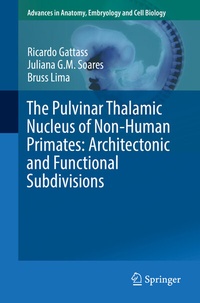
The Pulvinar Thalamic Nucleus of Non-Human Primates: Architectonic and Functional Subdivisions
Description

This book discusses the hypothesis that the primate pulvinar contains an original scaffold which is derived from cytoarchitectural markers and specific protein distributions. Thereafter, along primate evolution, different selective pressures acted in order to shape and fine-tune the connectivity of the pulvinar with specific regions of the neocortex. This divergence created, among other things, the different sets of retinotopic map representations in the pulvinar nucleus depending on functional and behavioral requirements of each species.
The pulvinar, the largest nucleus of the primate thalamus, has extensive and reciprocal connections with several areas of the neocortex. These input-output loops suggest that the pulvinar may regulate the flow of information within and between cortical areas in a highly dynamic fashion. Therefore, understanding the anatomical subdivisions within the pulvinar, and its connectivity with the cortex, is paramount to understanding pulvinar physiological function. However, there is a stark contrast regarding the way that the pulvinar is subdivided depending on the technique employed. Cytoarchitectural and immunohistochemical methods reveal a very similar pattern of pulvinar subdivision across Old- and New-World monkeys. On the other hand, electrophysiological and connectivity studies expose clear discrepancies in pulvinar organization across primate evolution.
More details
Other editions
Additional editions
Content
Chapter 1: introduction.- Chapter 2: Cytoarchitecture and myeloarchitecture of the pulvinar.- Chapter 3: Chemoarchitecture of the pulvinar.- Chapter 4: Visual map representations in the primate pulvinar.- Chapter 5: Connectivity of the pulvinar.- Chapter 6: Reestablishing the chemoarchitectural borders based on electrophysiological and connectivity data.- Chapter 7: Visual topography of the pulvinar projection zones.- Chapter 8: Comparative pulvinar organization across different primate species.- Chapter 9: Response properties of pulvinar neurons studied with single unit electrophysiological recordings.- Chapter 10: Modulation of pulvinar neuronal activity by arousal.- Chapter 11: Gaba inactivation of the pulvinar.- Chapter 12: The role of the pulvinar in spatial visual attention.
