

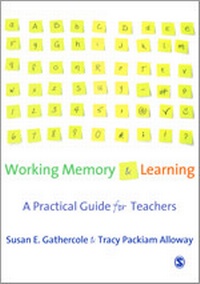
Working Memory and Learning
A Practical Guide for Teachers
1st Edition
Published on 9. January 2008
144 pages
978-1-4462-0038-4 (ISBN)
Description

Dr Tracy Alloway has been awarded the prestigious Joseph Lister Award from the British Science Association.
'The authors have written a guide for practitioners that is both highly practical, and yet based upon sound theoretical principles....This book achieves a successful, yet often elusive, link between theory, research and practice, and deserves to have a high readership. I will have no hesitation in recommending it to a range of readers' - Jane Mott, Support for Learning
'This book fulfils its aim to explain working memory and the limits it places on children's classroom learning. For teachers it gives a very clear guide and fills a gap in understanding that can only lead to more child-centred approaches to teaching and learning' - Lynn Ambler, Support for Learning
'A clear and accessible account of current theory and research, which is then applied to children's learning in the classroom....The range of strategies...are well grounded in theory derived from research and sit within a coherent conceptual model' - The Psychologist
'An easy to read yet informative book that explains the concepts clearly and offers practitioners ways to support those with poor working memory in the classroom' - SNIP
`The topic of working memory nowadays tends to dominate discussions with teachers and parents, and both groups can helpfully be directed to this easy-to-read but serious text ... (it) is likely to prove a turning-point in the management and facilitation of hard-to-teach children. In a situation muddied by ever-multiplying syndromes and disorders, this book delivers a clarifying and reassuring isolation of the major cognitive characteristic that cuts across all the boundaries and leaves the class teacher and SENCO empowered. I think very highly of the book and shall be recommending it steadily' - Martin Turner, Child Center for Evaluation and Teaching, Kuwait
Susan Gathercole is winner of the British Psychological Society's President's Award for 2007
A good working memory is crucial to becoming a successful learner, yet there is very little material available in an easy-to-use format that explains the concept and offers practitioners ways to support children with poor working memory in the classroom.
This book provides a coherent overview of the role played by working memory in learning during the school years, and uses theory to inform good practice.
Topics covered include:
- the link between working memory skills and key areas of learning (such as literacy & numeracy)
- the relationship between working memory and children with developmental disorders
- assessment of children for working memory deficits
- strategies for supporting working memory in under-performing children
This accessible guide will help SENCOs, teachers, teaching assistants, speech and language therapists and educational psychologists to understand and address working memory in their setting.
'The authors have written a guide for practitioners that is both highly practical, and yet based upon sound theoretical principles....This book achieves a successful, yet often elusive, link between theory, research and practice, and deserves to have a high readership. I will have no hesitation in recommending it to a range of readers' - Jane Mott, Support for Learning
'This book fulfils its aim to explain working memory and the limits it places on children's classroom learning. For teachers it gives a very clear guide and fills a gap in understanding that can only lead to more child-centred approaches to teaching and learning' - Lynn Ambler, Support for Learning
'A clear and accessible account of current theory and research, which is then applied to children's learning in the classroom....The range of strategies...are well grounded in theory derived from research and sit within a coherent conceptual model' - The Psychologist
'An easy to read yet informative book that explains the concepts clearly and offers practitioners ways to support those with poor working memory in the classroom' - SNIP
`The topic of working memory nowadays tends to dominate discussions with teachers and parents, and both groups can helpfully be directed to this easy-to-read but serious text ... (it) is likely to prove a turning-point in the management and facilitation of hard-to-teach children. In a situation muddied by ever-multiplying syndromes and disorders, this book delivers a clarifying and reassuring isolation of the major cognitive characteristic that cuts across all the boundaries and leaves the class teacher and SENCO empowered. I think very highly of the book and shall be recommending it steadily' - Martin Turner, Child Center for Evaluation and Teaching, Kuwait
Susan Gathercole is winner of the British Psychological Society's President's Award for 2007
A good working memory is crucial to becoming a successful learner, yet there is very little material available in an easy-to-use format that explains the concept and offers practitioners ways to support children with poor working memory in the classroom.
This book provides a coherent overview of the role played by working memory in learning during the school years, and uses theory to inform good practice.
Topics covered include:
- the link between working memory skills and key areas of learning (such as literacy & numeracy)
- the relationship between working memory and children with developmental disorders
- assessment of children for working memory deficits
- strategies for supporting working memory in under-performing children
This accessible guide will help SENCOs, teachers, teaching assistants, speech and language therapists and educational psychologists to understand and address working memory in their setting.
Reviews / Votes
'The authors have written a guide for practitioners that is both highly practical, and yet based upon sound theoretical principles....This book achieves a successful, yet often elusive, link between theory, research and practice, and deserves to have a high readership. I will have no hesitation in recommending it to a range of readers' - Jane Mott, Support for Learning'This book fulfils its aim to explain working memory and the limits it places on children's classroom learning. For teachers it gives a very clear guide and fills a gap in understanding that can only lead to more child-centred approaches to teaching and learning' - Lynn Ambler, Support for Learning
All prices
More details
Language
English
Place of publication
London
United Kingdom
Target group
College/higher education
ISBN-13
978-1-4462-0038-4 (9781446200384)
Copyright in bibliographic data and cover images is held by Nielsen Book Services Limited or by the publishers or by their respective licensors: all rights reserved.
Schweitzer Classification
Other editions
Additional editions
Book
01/2008
1st Edition
SAGE Publications Inc
€68.80
Shipment within 10-20 days
Persons
Tracy Packiam Alloway, PhD, is a professor of Psychology at the University of North Florida. Formerly, she was the Director of the Center for Memory and Learning in the Lifespan in the UK. She is an expert on working memory and education, and has published over 75 journal articles and books on this topic. She developed the internationally recognized Alloway Working Memory Assessment (Pearson Assessment, translated into 20 languages). She writes a blog for Psychology Today and Huffington Post. She has also provided advice to Fortune 500 companies, like Prudential, as well as the World Bank and BBC.
www.tracyalloway.com
www.tracyalloway.com
Content
What Is Working Memory?
Working Memory in Childhood
Working Memory and Learning
Children with Working Memory Impairments
Children with Short-Term Memory Impairments
Working Memory in Children with Developmental Disorders
Assessing Working Memory
Supporting Learning in Memory-Impaired Children
Working Memory in Childhood
Working Memory and Learning
Children with Working Memory Impairments
Children with Short-Term Memory Impairments
Working Memory in Children with Developmental Disorders
Assessing Working Memory
Supporting Learning in Memory-Impaired Children
