
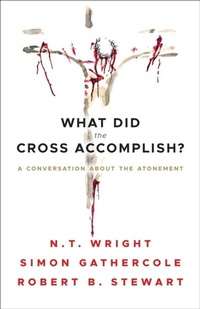
What Did the Cross Accomplish?
Description
Alles über E-Books | Antworten auf Fragen rund um E-Books, Kopierschutz und Dateiformate finden Sie in unserem Info- & Hilfebereich.
In this book, readers will enjoy a fascinating and cordial discussion between N. T. Wright and Simon Gathercole on the meaning and nature of the doctrine of atonement. These two highly respected scholars discuss in clear and understandable language the meanings of the crucifixion of Jesus Christ. Their discussion explores various theories of atonement and looks closely at the Old Testament to discover Paul's meaning of his words that "Christ died for our sins in accordance with the Scriptures."
Wright presents his case first, then Gathercole responds with a contrary point of view. Their discussion confronts questions including: What exactly is this "scandal of the cross"? What role does the notion of sacrifice, as understood in its ancient context, play in the atonement of Christ? Is the atonement a "victory"? How so? Was Christ a "substitute," taking humankind's place on the cross and suffering the death and judgment that sinners deserve? How does the death of Christ on the cross rescue or liberate sinners from death? Does the cross achieve benefits for only humans, or do those benefits extend to the entirety of creation? This book is a succinct conversation in which all these questions receive attention, with nuanced differences between the two interlocutors. This conversation along with Robert Stewart's introductory framework make this book an excellent primer to the study of the atonement, and readers will come away with a deeper understanding of the meanings of the cross.
All prices
More details
Other editions
Additional editions
Persons
Simon Gathercole is Reader in New Testament Studies and Director of Studies in Theology at Fitzwilliam College at the University of Cambridge. He previously taught at the University of Aberdeen. Gathercole is a leading expert in Christology and the doctrine of atonement. Among his numerous publications is his Defending Substitution: An Essay on Atonement in Paul.
Content
- Intro
- Endorsements
- Half Title
- Title Page
- Copyright
- Dedication
- Epigraph
- Contents
- Acknowledgments
- Theology, Worldview, and the Meal Celebrating the Cross: Theological Method and the Atonement
- Theology and Worldviews
- Atonement and the Lord's Supper
- The Meaning of the Atonement: N. T. Wright and Simon Gathercole in Dialogue
- N. T. Wright: Opening Statement
- Simon Gathercole: Opening Statement
- Point-Counterpoint: Discussion
- Questions and Answers
- Day 2: Concluding Comments, Q and A
- Further Reading
- Classic Works on the Atonement
- Other Sources
- Index

System requirements
File format: ePUB
Copy protection: Adobe-DRM (Digital Rights Management)
System requirements:
- Computer (Windows; MacOS X; Linux): Install the free reader Adobe Digital Editions prior to download (see eBook Help).
- Tablet/smartphone (Android; iOS): Install the free app Adobe Digital Editions or the app PocketBook before downloading (see eBook Help).
- E-reader: Bookeen, Kobo, Pocketbook, Sony, Tolino and many more (not Kindle).
The file format ePub works well for novels and non-fiction books – i.e., „flowing” text without complex layout. On an e-reader or smartphone, line and page breaks automatically adjust to fit the small displays.
This eBook uses Adobe-DRM, a „hard” copy protection. If the necessary requirements are not met, unfortunately you will not be able to open the eBook. You will therefore need to prepare your reading hardware before downloading.
Please note: We strongly recommend that you authorise using your personal Adobe ID after installation of any reading software.
For more information, see our ebook Help page.
File format: PDF
Copy-Protection: Adobe-DRM (Digital Rights Management)
System requirements:
- Computer (Windows; MacOS X; Linux): Install the free reader Adobe Digital Editions prior to download (see eBook Help).
- Tablet/smartphone (Android; iOS): Install the free app Adobe Digital Editions or the app PocketBook before downloading (see eBook Help).
- E-reader: Bookeen, Kobo, Pocketbook, Sony, Tolino and many more (only limited: Kindle).
The file format PDF always displays a book page identically on any hardware. This makes PDF suitable for complex layouts such as those used in textbooks and reference books (images, tables, columns, footnotes). Unfortunately, on the small screens of e-readers or smartphones, PDFs are rather annoying, requiring too much scrolling.
This eBook uses Adobe-DRM, a „hard” copy protection. If the necessary requirements are not met, unfortunately you will not be able to open the eBook. You will therefore need to prepare your reading hardware before downloading.
Please note: We strongly recommend that you authorise using your personal Adobe ID after installation of any reading software.
For more information, see our eBook Help page.
File format: ePUB
Copy protection: Watermark-DRM (Digital Rights Management)
System requirements:
- Computer (Windows; MacOS X; Linux): Use a reading software that can process the file format ePUB: e.g., Adobe Digital Editions or FBReader – both free (see eBook Help).
- Tablet/Smartphone (Android; iOS): Before downloading, install the free app Adobe Digital Editions (see eBook Help).
- E-reader: Bookeen, Kobo, Pocketbook, Sony, Tolino and many more (not Kindle).
The file format ePUB works well for novels and non-fiction books – i.e., „flowing” text without complex layout. On an e-reader or smartphone, line and page breaks automatically adjust to fit the small displays.
This eBook uses Watermark-DRM, a „soft” copy protection. This means that there are no technical restrictions to prevent illegal distribution. However, there is a personalised watermark embedded in the eBook that can be used to identify the purchaser of the eBook in the event of misuse and to provide evidence for legal purposes.
For more information, see our eBook Help page.
