

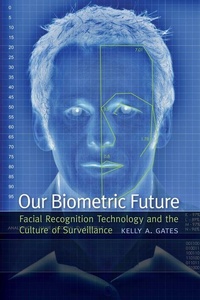
Our Biometric Future
Facial Recognition Technology and the Culture of Surveillance
1st Edition
Published on 23. January 2011
277 pages
978-0-8147-3303-5 (ISBN)
Description

Since the 1960s, a significant effort has been underway to program computers to "see" the human face—to develop automated systems for identifying faces and distinguishing them from one another-commonly known as Facial Recognition Technology. While computer scientists are developing FRT in order to design more intelligent and interactive machines, businesses and states agencies view the technology as uniquely suited for "smart" surveillance-systems that automate the labor of monitoring in order to increase their efficacy and spread their reach.
Tracking this technological pursuit, Our Biometric Future identifies FRT as a prime example of the failed technocratic approach to governance, where new technologies are pursued as shortsighted solutions to complex social problems. Culling news stories, press releases, policy statements, PR kits and other materials, Kelly Gates provides evidence that, instead of providing more security for more people, the pursuit of FRT is being driven by the priorities of corporations, law enforcement and state security agencies, all convinced of the technology's necessity and unhindered by its complicated and potentially destructive social consequences. By focusing on the politics of developing and deploying these technologies, Our Biometric Future argues not for the inevitability of a particular technological future, but for its profound contingency and contestability.
Tracking this technological pursuit, Our Biometric Future identifies FRT as a prime example of the failed technocratic approach to governance, where new technologies are pursued as shortsighted solutions to complex social problems. Culling news stories, press releases, policy statements, PR kits and other materials, Kelly Gates provides evidence that, instead of providing more security for more people, the pursuit of FRT is being driven by the priorities of corporations, law enforcement and state security agencies, all convinced of the technology's necessity and unhindered by its complicated and potentially destructive social consequences. By focusing on the politics of developing and deploying these technologies, Our Biometric Future argues not for the inevitability of a particular technological future, but for its profound contingency and contestability.
Reviews / Votes
This work is a fascinating, timely investigation of the cultural practices and institutional priorities surrounding automated face perception technologies - C. Tappert (Choice) A groundbreaking study. Our Biometric Future considers facial recognition technology through its wide range of political entanglements, such as post-9/11 security measures, the management of urban populations in commercial districts, and self-representation in online social networking sites. Across these contexts, Gates shows how facial recognition's political effects have developed in spite of the fact that the technology does not actually work very well. Written with style and wit, Our Biometric Future will resonate with readers in cultural studies, new media, science and technology studies, and anyone interested in surveillance, privacy and security in contemporary life. - Jonathan Sterne,McGill University, author of The Audible Past: Cultural Origins of Sound Reproduction Gates deftly explores the cultural work performed by facial recognition technologies, and in so doing demonstrates considerable skill in the critical analysis of emergent technologies. This book represents a significant contribution to our understanding about the ongoing elaboration of surveillance society throughout the globe. - Anne Balsamo,author of Technologies of the Gendered Body Given its spotty track record, it's hard to see why facial recognition technology has so quickly become one of the most widely used forms of biometrics (second only to fingerprints). Kelly Gates' Our Biometric Future, a thorough exploration of FRT's relatively short history, provides some clues...[an] impressive book. (London Review of Books)More details
Series
Language
English
Place of publication
New York
United States
Target group
Professional and scholarly
File size
3,39 MB
ISBN-13
978-0-8147-3303-5 (9780814733035)
Copyright in bibliographic data and cover images is held by Nielsen Book Services Limited or by the publishers or by their respective licensors: all rights reserved.
Schweitzer Classification
Other editions
Additional editions
Book
01/2011
New York University Press
€36.50
Shipment within 15-20 days
Book
01/2011
New York University Press
€103.50
Shipment within 15-20 days
Person
Kelly Gates is Associate Professor in the Department of Communication at the University of California, San Diego. She is the author of Our Biometric Future: Facial Recognition Technology and the Culture of Surveillance, as well as the editor of International Encyclopedia of Media Studies, Vol. 6: Media Studies Futures and The New Media of Surveillance. Her writing has appeared in numerous journals, including Surveillance & Society, Communication and Critical/Cultural Studies, and Social Semiotics.
Content
- Intro
- Contents
- List of Abbreviations
- Acknowledgments
- Introduction: Experimenting with the Face
- 1 Facial Recognition Technology from the Lab to the Marketplace
- 2 Police Power and the Smart CCTV Experiment
- 3 Finding the Face of Terror in Data
- 4 Inventing the Security-Conscious, Tech-Savvy Citizen
- 5 Automated Facial Expression Analysis and the Mobilization of Affect
- Conclusion
- Notes
- Bibliography
- Index
- A
- B
- C
- D
- E
- F
- G
- H
- I
- J
- K
- L
- M
- N
- O
- P
- R
- S
- T
- U
- V
- W
- Y
- Z
- About the Author
