

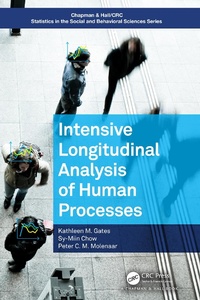
Intensive Longitudinal Analysis of Human Processes
Systems Approaches to Human Process Analysis
1st Edition
Published on 31. January 2023
260 pages
978-1-4822-3060-4 (ISBN)
Description

This book focuses on a span of statistical topics relevant to researchers who seek to conduct person-specific analysis of human data. Our purpose is to provide one consolidated resource that includes techniques from disciplines such as engineering, physics, statistics, and quantitative psychology and outlines their application to data often seen in human research. The book balances mathematical concepts with information needed for using these statistical approaches in applied settings, such as interpretative caveats and issues to consider when selecting an approach.
The statistical topics covered here include foundational material as well as state-of-the-art methods. These analytic approaches can be applied to a range of data types such as psychophysiological, self-report, and passively collected measures such as those obtained from smartphones. We provide examples using varied data sources including functional MRI (fMRI), daily diary, and ecological momentary assessment data.
Features:
Description of time series, measurement, model building, and network methods for person-specific analysis
Discussion of the statistical methods in the context of human research
Empirical and simulated data examples used throughout the book
R code for analyses and recorded lectures for each chapter available at the book website: https://www.personspecific.com/
Across various disciplines of human study, researchers are increasingly seeking to conduct person-specific analysis. This book provides comprehensive information, so no prior knowledge of these methods is required. We aim to reach active researchers who already have some understanding of basic statistical testing. Our book provides a comprehensive resource for those who are just beginning to learn about person-specific analysis as well as those who already conduct such analysis but seek to further deepen their knowledge and learn new tools.
The statistical topics covered here include foundational material as well as state-of-the-art methods. These analytic approaches can be applied to a range of data types such as psychophysiological, self-report, and passively collected measures such as those obtained from smartphones. We provide examples using varied data sources including functional MRI (fMRI), daily diary, and ecological momentary assessment data.
Features:
Description of time series, measurement, model building, and network methods for person-specific analysis
Discussion of the statistical methods in the context of human research
Empirical and simulated data examples used throughout the book
R code for analyses and recorded lectures for each chapter available at the book website: https://www.personspecific.com/
Across various disciplines of human study, researchers are increasingly seeking to conduct person-specific analysis. This book provides comprehensive information, so no prior knowledge of these methods is required. We aim to reach active researchers who already have some understanding of basic statistical testing. Our book provides a comprehensive resource for those who are just beginning to learn about person-specific analysis as well as those who already conduct such analysis but seek to further deepen their knowledge and learn new tools.
More details
Series
Edition
1. Auflage
Language
English
Place of publication
Philadelphia, PA
United States
Publishing group
Taylor & Francis Inc
Illustrations
11 Tables, black and white; 3 Line drawings, color; 53 Line drawings, black and white; 6 Illustrations, color; 50 Illustrations, black and white
ISBN-13
978-1-4822-3060-4 (9781482230604)
Copyright in bibliographic data and cover images is held by Nielsen Book Services Limited or by the publishers or by their respective licensors: all rights reserved.
Schweitzer Classification
Other editions
Additional editions
Kathleen M. Gates | Sy-Miin Chow | Peter C. M. Molenaar
Intensive Longitudinal Analysis of Human Processes
Systems Approaches to Human Process Analysis
Book
01/2023
1st Edition
Chapman & Hall/CRC
€159.90
Article not available for order
Persons
Kathleen (Katie) Gates is an associate professor of Quantitative Psychology in the Department of Psychology at the University of North Carolina at Chapel Hill. She obtained her Ph.D. in the Department of Human Development and Family Studies (quant focus) at Penn State, a Masters of Forensic Psychology at the City University of New York (John Jay College), and a BS in Psychology from Michigan State University. Katie's work is motivated by problems in analyzing individual-level data. She develops algorithms and programs that may aid researchers in better quantifying behavioral, psychophysiological, and emotional processes across time. The end goal is to help researchers identify patterns within individuals so we can provide person-specific prevention, treatment, and intervention protocols as well as better understand the varied basic physiological underpinnings for emotions, cognition, and behaviors.
Sy-Miin Chow is Professor of Human Development and Family Studies at the Pennsylvania State University. She is an elected fellow of the Alexander von Humboldt Foundation in Germany and a winner of the Cattell Award from the Society for Multivariate Experimental Psychology as well as the Early Career Award from the Psychometric Society. Her work focuses on methodologies for handling intensive longitudinal data, methodological issues that arise in studies of change and human dynamics; and models and approaches for representing the dynamics of emotions, child development and family processes, as well as ways of promoting well-being and risk prevention.
Peter C. M. Molenaar is Distinguished Professor of Human Development and Family Studies at the Pennsylvania State University. He is a recipient of the Pauline Schmitt Russell Distinguished Research Career Award from the College of Health and Human Development at Penn State, the Aston Gottesman Lecture Award from the University of Virginia, the Sells Award for Distinguished Mulitvariate Research from the Society for Multivariate Experimental Psychology (SMEP), and the Tanaka Award from SMEP in 2017. His work instituted what many characterize as a conceptual and methodological paradigm-shift in the analysis of psychological, social, and behavioral processes from an inter-individual to an intra-individual variation perspective.
Sy-Miin Chow is Professor of Human Development and Family Studies at the Pennsylvania State University. She is an elected fellow of the Alexander von Humboldt Foundation in Germany and a winner of the Cattell Award from the Society for Multivariate Experimental Psychology as well as the Early Career Award from the Psychometric Society. Her work focuses on methodologies for handling intensive longitudinal data, methodological issues that arise in studies of change and human dynamics; and models and approaches for representing the dynamics of emotions, child development and family processes, as well as ways of promoting well-being and risk prevention.
Peter C. M. Molenaar is Distinguished Professor of Human Development and Family Studies at the Pennsylvania State University. He is a recipient of the Pauline Schmitt Russell Distinguished Research Career Award from the College of Health and Human Development at Penn State, the Aston Gottesman Lecture Award from the University of Virginia, the Sells Award for Distinguished Mulitvariate Research from the Society for Multivariate Experimental Psychology (SMEP), and the Tanaka Award from SMEP in 2017. His work instituted what many characterize as a conceptual and methodological paradigm-shift in the analysis of psychological, social, and behavioral processes from an inter-individual to an intra-individual variation perspective.
Content
1.Theory: Mathematical theorems about the relation between IAV and IEV. 2. P-Technique. 3. Vector Autoregression (VAR). 4. Dynamic Factor Analysis. 5. Model Specification and Selection Procedures.6. Models of Intraindividual Variability with Time-Varying Parameters (TVPs). 7. Control Theory Optimization of Dynamic Processes. 8. The Intersection of Network Science and IAV.
