

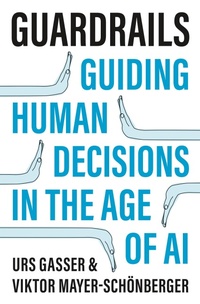
Guardrails
Guiding Human Decisions in the Age of AI
1st Edition
Published on 27. March 2024
240 pages
978-0-691-25635-1 (ISBN)
Description

How society can shape individual actions in times of uncertainty
When we make decisions, our thinking is informed by societal norms, "guardrails" that guide our decisions, like the laws and rules that govern us. But what are good guardrails in today's world of overwhelming information flows and increasingly powerful technologies, such as artificial intelligence? Based on the latest insights from the cognitive sciences, economics, and public policy, Guardrails offers a novel approach to shaping decisions by embracing human agency in its social context.
In this visionary book, Urs Gasser and Viktor Mayer-Schönberger show how the quick embrace of technological solutions can lead to results we don't always want, and they explain how society itself can provide guardrails more suited to the digital age, ones that empower individual choice while accounting for the social good, encourage flexibility in the face of changing circumstances, and ultimately help us to make better decisions as we tackle the most daunting problems of our times, such as global injustice and climate change.
Whether we change jobs, buy a house, or quit smoking, thousands of decisions large and small shape our daily lives. Decisions drive our economies, seal the fate of democracies, create war or peace, and affect the well-being of our planet. Guardrails challenges the notion that technology should step in where our own decision making fails, laying out a surprisingly human-centered set of principles that can create new spaces for better decisions and a more innovative and prosperous society.
When we make decisions, our thinking is informed by societal norms, "guardrails" that guide our decisions, like the laws and rules that govern us. But what are good guardrails in today's world of overwhelming information flows and increasingly powerful technologies, such as artificial intelligence? Based on the latest insights from the cognitive sciences, economics, and public policy, Guardrails offers a novel approach to shaping decisions by embracing human agency in its social context.
In this visionary book, Urs Gasser and Viktor Mayer-Schönberger show how the quick embrace of technological solutions can lead to results we don't always want, and they explain how society itself can provide guardrails more suited to the digital age, ones that empower individual choice while accounting for the social good, encourage flexibility in the face of changing circumstances, and ultimately help us to make better decisions as we tackle the most daunting problems of our times, such as global injustice and climate change.
Whether we change jobs, buy a house, or quit smoking, thousands of decisions large and small shape our daily lives. Decisions drive our economies, seal the fate of democracies, create war or peace, and affect the well-being of our planet. Guardrails challenges the notion that technology should step in where our own decision making fails, laying out a surprisingly human-centered set of principles that can create new spaces for better decisions and a more innovative and prosperous society.
More details
Other editions
Additional editions
Book
03/2024
Princeton University Press
€27.50
Shipment within 10-20 days
Persons
Urs Gasser is professor of public policy, governance, and innovative technology and dean of the School of Social Sciences and Technology at the Technical University of Munich. His books include (with John Palfrey) Born Digital: How Children Grow Up in a Digital Age. Viktor Mayer-Schönberger is professor of internet governance and regulation at the University of Oxford. His books include Delete: The Virtue of Forgetting in the Digital Age (Princeton).
Content
- Cover
- Contents
- 1. Decisions: How We Decide and Why It Matters: Human Agency and Changing the World
- 2. Rules: The Governance of Cyberspace Offers a Cautious Tale of Hype, Hope, and Failure
- 3. Falsities: Two Ways to Approach the Problem of Misinformation
- 4. Bias: Why We Can't Expect AI to Solve Deep-Rooted Flaws in Human Decision-Making
- 5. Doubt: Incomplete Information and the Problem of Irreversibility
- 6. Principles: Guardrails Should Empower Individuals, Be Socially Anchored, and Encourage Learning
- 7. Self-Restraint: How to Avoid the Governance Trap of Too Much Context-Awareness, or Not Enough
- 8. Range: Four Case Studies That Illustrate the Art and Science of Making Innovative Guardrails
- 9. Machines: Why Technology Is Neither Anathema nor a Panacea, But a Valuable Piece in the Puzzle
- 10. Futures: How to Think About the Exercise of Power as Humans Approach a New Digital Frontier
- Acknowledgments
- Notes
- Index
