

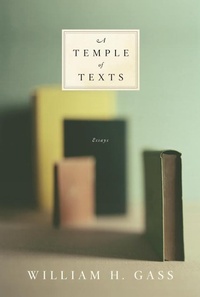
A Temple of Texts
Published on 10. February 2010
432 pages
978-0-307-49824-3 (ISBN)
Description

From one of the most admired essayists and novelists at work today: a new collection of essays—his first since Tests of Time, winner of the National Book Critics Circle Award for Criticism.
These twenty-five essays speak to the nature and value of writing and to the books that result from a deep commitment to the word. Here is Gass on Rilke and Gertrude Stein; on friends such as Stanley Elkin, Robert Coover, and William Gaddis; and on a company of "healthy dissidents,” among them Rabelais, Elias Canetti, John Hawkes, and Gabriel García Márquez.
In the title essay, Gass offers an annotated list of the fifty books that have most influenced his thinking and his work and writes about his first reaction to reading each. Among the books: Ludwig Wittgenstein's Tractatus Logico-Philosophicus ("A lightning bolt,” Gass writes. "Philosophy was not dead after all. Philosophical ambitions were not extinguished. Philosophical beauty had not fled prose.”) . . . Ben Jonson's The Alchemist ("A man after my own heart. He is capable of the simplest lyrical stroke, as bold and direct as a line by Matisse, but he can be complex in a manner that could cast Nabokov in the shade . . . Shakespeare may have been smarter, but he did not know as much.”) . . . Gustave Flaubert's letters ("Here I learned—and learned—and learned.”) And after reading Malory's Le Morte d'Arthur, Gass writes "I began to eat books like an alien worm.”
In the concluding essay, "Evil,” Gass enlarges upon the themes of artistic quality and cultural values that are central to the books he has considered, many of which seek to reveal the worst in people while admiring what they do best.
As Gass writes, "The true alchemists do not change lead into gold, they change the world into words.”
A Temple of Texts is Gass at his most alchemical.
These twenty-five essays speak to the nature and value of writing and to the books that result from a deep commitment to the word. Here is Gass on Rilke and Gertrude Stein; on friends such as Stanley Elkin, Robert Coover, and William Gaddis; and on a company of "healthy dissidents,” among them Rabelais, Elias Canetti, John Hawkes, and Gabriel García Márquez.
In the title essay, Gass offers an annotated list of the fifty books that have most influenced his thinking and his work and writes about his first reaction to reading each. Among the books: Ludwig Wittgenstein's Tractatus Logico-Philosophicus ("A lightning bolt,” Gass writes. "Philosophy was not dead after all. Philosophical ambitions were not extinguished. Philosophical beauty had not fled prose.”) . . . Ben Jonson's The Alchemist ("A man after my own heart. He is capable of the simplest lyrical stroke, as bold and direct as a line by Matisse, but he can be complex in a manner that could cast Nabokov in the shade . . . Shakespeare may have been smarter, but he did not know as much.”) . . . Gustave Flaubert's letters ("Here I learned—and learned—and learned.”) And after reading Malory's Le Morte d'Arthur, Gass writes "I began to eat books like an alien worm.”
In the concluding essay, "Evil,” Gass enlarges upon the themes of artistic quality and cultural values that are central to the books he has considered, many of which seek to reveal the worst in people while admiring what they do best.
As Gass writes, "The true alchemists do not change lead into gold, they change the world into words.”
A Temple of Texts is Gass at his most alchemical.
More details
Other editions
Additional editions

Book
02/2006
Alfred A. Knopf
€44.80
Article exhausted; check different version
Person
William H. Gass-essayist, novelist, literary critic-was born in Fargo, North Dakota. He is the author of seven works of fiction and nine books of essays, including Life Sentences, A Temple of Texts, and Tests of Time, and was a professor of philosophy at Washington University. He died in 2017.
Content
- Intro
- Other Books by this Author
- Title Page
- Dedication
- Contents
- Acknowledgments
- Chapter 1 - To a Young Friend Charged with Possession of the Classics
- Chapter 2 - Influence
- Chapter 3 - A Temple of Texts : Fifty Literary Pillars
- Chapter 4 - The Blessed Company: The Book of Prefaces
- Chapter 5 - Erasmus: The Praise of Folly
- Chapter 6 - Anonymous: A Thousand and One Nights
- Chapter 7 - François Rabelais: Gargantua and Pantagruel
- Chapter 8 - Robert Burton: The Anatomy of Melancholy
- Chapter 9 - Gertrude Stein: Three Lives
- Chapter 10 -Flann O'Brien: At Swim-Two-Birds
- Chapter 11 - Ernesto Sábato: On Heroes and Tombs
- Chapter 12 - A Defense of the Book
- Chapter 13 - William Gaddis: And His Goddamn Books
- Chapter 14 - Elias Canetti: The Tongue Set Free
- Chapter 15 - John Hawkes: Humors of Blood & Skin
- Chapter 16 - Robert Coover: The Public Burning
- Chapter 17 - Gabriel García Márquez: Chronicle of a Death Foretold
- Chapter 18 - Stanley Elkin: Open on the Sabbath
- Chapter 19 - The Sentence Seeks Its Form
- Chapter 20 - Rainer Maria Rilke: Auguste Rodin
- Chapter 21 - Rainer Maria Rilke: Rilke and the Requiem
- Chapter 22 - Sacred Texts
- Chapter 23 - Spectacles
- Chapter 24 - Evil
- Copyright
