

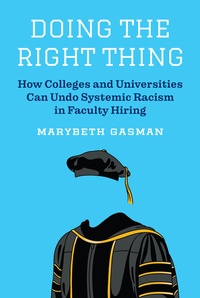
Doing the Right Thing
How Colleges and Universities Can Undo Systemic Racism in Faculty Hiring
1st Edition
Published on 1. June 2022
296 pages
978-0-691-22944-7 (ISBN)
Description

An honest confrontation of systemic racism in faculty hiring-and what to do about it
While colleges and universities have been lauded for increasing student diversity, these same institutions have failed to achieve any comparable diversity among their faculty. In 2017, of the nation's full-time, tenure-track and tenured faculty, only 3 percent each were Black men, Black women, Hispanic men, and Hispanic women. Only 6 percent were Asian/Pacific Islander men, 5 percent were Asian/Pacific Islander women, and 1 percent were American Indian/Alaska Native. Why are the numbers so abysmal? In Doing the Right Thing, Marybeth Gasman takes a hard, insightful look at the issues surrounding the recruitment and hiring of faculty of color. Relying on national data and interviews with provosts, deans, and department chairs from sixty major universities, Gasman documents the institutional forces stymieing faculty diversification, and she makes the case for how such deficiencies can and should be rectified.
Even as institutions publicly champion inclusive excellence and the number of doctoral students of color increases, Gasman reveals the entrenched constraints contributing to the faculty status quo. Impediments to progress include the alleged trade-off between quality and diversity, the power of pedigree, the rigidity of academic pipelines, failures of administrative leadership, lack of accountability among administration and faculty, and the opacity and arbitrariness of the recruitment and hiring process. Gasman contends that leaders must acknowledge institutional failures of inclusion, pervasive systemic racism, and biases that restrict people of color from pursuing faculty careers.
Recognizing that individuals from all backgrounds are essential to the creation and teaching of knowledge, Doing the Right Thing puts forth a concrete call for colleges and universities to take action and do better.
While colleges and universities have been lauded for increasing student diversity, these same institutions have failed to achieve any comparable diversity among their faculty. In 2017, of the nation's full-time, tenure-track and tenured faculty, only 3 percent each were Black men, Black women, Hispanic men, and Hispanic women. Only 6 percent were Asian/Pacific Islander men, 5 percent were Asian/Pacific Islander women, and 1 percent were American Indian/Alaska Native. Why are the numbers so abysmal? In Doing the Right Thing, Marybeth Gasman takes a hard, insightful look at the issues surrounding the recruitment and hiring of faculty of color. Relying on national data and interviews with provosts, deans, and department chairs from sixty major universities, Gasman documents the institutional forces stymieing faculty diversification, and she makes the case for how such deficiencies can and should be rectified.
Even as institutions publicly champion inclusive excellence and the number of doctoral students of color increases, Gasman reveals the entrenched constraints contributing to the faculty status quo. Impediments to progress include the alleged trade-off between quality and diversity, the power of pedigree, the rigidity of academic pipelines, failures of administrative leadership, lack of accountability among administration and faculty, and the opacity and arbitrariness of the recruitment and hiring process. Gasman contends that leaders must acknowledge institutional failures of inclusion, pervasive systemic racism, and biases that restrict people of color from pursuing faculty careers.
Recognizing that individuals from all backgrounds are essential to the creation and teaching of knowledge, Doing the Right Thing puts forth a concrete call for colleges and universities to take action and do better.
More details
Other editions
Additional editions
Marybeth Gasman
Doing the Right Thing
How Colleges and Universities Can Undo Systemic Racism in Faculty Hiring
Book
08/2024
Princeton University Press
€24.00
Shipment within 10-20 days
Marybeth Gasman
Doing the Right Thing
How Colleges and Universities Can Undo Systemic Racism in Faculty Hiring
Book
06/2022
Princeton University Press
€35.00
Shipment within 10-20 days
Person
Marybeth Gasman is the Samuel DeWitt Proctor Endowed Chair in Education and a Distinguished Professor at Rutgers University. Her books include Making Black Scientists and Educating a Diverse Nation. She lives in Philadelphia. Twitter @marybethgasman Instagram @marybethgasman
Content
- Cover
- Contents
- List of Tables
- Preface
- 1. Let's Lay the Cards on the Table
- 2. What Does Faculty Diversity Look Like?
- 3. "We Care about Diversity, but What about Quality?"
- 4. What about the Pipeline?
- 5. Where Are the Leaders?
- 6. Do Search Committees Know What They Are Doing?
- 7. Should We Require a Diversity Statement?
- 8. Exceptions? No! Excuses? Yes!
- 9. Dismantling and Reforming the System: A Call to Action
- Appendix A. Approach to the Study
- Appendix B. A Deeper Look at Law Schools
- Acknowledgments
- References
- Supplementary Bibliography
- Index
