

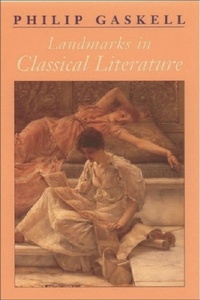
Landmarks in Classical Literature
Description

Landmarks in Classical Literature is the final volume in a set of three books about the major authors of Western literature and their works from Classical times until the early twentieth century. In this volume, Philip Gaskell introduces the work of the greatest writers of Classical Greece and Rome in translation. The book begins with prehistory and the age of the Homeric epics, the Iliad and the Odyssey; and looks at later lyric poets such as Sappho and Pindar. There follows the great age of classical Greece, of miraculous art and pristine democracy, with Sophocles and his fellow-dramatists, the historians Herodotus and Thucydides, and Plato''s fascinating Socratic dialogues. After a brief consideration of the next, Hellenistic, period of Greek culture which included the work of the pastoral poet Theocritus, the book moves on to the golden age of Roman literature. Here are the poets and thinkers of late-Republican and early Imperial Rome, a turbulent period of war and grandeur, including Julius Caesar, soldier, historian, and dictator; Cicero, politician, lawyer, and letter-writer; the poets Virgil (of the Aeneid), Horace, and Ovid; and Tacitus, the greatest Roman historian.There are chapters covering politics and society, religion, culture and the arts, language, warfare, economics, technology and philosophy to enable the reader to understand and appreciate the literature in its various contexts. Advice about reading the classics in translation, and the form and pronunciation of classical names and metre in classical verse is provided from the outset, and guidance on the best translations is given. An appendix provides more specialised information on the survival of ancient texts and textual scholarship.
Key Features
- Introduces the best and most important literature of ancient Greece and Rome
- Clearly and engagingly written for readers with no prior knowledge of the period, or of Greek or Latin
- Sets the authors and their works in their historical contexts
More details
Other editions
Additional editions
Content
- Intro
- Contents
- Abbreviations
- Preface
- Acknowledgements
- Introduction
- Reading the classics today - the classical canon - the classics in translation - the form and pronunciaton of Greek and Latin names - metre in classical verse - dates - Roman numerals - maps
- I The Homeric age
- 1 The spread of civilisation: the past in the present - from neolithic tribalism to the first cities - The Minioans
- 2 The Greeks: the Mycenaeans - Dark-Age Greece - the Greek language - the Greek alphabet - Bronze-Age society and culture - Mycenaean religion
- 3 Homer and epic poetry: the background - the Iliad - the Odyssey - Hesiod
- II: Greece in the fifth century BC
- 4 From Archaic to early-Classical Greece: Athens - Sparta - the Persian Wars - women, resident foreigners, and slaves - colonisation
- 5 Religion, the arts, education, and books: religous belief and practices - architecture - painting - sculpture - music - education, literary, and books
- 6 Lyric poetry: Pindar and his predecessors: the lyric - Sappho and Anacreon - Pindar
- 7 Sophocles and Athenian drama: tragedy - the three tragedians - Aeschylus - Sophocles - Euripides - Aristophanes and comedy
- 8 Herodotus and Greek history: Greek historians - Herodotus and the Persian War - Xenophon and the Persian Expedition
- 9 Plato and philosophy: the pre-Socratics - Socrates - Plato - Aristotle
- Interchapter: the Hellenistic age
- Alexander's empire and its successors - language and society - the visual arts - literature - history - philosophy and science - scholarship and libraries
- III Late-Republican and early-Imperial Rome
- 10 The expansion of Rome: from city-state to superstate - the Latin language - Roman names
- 11 Republic and Empire: conquest abroad, strife at home - politics and society - religion
- 12 Maintaining the state: economics and technology - the Roman army
- 13 The arts: painting, sculpture and architecture - drama: Plautus, Terence, Seneca - education, books, and libraries
- 14 Cicero: rhetoric and philosophy - the legacy of Greece: rhetoric, philosophy - Cicero - Seneca
- 15 Virgil: from pastoral to epic - Theocritus and pastoral poetry - Virgil - the Eclogues - The Georgics - the Aeneid - Virgil's reputation and influence
- 16 Horace: epigram, lyric, and satire - Catullus - Horace - Juvenal
- 17 Ovid: love poetry and the novel - Ovid - the novel - Longus - Petronius - Apuleius
- 18 Tacitus and Roman history: Roman historians - Caesar and the Gallic War - Sallust - Livy - Tacitus - Plutarch - Suetonius
- Afterword
- Appendix - Classical studies
- The survival of ancient texts - the transmission of texts - textual scholarship - history and archaeology
- Reference bibliography
- Index and guide to pronunciation
