

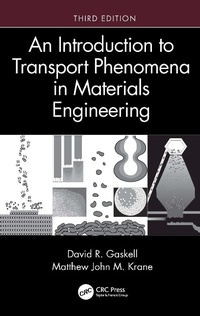
An Introduction to Transport Phenomena in Materials Engineering
3rd Edition
Published on 24. January 2024
613 pages
978-1-000-99638-8 (ISBN)
Description

This book elucidates the important role of conduction, convection, and radiation heat transfer, mass transport in solids and fluids, and internal and external fluid flow in the behavior of materials processes. These phenomena are critical in materials engineering because of the connection of transport to the evolution and distribution of microstructural properties during processing. From making choices in the derivation of fundamental conservation equations, to using scaling (order-of-magnitude) analysis showing relationships among different phenomena, to giving examples of how to represent real systems by simple models, the book takes the reader through the fundamentals of transport phenomena applied to materials processing. Fully updated, this third edition of a classic textbook offers a significant shift from the previous editions in the approach to this subject, representing an evolution incorporating the original ideas and extending them to a more comprehensive approach to the topic.
FEATURES
Introduces order-of-magnitude (scaling) analysis and uses it to quickly obtain approximate solutions for complicated problems throughout the book
Focuses on building models to solve practical problems
Adds new sections on non-Newtonian flows, turbulence, and measurement of heat transfer coefficients
Offers expanded sections on thermal resistance networks, transient heat transfer, two-phase diffusion mass transfer, and flow in porous media
Features more homework problems, mostly on the analysis of practical problems, and new examples from a much broader range of materials classes and processes, including metals, ceramics, polymers, and electronic materials
Includes homework problems for the review of the mathematics required for a course based on this book and connects the theory represented by mathematics with real-world problems
This book is aimed at advanced engineering undergraduates and students early in their graduate studies, as well as practicing engineers interested in understanding the behavior of heat and mass transfer and fluid flow during materials processing. While it is designed primarily for materials engineering education, it is a good reference for practicing materials engineers looking for insight into phenomena controlling their processes.
A solutions manual, lecture slides, and figure slides are available for qualifying adopting professors. Companion website: https://transportphenomena.org/
FEATURES
Introduces order-of-magnitude (scaling) analysis and uses it to quickly obtain approximate solutions for complicated problems throughout the book
Focuses on building models to solve practical problems
Adds new sections on non-Newtonian flows, turbulence, and measurement of heat transfer coefficients
Offers expanded sections on thermal resistance networks, transient heat transfer, two-phase diffusion mass transfer, and flow in porous media
Features more homework problems, mostly on the analysis of practical problems, and new examples from a much broader range of materials classes and processes, including metals, ceramics, polymers, and electronic materials
Includes homework problems for the review of the mathematics required for a course based on this book and connects the theory represented by mathematics with real-world problems
This book is aimed at advanced engineering undergraduates and students early in their graduate studies, as well as practicing engineers interested in understanding the behavior of heat and mass transfer and fluid flow during materials processing. While it is designed primarily for materials engineering education, it is a good reference for practicing materials engineers looking for insight into phenomena controlling their processes.
A solutions manual, lecture slides, and figure slides are available for qualifying adopting professors. Companion website: https://transportphenomena.org/
More details
Edition
3rd edition
Language
English
Place of publication
London
United Kingdom
Publishing group
Taylor & Francis Ltd
Target group
College/higher education
Professional and scholarly
Product notice
Reflowable
Illustrations
26 Tables, black and white; 387 Line drawings, black and white; 6 Halftones, black and white; 393 Illustrations, black and white
ISBN-13
978-1-000-99638-8 (9781000996388)
Copyright in bibliographic data and cover images is held by Nielsen Book Services Limited or by the publishers or by their respective licensors: all rights reserved.
Schweitzer Classification
Other editions
Additional editions
David R. Gaskell | Matthew John M. Krane
An Introduction to Transport Phenomena in Materials Engineering
Book
01/2024
3rd Edition
CRC Press
€174.50
Shipment within 15-20 days
Persons
David R. Gaskell (1940-2013) was Professor of Materials Engineering at Purdue University from 1982 to 2013. Dr. Gaskell was born in Glasgow, Scotland, and attended the Royal College of Science and Technology, receiving First Class Honors in metallurgy and technical chemistry for a BSc in 1962. He moved to Hamilton, Canada, to pursue graduate studies at McMaster University and then immigrated to the United States, teaching first at the University of Pennsylvania and then at Purdue. During his career, he served as a visiting professor at the NRC Atlantic Regional Laboratory, Canada, and at the G. C. Williams Cooperative Research Centre for Extraction Metallurgy in the Department of Chemical Engineering, University of Melbourne, Australia. Professor Gaskell was dedicated to teaching and was the recipient of the Reinhardt Schumann Jr. Best Undergraduate Teacher Award in Materials Engineering several times over.
Matthew John M. Krane (1964- ) is Professor of Materials Engineering at Purdue University and a member of the Purdue Center for Metal Casting Research and the Purdue Heat Treatment Consortium. Using modeling and experiments, his research focuses on the connection between macroscopic transport phenomena and defect formation during materials processes, particularly the study of the solidification of metal alloys. Professor Krane has been with Purdue's School of Materials Engineering since 1996, but his education is in mechanical engineering (Cornell, BS, 1986; Pennsylvania, MS, 1989; Purdue, PhD, 1996), with a concentration in heat transfer and fluid flow. He has been a visiting researcher at the University of Birmingham (UK), the University of Greenwich (UK), and the Universite de Lorraine (Nancy, France). In addition to consulting, research programs, and undergraduate projects with the metals processing industry during his time at Purdue, he worked in industry for three years on thermal issues in the design and manufacturing of electronic packaging.
Matthew John M. Krane (1964- ) is Professor of Materials Engineering at Purdue University and a member of the Purdue Center for Metal Casting Research and the Purdue Heat Treatment Consortium. Using modeling and experiments, his research focuses on the connection between macroscopic transport phenomena and defect formation during materials processes, particularly the study of the solidification of metal alloys. Professor Krane has been with Purdue's School of Materials Engineering since 1996, but his education is in mechanical engineering (Cornell, BS, 1986; Pennsylvania, MS, 1989; Purdue, PhD, 1996), with a concentration in heat transfer and fluid flow. He has been a visiting researcher at the University of Birmingham (UK), the University of Greenwich (UK), and the Universite de Lorraine (Nancy, France). In addition to consulting, research programs, and undergraduate projects with the metals processing industry during his time at Purdue, he worked in industry for three years on thermal issues in the design and manufacturing of electronic packaging.
Content
1. Introduction to Transport Phenomena in Materials Processing. 2. Steady State Conduction Heat Transfer. 3. Transient Conduction Heat Transfer. 4. Mass Diffusion in the Solid State. 5. Fluid Statics. 6. Mechanical Energy Balance in Fluid Flow. 7. Equations of Fluid Motion. 8. Internal Flows. 9. External Flows. 10. Convection Heat Transfer. 11. Mass Transfer in Fluids. 12. Radiation Heat Transfer.
