

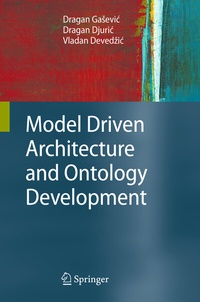
Model Driven Architecture and Ontology Development
Description

Defining a formal domain ontology is generally considered a useful, not to say necessary step in almost every software project. This is because software deals with ideas rather than with self-evident physical artefacts. However, this development step is hardly ever done, as ontologies rely on well-defined and semantically powerful AI concepts such as description logics or rule-based systems, and most software engineers are largely unfamiliar with these.
Gasevic and his co-authors try to fill this gap by covering the subject of MDA application for ontology development on the Semantic Web. Part I of their book describes existing technologies, tools, and standards like XML, RDF, OWL, MDA, and UML. Part II presents the first detailed description of OMG's new ODM (Ontology Definition Metamodel) initiative, a specification which is expected to be in the form of an OMG language like UML. Finally, Part III is dedicated to applications and practical aspects of developing ontologies using MDA-based languages. The book is supported by a website showing many ontologies, UML and other MDA-based models, and the transformations between them.
"The book is equally suited to those who merely want to be informed of the relevant technological landscape, to practitioners dealing with concrete problems, and to researchers seeking pointers to potentially fruitful areas of research. The writing is technical yet clear and accessible, illustrated throughout with useful and easily digestible examples." from the Foreword by Bran Selic, IBM Rational Software, Canada.
"I do not know another book that offers such a high quality insight into UML and ontologies." Steffen Staab, U Koblenz, Germany
Reviews / Votes
From the reviews:
"The central theme of this book is the definition and application of ontologies for developing software systems. . The presentation style is clear and accessible . . This book provides adequate guidelines for enjoying the semantic Web's benefits, and warns of the potential dangers of its misuse. It is well written, innovative, and definitely recommended as a book to return to from time to time, to gather some fresh ideas and continue working on their implementation." (M. Ivanovi, Computing Reviews, January, 2007)
"The book is equally suited to those who merely want to be informed of the relevant technological landscape, to practitioners dealing with concrete problems, and to researchers seeking pointers to potentially fruitful areas of research. The writing is technical yet clear and accessible, illustrated throughout with useful and easily digestible examples." (from the Foreword by Bran Selic, IBM Rational Software, Canada)
"I do not know another book that offers such a high quality insight into UML and ontologies" (Steffen Staab, U Koblenz, Germany)
"The authors offer not only high level conceptual presentations, but also implementation-level coverage of the presented technologies, and even hands-on guidance to their practical application." (Jean Bézivin, U Nantes, France)
More details
Other editions
Additional editions
Persons
Dragan Gasevic is a lecturer of Computer Science with the Military academy, Belgrade Serbia and Montenegro, as well as a researcher with the GOOD OLD AI research group, University of Belgrade. He has received his BS, MS, and PhD degrees in computer science from the University of Belgrade in 2000, 2002, and 2004, respectively. His research interests mostly include Semantic Web, ontologies, MDA, and applications of artificial intelligence techniques to education.
Dragan Djuric is a PhD candidate at FON - School of Business Administration, University of Belgrade, and also a researcher with the GOOD OLD AI research group. His interests mostly include Enterprise software architecture, Object-Oriented development, Java platform and Intelligent Information Systems.
Vladan Devedzic is an associate professor of computer science at the Department of Information Systems, FON - School of Business Administration, University of Belgrade, Serbia and Montenegro. He is also the head of the GOOD OLD AI research group. His main research interests include software engineering, intelligent systems, knowledge representation, ontologies, Semantic Web, intelligent reasoning, and applications of artificial intelligence techniques to education and medicine.
