

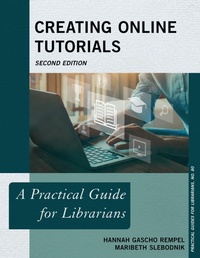
Creating Online Tutorials
A Practical Guide for Librarians
2nd Edition
Published on 14. February 2024
228 pages
979-8-216-33022-6 (ISBN)
Description

Today's students rely heavily on electronic resources; they expect to be able to access library resources from any location and at any time of the day. Online education is ubiquitous from K-12 through graduate level coursework and is increasingly used in on-the-job training. Libraries must be prepared to guide learners to use library resources when and where they are needed. Thoughtfully designed online tutorials can be the library's answer to providing this point-of-need instruction that learners have come to expect.
When librarians don't have the technical expertise needed to create online tutorials, Creating Online Tutorials: A Practical Guide for Librarians, Second Edition will help guide them through the basics of designing and producing an online tutorial. Using practical examples, the book leads librarians through the process of creating an online tutorial from start to finish and provides tips and strategies that will be useful to librarians with more experience in designing online tutorials.
This detailed roadmap for designing and producing online tutorials covers:
Is a tutorial the right solution?Assessing diverse user needsChoosing the right technologySelecting and organizing instructional contentPlanning tutorial design elementsIntegrating assessment into tutorial designMaintaining and updating tutorialsFinding online tutorial resources
After reading this book, new tutorial developers will have a practical, adaptable blueprint that enables them to confidently address the creation of their first online tutorials, and experienced developers will learn efficient techniques to create and enhance future tutorials that are attractive, effective teaching tools.
When librarians don't have the technical expertise needed to create online tutorials, Creating Online Tutorials: A Practical Guide for Librarians, Second Edition will help guide them through the basics of designing and producing an online tutorial. Using practical examples, the book leads librarians through the process of creating an online tutorial from start to finish and provides tips and strategies that will be useful to librarians with more experience in designing online tutorials.
This detailed roadmap for designing and producing online tutorials covers:
Is a tutorial the right solution?Assessing diverse user needsChoosing the right technologySelecting and organizing instructional contentPlanning tutorial design elementsIntegrating assessment into tutorial designMaintaining and updating tutorialsFinding online tutorial resources
After reading this book, new tutorial developers will have a practical, adaptable blueprint that enables them to confidently address the creation of their first online tutorials, and experienced developers will learn efficient techniques to create and enhance future tutorials that are attractive, effective teaching tools.
More details
Series
Edition
2nd edition
Language
English
Place of publication
United States
Publishing group
Bloomsbury Publishing Plc
Illustrations
33 BW Photos, 40 Tables, 53 Textboxes
ISBN-13
979-8-216-33022-6 (9798216330226)
Copyright in bibliographic data and cover images is held by Nielsen Book Services Limited or by the publishers or by their respective licensors: all rights reserved.
Schweitzer Classification
Other editions
Additional editions
Book
03/2024
2nd Edition
Rowman & Littlefield Publishers
€71.30
Shipment within 3-4 weeks
Persons
Hannah Gascho Rempel is a professor at Oregon State University Libraries and Head of the Research and Learning Department. Since joining OSU in 2007, she has spearheaded the development of OSU Libraries' services for graduate students and has been deeply involved in the Research and Learning Department's transition to a more strategic focus on instruction activities, including an increased emphasis on the incorporation of online learning objects and tutorials. She earned her Master of Science in Horticulture at Oregon State University, and her Master of Library and Information Science degree at the University of Washington. Prior to working at OSU, she served as an adult reference librarian at the Corvallis-Benton County Public Library.
Throughout her career as an instruction and science librarian, she has created tutorials for a range of audiences. Her Zotero tutorials are widely used by members of the OSU research community, as well as researchers beyond OSU. She has created do-it-yourself tutorials for first-year students, as well as many subject-specific tutorials to support her liaison areas. She has written and presented on the barriers to creating and managing tutorials. In addition, she writes frequently on providing library services targeting graduate students' needs. Her writings have also explored the use of curiosity and play-based learning principles to engage learners with library research in new ways. She co-authored the book Understanding How Students Develop: A Practical Guide to provide librarians and other educators with theories and practical tools to more effectively reach students with varied needs. As a past editor of The Journal of Web Librarianship, she helped shape the conversation about technology and web use in libraries. She and her family live in Corvallis, Oregon.
Maribeth Slebodnik is a Research & Learning Librarian and liaison to the College of Nursing at the University of Arizona, as well as a senior lecturer in the College of Nursing. She has created tutorials for beginning biology students as well as graduate nursing and nutrition science students, and she teaches graduate nursing students how to perform systematic reviews. She is a member of the Association of College and Research Libraries division of the American Library Association, serving as chair of the Science and Technology Section and convener of the Health Sciences Interest Group. She is a member of the editorial board of portal: Libraries and the Academy, for which she edits the Worth Noting column about new developments in academic librarianship.
Maribeth earned a Bachelor of Science in Nursing and a Master of Library Science from Indiana University. After twelve years as a neonatal intensive care and traveling nurse, she returned to school to retool as a librarian. She worked as a corporate librarian in St. Louis, Missouri, and as an academic librarian at Indiana State University, Purdue University, and the University of Arizona. She and her family live in Tucson, Arizona.
Throughout her career as an instruction and science librarian, she has created tutorials for a range of audiences. Her Zotero tutorials are widely used by members of the OSU research community, as well as researchers beyond OSU. She has created do-it-yourself tutorials for first-year students, as well as many subject-specific tutorials to support her liaison areas. She has written and presented on the barriers to creating and managing tutorials. In addition, she writes frequently on providing library services targeting graduate students' needs. Her writings have also explored the use of curiosity and play-based learning principles to engage learners with library research in new ways. She co-authored the book Understanding How Students Develop: A Practical Guide to provide librarians and other educators with theories and practical tools to more effectively reach students with varied needs. As a past editor of The Journal of Web Librarianship, she helped shape the conversation about technology and web use in libraries. She and her family live in Corvallis, Oregon.
Maribeth Slebodnik is a Research & Learning Librarian and liaison to the College of Nursing at the University of Arizona, as well as a senior lecturer in the College of Nursing. She has created tutorials for beginning biology students as well as graduate nursing and nutrition science students, and she teaches graduate nursing students how to perform systematic reviews. She is a member of the Association of College and Research Libraries division of the American Library Association, serving as chair of the Science and Technology Section and convener of the Health Sciences Interest Group. She is a member of the editorial board of portal: Libraries and the Academy, for which she edits the Worth Noting column about new developments in academic librarianship.
Maribeth earned a Bachelor of Science in Nursing and a Master of Library Science from Indiana University. After twelve years as a neonatal intensive care and traveling nurse, she returned to school to retool as a librarian. She worked as a corporate librarian in St. Louis, Missouri, and as an academic librarian at Indiana State University, Purdue University, and the University of Arizona. She and her family live in Tucson, Arizona.
