

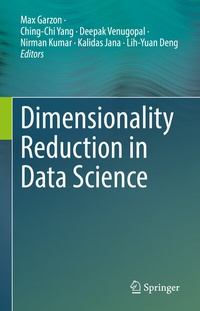
Dimensionality Reduction in Data Science
1st Edition
Published on 28. July 2022
XI, 265 pages
978-3-031-05371-9 (ISBN)
Description

This book provides a practical and fairly comprehensive review of Data Science through the lens of dimensionality reduction, as well as hands-on techniques to tackle problems with data collected in the real world. State-of-the-art results and solutions from statistics, computer science and mathematics are explained from the point of view of a practitioner in any domain science, such as biology, cyber security, chemistry, sports science and many others. Quantitative and qualitative assessment methods are described to implement and validate the solutions back in the real world where the problems originated.
The ability to generate, gather and store volumes of data in the order of tera- and exo bytes daily has far outpaced our ability to derive useful information with available computational resources for many domains.
This book focuses on data science and problem definition, data cleansing, feature selection and extraction,statistical, geometric, information-theoretic, biomolecular and machine learning methods for dimensionality reduction of big datasets and problem solving, as well as a comparative assessment of solutions in a real-world setting.
This book targets professionals working within related fields with an undergraduate degree in any science area, particularly quantitative. Readers should be able to follow examples in this book that introduce each method or technique. These motivating examples are followed by precise definitions of the technical concepts required and presentation of the results in general situations. These concepts require a degree of abstraction that can be followed by re-interpreting concepts like in the original example(s). Finally, each section closes with solutions to the original problem(s) afforded by these techniques, perhaps in various ways to compare and contrast dis/advantages to other solutions.
The ability to generate, gather and store volumes of data in the order of tera- and exo bytes daily has far outpaced our ability to derive useful information with available computational resources for many domains.
This book focuses on data science and problem definition, data cleansing, feature selection and extraction,statistical, geometric, information-theoretic, biomolecular and machine learning methods for dimensionality reduction of big datasets and problem solving, as well as a comparative assessment of solutions in a real-world setting.
This book targets professionals working within related fields with an undergraduate degree in any science area, particularly quantitative. Readers should be able to follow examples in this book that introduce each method or technique. These motivating examples are followed by precise definitions of the technical concepts required and presentation of the results in general situations. These concepts require a degree of abstraction that can be followed by re-interpreting concepts like in the original example(s). Finally, each section closes with solutions to the original problem(s) afforded by these techniques, perhaps in various ways to compare and contrast dis/advantages to other solutions.
More details
Series
Language
English
Place of publication
Cham
Switzerland
Publishing group
Springer International Publishing
Target group
Professional and scholarly
Product notice
Reflowable
Illustrations
XI, 265 p. 62 illus.
File size
4,28 MB
ISBN-13
978-3-031-05371-9 (9783031053719)
DOI
10.1007/978-3-031-05371-9
Schweitzer Classification
Other editions
Additional editions
Max Garzon | Ching-Chi Yang | Deepak Venugopal
Dimensionality Reduction in Data Science
Book
07/2022
Springer
€69.54
Shipment within 15-20 days
Persons
Max H. Garzon
is professor of computer science and bioinformatics at the U of Memphis. He has (co-)authored about 200 books, book chapters, journal or refereed conference publications. The main theme of his research is biomolecule-based computing and applications to areas such as bioinformatics, nanotechnology, self-assembly, machine learning and foundations of data science. He has served on the editorial board and as guest editor of several journals and as mentor of about 90 MS and PhD students in these areas. He has also served as TPC member and organizer of many scientific conferences and professional meetings and has been a visiting professor and guest scientist at several research institutions around the world.
Ching-Chi Yang is an assistant professor of mathematical sciences at the University of Memphis. He received a doctoral degree in statistics from The Pennsylvania State University in 2019. His primary interests focus on statistical learning, dimensional analysis, industrial and engineering statistics, response surface methodology. His related research projects vary from response surface methodology, tropical cyclone predictions, to stock price predictions. He has received awards including the American Society for Quality 2018 Fall Technical Conference Student Scholarship, and Jack and Eleanor Pettit Scholarship in Science from Penn State University.
Deepak Venugopal is an associate professor in the department of Computer Science at University of Memphis. His research interests lie in the fields of Machine Learning and Artificial Intelligence. In particular, he has made research contributions to statistical relational learning, Neuro-Symbolic AI, explainable AI and AI-based educational technologies. Dr. Venugopal regularly teaches Machine learning and AI courses both at the graduate and undergraduate levels.
Nirman Kumar is an assistant professor of computer science at the University of Memphis since 2016. His research area is approximation algorithms and Computational geometry. Nirman holds a Phd and Masters degree in Computer Science from the University of Illinois, and a Bachelors degree in Computer Science and Enginnering from the Indian Institute of Technology, Kanpur.
Kalidas Jana is post-doctoral research fellow in Economics and Data Science at the University of Memphis. He received Ph.D. in Economics from North Carolina State University in 2005. His research interests are in Econometrics and Data Science.
Lih-Yuan Deng received the B.S. and M.S. degree in Mathematics from National Taiwan University, Taiwan in 1975 and 1977, respectively. He also received M.S. and Ph.D. degrees in Computer Science and Statistics from University of Wisconsin-Madison, USA in 1982 and 1984, respectively. He is currently professor in the department of Mathematical Sciences, University of Memphis, USA. His active research work is mainly in the area of "design of random number generators" for computer simulation and computer security applications.
Ching-Chi Yang is an assistant professor of mathematical sciences at the University of Memphis. He received a doctoral degree in statistics from The Pennsylvania State University in 2019. His primary interests focus on statistical learning, dimensional analysis, industrial and engineering statistics, response surface methodology. His related research projects vary from response surface methodology, tropical cyclone predictions, to stock price predictions. He has received awards including the American Society for Quality 2018 Fall Technical Conference Student Scholarship, and Jack and Eleanor Pettit Scholarship in Science from Penn State University.
Deepak Venugopal is an associate professor in the department of Computer Science at University of Memphis. His research interests lie in the fields of Machine Learning and Artificial Intelligence. In particular, he has made research contributions to statistical relational learning, Neuro-Symbolic AI, explainable AI and AI-based educational technologies. Dr. Venugopal regularly teaches Machine learning and AI courses both at the graduate and undergraduate levels.
Nirman Kumar is an assistant professor of computer science at the University of Memphis since 2016. His research area is approximation algorithms and Computational geometry. Nirman holds a Phd and Masters degree in Computer Science from the University of Illinois, and a Bachelors degree in Computer Science and Enginnering from the Indian Institute of Technology, Kanpur.
Kalidas Jana is post-doctoral research fellow in Economics and Data Science at the University of Memphis. He received Ph.D. in Economics from North Carolina State University in 2005. His research interests are in Econometrics and Data Science.
Lih-Yuan Deng received the B.S. and M.S. degree in Mathematics from National Taiwan University, Taiwan in 1975 and 1977, respectively. He also received M.S. and Ph.D. degrees in Computer Science and Statistics from University of Wisconsin-Madison, USA in 1982 and 1984, respectively. He is currently professor in the department of Mathematical Sciences, University of Memphis, USA. His active research work is mainly in the area of "design of random number generators" for computer simulation and computer security applications.
Content
1. What is Data Science (DS)?.- 2. Solutions to Data Science Problems.- 3. What is Dimensionality Reduction (DR)?.- 4. Conventional Statistical Approaches.- 5. Geometric Approaches.- 6. Information-theoretic Approaches.- 7. Molecular Computing Approaches.- 8. Statistical Learning Approaches.- 9. Machine Learning Approaches.- 10. Metaheuristics of DR Methods.- 11. Appendices.
