

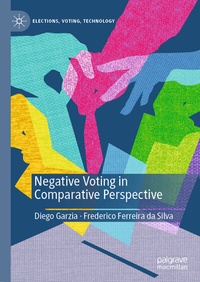
Negative Voting in Comparative Perspective
Description

Why do some people conceive their vote choices as mostly against, rather than for a given party/candidate? Who are these negative voters? What macro-level conditions favor the development of negative voting? This volume provides answers to these questions through the first comparative assessment of negative voting in contemporary democracies. It presents a composite theoretical framework for the analysis of negative voting and tests it extensively on originally collected survey data from Canada, France, Germany, the Netherlands, and the United States. Examining negative voting as a possible behavioral consequence of affective polarization and negative partisanship, this study sheds light on the electoral implications of increasingly antagonistic attitudes among the electorate.
More details
Other editions
Additional editions
Persons
Diego Garzia is an Assistant Professor of Political Science at the University of Lausanne, and also a recurring Visiting Fellow at the European University Institute in Fiesole. He currently serves as a member of the Scientific Committee of the Italian National Election Study (ITANES). With Palgrave Macmillan, he authored Personalization of Politics and Electoral Change in 2014.
Frederico Ferreira da Silva
is a Senior Researcher at the University of Lausanne, Switzerland. He received a Ph.D. in Political and Social Sciences from the European University Institute. His research on elections, public opinion and voting behavior has been published in numerous academic journals and monographs.
Content
Chapter 1: Introduction.- Chapter 2: Negative Voting: A Brief Literature Review.- Chapter 3: Measuring Negative Voting in Democratic Elections.- Chapter 4: The Negative Voting Dataset: 2020-2022.- Chapter 5: The Socio-demographic Profile of Negative Voters.- Chapter 6: Anti-incumbency and Negative Voting.- Chapter 7: Partisanship, Ideology, and Negative Voting.- Chapter 8: Media Usage and Negative Voting.- Chapter 9: In-group Affect, Out-group Distain, and Negative Voting.- Chapter 10: Negative Voting and Affective Polarization.- Chapter 11: The Normative Implications of Negative Voting.- Chapter 12: Conclusions.
