

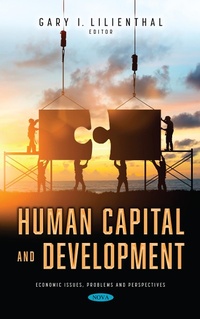
Human Capital and Development
Published on 20. May 2021
360 pages
978-1-5361-9733-4 (ISBN)
Description

This book asks the following incisive questions. Does the body of scholarship on the term "human capital" constitute a species of the meaning of the term "slavery," and if so, in what way? How has the so-called capabilities approach to human development affected the scholarship of human development, in the context of curbing the catastrophic excesses of market behavior? How is it that some humans can be domesticated to create human capital for other groups of humans? To what extent can the international legal instruments effectively fight and combat child labor? How have dynastic China and India developed very long-term systems for the creation and maintenance of national human capital among its peoples? Have the state responses to pandemics been medicalized as a device for human capital maintenance, and if so, in what ways? What is the true meaning of the term "fit and proper" as it is imported into development and dissolution of human capital at the professional or "mandarin" levels of societies? Taking these questions together, the book Human Capital and Development asks this question: have national forms of slavery developed from what is now described as the capabilities approach to human development, with human domestication and child labor forming national systems of human capital formation, maintained by medicalization and controlled by judgments by authorities of fitness and propriety? Chapter One contains a complete scholarly survey of the field of human capital, covering legal, sociological, regulatory, and economic facets of the field. Chapter Two is a detailed critical literature review of the field of human development, linking this still nascent field to that of human capital. Chapter Three follows from Chapter One, elaborating on the new and virtually unspoken field of human domestication, as it serves to create human capital. Chapter Four discusses the international law field of child labor and elaborates on the dual effects on human capital and human development of child labor in its current form. Chapter Five is a comparative analysis of how the two ancient societies of China and India had deployed systems lasting beyond archaeological spans of time to maintain their national human capital, by regulating their supplies of water to their vast populations. Chapter Six in many ways follows on from chapter Three on human domestication, as it discusses critically how the epideictic rhetoric of pandemic contagion and control might marshal human capital in the various strata of society. Chapter Seven is a critical analysis of how human capital is formed by imperial legislation in the upper levels of society's "mandarins," its professional classes, by implementing around the world a common "fit and proper," or integrity, test. The overall research outcomes suggest that human capital is human differentiation, by the masters onto the servants. Human development is a dynamic conjunction of those capabilities of apparently freely maintaining social networks. Those who had abolished the progymnasmata education system had now reinstated some lower levels of its simpler exercises, ensuring continuing human domestication and maintaining a human capital in explicit knowledge. Thus, child labor remains a national-level program for formation of national employee human capital. In dynastic China, emperors had wholly owned the people's human capital, and both stabilized and assessed it through local customary registries. In India, sacred rivers were themselves entities containing the culture's externalized symbology. The International Sanitary Conferences confirmed already-developing European national rules into an international order of human capital medicalization, disguised as human development. The public parties to a "fit and proper" assessment are said to be the court and an ellipsis of members of the public, without the public ever actually participating in the assessment. Thus, human capital in a profession is created in a national professional class purely by the authority of differentiation.
More details
Other editions
Additional editions

Gary I. Lilienthal
Human Capital and Development
Book
07/2021
Nova Science Publishers Inc
€303.55
Shipment within 15-20 days
Content
- Intro
- Contents
- Foreword
- Preface
- Chapter 1
- Human Capital and Slavery: Does the One Infer the Other?
- Abstract
- 1. Introduction
- 2. Property in Human Beings
- 2.1. Domestication
- 2.2. Domestication of Humans
- 2.3. Developing State Property in Human Beings
- 2.4. Free and Informed Consent in the Surrogacy Factories
- 3. Slavery
- 3.1. The Anthropology of Slavery
- 3.2. Natural Law and Slavery
- 4. Human Capital Theory: Foundations of a Field of Inquiry
- 5. The Human Capital Revolution
- 6. The International Law Definitions of Slavery
- Conclusion
- References
- Chapter 2
- Human Progress Measured by the Human Development Index: The Capabilities Approach Advocating State Protection of Freedoms
- Abstract
- 1. Introduction
- 2. Towards a Developmental Ethology
- 2.1. Human Development in Context
- 3. The Human Development Approach and Crisis
- 3.1. Tentative Criteria for Human Development Thinking and Crisis
- 3.2. Crisis in Human Life
- 4. Higher Education in Equitable Human Development
- 4.1. Higher Education and Development
- 4.2. Higher Education and Economic Development
- 4.3. Higher Education and Social Development
- 4.4. Equity and Development
- 5. Understanding Poverty
- 5.1. Attributes of Economic Development
- Conclusion
- References
- Chapter 3
- The Domestication of Human Beings with Their Own Externalised Metarepresentations: Drawing Human Capital from Enculturation
- Abstract
- 1. Introduction
- 2. Representation and Recursion
- 2.1. Representation and Recursion in Human Evolution
- 3. Peirce on the Symbol
- 3.1. Symbols as Habits
- 4. The Old Progymnasmata
- 5. Knowledge Management
- 5.1. Knowledge as a Category
- 5.2. Strategies to Handle Tacit and Explicit Knowledge
- 5.3. Key Factors Involved in Organizational Knowledge Sharing
- Conclusion
- References
- Chapter 4
- Child Labor in Its Worst Forms as Child Slavery: Deploying the International Instruments to Define Employer Limits
- Abstract
- 1. Introduction
- 2. Child Labor: The Concept and the Context
- 2.1. Definitions and Indicators
- 2.2. Historical Background
- 2.2.1. Ancient Civilization
- 2.2.2. Modern Civilization
- 3. International Instruments in Protecting Child Labor
- 3.1. United Nations Convention on the Rights of the Child 1989
- 3.2. Minimum Age Convention, 1973 (C138)
- 3.3. Convention of Worst Forms of Child Labor 1999 (C182)
- 3.3.1. The Worst Forms of Child Labor Recommendation 1999 (R190)
- 4. Ending Child Labor: Approaches, Challenges and Responses
- Conclusion
- References
- Chapter 5
- Customary Law of Water Control in Dynastic China and Indian Sacred Rivers Generating Public Moral Behaviour: A Human Capital Comparative Analysis
- Abstract
- 1. Introduction
- 2. Water Rights during Dynastic China
- 3. The Censorate
- 3.1. The Ming Dynasty Censorate
- 3.2. The Character of the Censors
- 3.3. Censors' Powers and Techniques
- 3.4. Censorial Control in Later Imperial and Republican Times
- 4. Indian Sacred Rivers: Their Spiritual Significance in Hindu Religion
- 4.1. Sacred Rivers and the Hindu Culture
- 4.2. Efforts to Refresh Polluted Rivers
- 4.3. Water Conservation in Ancient India
- 4.4. Check Dams in Ancient India
- 5. Power Flows: Hydro-hegemony and Water Conflicts in South Asia
- 5.1. India as Hydro-Hegemon
- Conclusion
- References
- Chapter 6
- Anti-Pandemic Legal Rules: Medicalization by the Established Contagion Principles of Fracastoro
- Abstract
- 1. Introductuion
- 2. Fracastoro
- 3. The Origin of Quarantine
- 4. Development of the Laws on Quarantine
- 4.1. Early Quarantine Regulations
- 4.2. Origin of British Quarantine Regulations
- 4.3. British Quarantine Legislation
- 4.4. Medical Inspection
- 4.5. The International Sanitary Conference of Vienna
- 4.6. The British Cholera Regulations
- 4.7. The International Sanitary Conference in Dresden
- 5. Rights and Quarantine during the SARS Global Health Crisis
- 5.1. Quarantine as a Public Health Intervention
- Conclusion
- References
- Chapter 7
- The Fit and Proper Person Test: Development and Dissolution of Human Capital
- Abstract
- 1. Background/Literature Review/Theoretical Foundation
- 1.1. Introduction to the Critical Literature Review
- 1.2. Moral Character as a Precondition for Professional Admission
- 1.2.1. Problems of Prediction
- 1.3. Fit and Proper
- 1.4. Challenges and Critiques of the "Fit and Proper Person" Requirement
- 1.4.1. The 'Fit and Proper Person' Requirement as a Self-Interested Strategy
- 1.4.2. Concerns about Links between Present Character and Future Behavior
- 1.4.3. Inconsistent and Arbitrary Standards
- 1.4.4. Procedural and Governance Problems
- 1.4.5. Logistical Challenges
- 1.5. Fit and Proper Person: A Practical Example
- 1.5.1. Fit and Proper Person: Legal Practitioners
- 1.5.2. Fit and Proper Person: Migration Agents
- 1.5.3. Fit and Proper Person: Tax Agents
- 1.5.4. Fit and Proper Person: Credit Activities
- 1.5.5. Disqualification under the Legal Profession Act 2004 (Vic) and Fit and Proper Persons in the Context of Licensed Conveyancers
- Conclusion
- References
- About the Editor
- Index
- Blank Page
- Blank Page
