

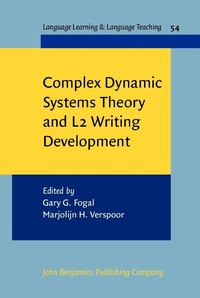
Complex Dynamic Systems Theory and L2 Writing Development
1st Edition
Published on 4. June 2020
322 pages
978-90-272-6114-4 (ISBN)
Description

This volume integrates complex dynamic systems theory (CDST) and L2 writing scholarship through a collection of in-depth studies and commentary across a range of writing constructs, learning contexts, and second and foreign languages. The text is arranged thematically across four topics: (i) perspectives on complexity, accuracy, and fluency, (ii) new constructs, approaches, and domains of L2-writing scholarship, (iii) methodological issues, and finally (iv) curricular perspectives. This work should appeal to graduate students and academics interested in expanded discussions on CDST, highlighting its utility for theorizing and researching language change, and to L2 writing scholars curious about how this fresh approach to researching L2 development can inform understandings of how L2 writing develops. As a CDST approach to language change has matured and taken a place among the dominant epistemologies in the field, students and researchers of L2 development alike will benefit from this volume.
More details
Other editions
Additional editions
Gary G. Fogal | Marjolijn H. Verspoor
Complex Dynamic Systems Theory and L2 Writing Development
Book
06/2020
John Benjamins Publishing Co
€119.04
Shipment within 10-15 days
Content
- Intro
- Complex Dynamic Systems Theory and L2 Writing Development
- Editorial page
- Title page
- Copyright page
- Table of contents
- Foreword
- Reference
- Introduction
- References
- Part I. CAF perspectives
- Chapter 1. Exploring dynamic developmental trajectories of writing fluency: Who benefited from the writing task?
- Introduction
- Research on patterns of changes in L2 writing
- Methods
- Setting
- Participants
- Task and procedure
- Data
- Analysis
- Results
- Discussion and conclusion
- References
- Appendix
- Chapter 2. Coordination of linguistic subsystems as a sign of automatization?
- Introduction
- CDST and development
- The study
- Subjects
- Texts
- Holistic scoring
- Operationalizing constructs
- Statistical analyses
- Results
- Statistical analyses
- Correlation analyses
- Variability and variation over time
- Interactions of variables over time
- Discussion and conclusion
- References
- Appendix 1. Writing topics
- Appendix 2. Samples for the first and the last text written by each learner
- Text 1 Julia
- Text 12. Julia
- Text 1. David
- Text 12. David
- Chapter 3. The dynamic co-development of linguistic and discourse-semantic complexity in advanced L2 writing
- Introduction
- Rationale
- Complexity in L2 research
- Connecting nominalization to semantic complexity
- Measuring L2 linguistic complexity
- Nominalization as an indicator of discourse-semantic complexity in advanced L2 writing
- The present study
- The setting
- The participants
- Measures
- Data coding and analysis
- Results
- Intra-variability in the development of linguistic and semantic complexity
- Interaction between linguistic complexity and semantic complexity
- Discussion
- Conclusion
- References
- Appendix. Writing samples with GMs annotated in bold
- Tablets Should Replace Printed Textbooks
- Funding information
- Online photo sharing: A New Trend
- Part II. New constructs, approaches, and domains
- Chapter 4. Adaptive imitation: Formulaicity and the words of others in L2 English academic writing
- Introduction
- Fluent formulaicity
- Developmental perspectives on fluent formulaicity
- Source text imitation
- Developmental perspectives on source text imitation
- Two studies
- Study 1: Cross-sectional study of writing test responses
- Aim
- Participants
- Writing data
- Analytic method 1: Fluent formulaicity
- Analytic method 2: Source text imitation
- Statistical analysis
- Findings
- Density of fluent formulae
- Source text imitation
- Summary of Study 1
- Study 2: Longitudinal case study
- Aim
- Method
- Context and focus sentence
- Identification of source text content and patterns for imitation
- Adaptive imitation of source text
- Summary of Study 2
- Discussion and conclusion
- Acknowledgements
- References
- Funding information
- Chapter 5. Profiling the dynamic changes of syntactic complexity in L2 academic writing: A multilevel synchrony method
- Introduction
- Measuring second language performance and development
- Syntactic complexity in L2 writing
- Nestedness in complex dynamic systems
- Multilevel synchrony method
- The present study
- Data coding and analysis
- Results
- Discussion and implications
- Conclusion
- References
- Chapter 6. Biographical retrodiction for investigating the evolution of learner agency and L2 writing development through study abroad experiences
- Introduction
- Understanding learner agency from a CDST perspective
- Biographical retrodiction for researching learner agency
- Effects of study abroad experiences on learner agency
- Method
- Context and research participants
- Research procedure and analysis
- Findings
- Changes in L2 writing
- Narrative analysis
- Jun's narrative
- Yu's narrative
- Discussion
- Development of L2 proficiency and writing through SA experiences
- Uniqueness and patterns in individual agentic systems
- Evolution of learner agency
- Conclusion
- References
- Appendix
- Part III. Methodological perspectives
- Chapter 7. The elusive phase shift: Capturing changes in L2 writing development and interaction between the cognitive and social ecosystems
- Introduction
- What is a phase shift?
- The interacting social and cognitive ecosystems
- Cognitive ecosystems
- Social ecosystems
- Finding phase shifts
- Quantitative measurements for investigating the cognitive ecosystem
- Qualitative analyses in the social ecosystem
- Finding control parameters using social ecosystem factors
- Discussion and conclusion
- References
- Chapter 8. Investigating complexity in L2 writing with mixed methods approaches
- Introduction
- A complex systems perspective on L2 writing
- Mixed methods research and the study of complex dynamic systems
- A brief history of mixed methods research
- Mixed methods and their relationship to complex dynamic systems
- The challenges associated with mixed methods research
- Applying a mixed methods approach to the investigation of L2 writing processes
- Methodological affordances: Investigating different levels of the complex system
- The macro-level
- The meso-level
- The micro-level
- Example 1
- Example 2
- Methodological challenges
- The preparation stage
- The implementation stage
- The analytical stage
- The dissemination stage
- Conclusion
- References
- Appendix. Transcription conventions (Clift, 2016)
- Chapter 9. A critical appraisal of the CDST approach to investigating linguistic complexity in L2 writing development
- Introduction
- CDST studies on L2 writing development
- A 'traditional' versus CDST analysis of L2 writing development: A case study
- Participants, data, and measures
- A traditional analysis
- A CDST analysis
- Discussion
- Added value of a CDST approach
- Controversial issues
- Link between new (metaphorical) concepts and research methods
- Confirmation and selection biases
- The forest and the trees, or why size matters and extreme anti-reductionism is self-defeating
- To generalize or not?
- Bring the noise
- Conclusion
- References
- Part IV. Curricular perspectives
- Chapter 10. Envisioning L2 writing development in CDST under a curricular optic: A proposal
- Introduction
- Positioning L2 writing research
- Calling for etic and emic inquiry in context with a system orientation
- Setting the stage
- Toward a proposal for integrated perspectives within a CDST framework
- 1. CDST as a metatheory - Searching for an object theory
- From metatheory to object theory
- A CDST-compatible object theory of language: System, dynamism, complexity
- 2. Writing development as an educational phenomenon
- 3. L2 writing as textual meaning-making
- Textual meaning-making as thinking and learning with language
- 4. L2 writing development as the ability to compose in increasing registerial and generic environments
- A registerial understanding of development
- Writing development as expansion of the generic repertoire
- Writing development along the continuum of oral-literate language use
- 5. Evolving agency in L2 literacy development
- Exploring agency in relation to structures and systems: A CDST perspective
- Agency in second language learning: Some considerations
- L2 literacy development as agency: From macro to micro and back
- 6. Adopting a curricular view for understanding L2 writing development
- Interrogating the choice of a curricular optic
- Voices supporting a curricular optic
- Complexity theory and a curricular optic: Of simplex systems and subsystems
- Complexity theory and a curricular optic: Of simplex systems and subsystems
- Reflecting on L2 writing development under a curricular optic
- References
- Chapter 11. Unpacking 'simplex systems': Curricular thinking for L2 writing development
- Introduction
- Complex and simplex systems
- A curricular frame for simplex systems
- Uses of simplex systems and curricular thinking
- The present study
- Method
- Background and context for the study
- Participants
- Instruments
- Analysis
- Findings
- Discussion
- Moving forward
- Conclusion
- References
- List of contributors
- Index
