

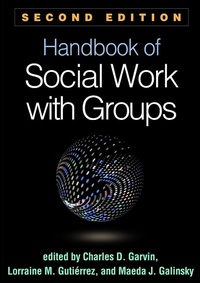
Handbook of Social Work with Groups
2nd Edition
Published on 16. May 2017
642 pages
978-1-4625-3061-8 (ISBN)
Description

Social work students, practitioners, and researchers. Serves as a text in undergraduate- and graduate-level courses such as Group Work, Advanced Practice, Community Practice, and Social Work and Social Justice
More details
Other editions
Additional editions
Charles D. Garvin | Lorraine M. Gutierrez | Maeda J. Galinsky
Handbook of Social Work with Groups, Second Edition
Book
07/2017
2nd Edition
Guilford Press
€75.50
Shipment within 15-20 days
Persons
Charles D. Garvin, PhD, until his death in 2023, was Professor Emeritus in the School of Social Work at the University of Michigan. He was internationally known for his contributions to group work and social justice issues in social work. Dr Garvin was the author or editor of several books, as well as many journal articles and book chapters, and served as coeditor of Small Group Research. A past chair and board member of the International Association for Social Work with Groups, he was a recipient of the Significant Lifetime Achievement in Social Work Education Award from the Council on Social Work Education. In 2020, Dr. Garvin was named an NASW Social Work Pioneer by the National Association of Social Workers Foundation.
Lorraine M. Gutiérrez, PhD, is Arthur F. Thurnau Professor in the School of Social Work and the Department of Psychology at the University of Michigan, where she is also faculty associate in Latino Studies. Her teaching and scholarship focus on multicultural praxis in communities, organizations, and higher education. A Fellow of the American Psychological Association and the Society for Community Research and Action, Dr. Gutiérrez is a member of the editorial team of the Journal of Community Practice.
Maeda J. Galinsky, PhD, until her death in 2019, was Kenan Distinguished Professor Emerita in the School of Social Work at the University of North Carolina at Chapel Hill. She published widely in the area of group work theory, practice, and research, including articles on support groups, open-ended groups, and evaluation of innovative interventions. Dr. Galinsky served on the editorial boards of Social Work with Groups, Small Group Research, American Journal of Orthopsychiatry, and Social Work Research, and on the board of the International Association for Social Work with Groups.
Content
Introduction, Charles D. Garvin, Lorraine M. Gutiérrez, and Maeda J. Galinsky
I. Theoretical and Philosophical Foundations
1. Group Dynamics, Ronald W. Toseland
2. An Ecological/Systems/Seven C's Perspective on Group Practice, John E. Tropman
3. Social Group Work in a Global Context, Rebecca Smith, Justin Bucchio, & Barbara F. Turnage
4. An Empowerment Perspective, Margot Breton
5. Ethics and Values in Group Work, Allan E. Barsky & Helen Northen
6. Group Work and Socially Just Practice, R. M. Ortega
II. Principal Foundations of Group Practice Models
7. The Mutual Aid Model, Alex Gitterman
8. Cognitive-Behavioral Group Work, Richard Tolman & Craig W. LeCroy
III. Group Work Approaches Related to Purpose
9. Support and Self-Help Groups, Linda Farris Kurtz
10. Psychoeducational Groups, Jennifer Root
11. Social Work with Groups and Drug Abuse Prevention with Youth: Rich History and Untapped Potential, Flavio F. Marsiglia & Elizabeth Kiehne
IV. Group Work Approaches Related to Setting
12. Group Work in Health Care Settings, Brian L. Kelly
13. Evidence-Based Group Work in Mental Health Practice, Mary C. Ruffolo & Carolyn M. Maker
14. Involuntary Groups, Ronald Rooney & Michael Chovanec
15. Strengths-Based Group Work with Children and Adolescents, Andrew Malekoff
16. Group Work in Child Welfare, Barbara Rittner
17. Group-Based Approaches to Preventing Adolescent Substance Abuse: The State of Social Work Science, David Córdova, Francheska Alers-Rojas, Brian Perron, Christopher P. Salas-Wright, & Michael G. Vaughn
18. Groups for Older Adults, Ruth Campbell
19. Groups for Reducing Intergroup Conflicts, David Bargal
20. Group Interventions for Partner Abuse, Daniel G. Saunders
21. Group Work with Immigrants and Refugees, Izumi Sakamoto & Sidonia Couto
22. Intergroup Dialogue: Engaging Difference for Social Change, Biren (Ratnesh) A. Nagda
23. Group Work in the Shadow of Mass Incarceration, Reuben Jonathan Miller, Desmond Upton Patton, & Jorge Delva
V. Group Work in Organizational and Community Settings
24. Assessing and Strengthening Characteristics of Effective Groups in Community-Based Participatory Research Partnerships, Amy J. Schulz, Barbara A. Israel, & Paula Lantz
25. Participatory Research, Popular Education, and Popular Theatre: Contributions to Group Work, Janet L. Finn, Jillian Dean Campana, & Maxine Jacobson
26. Social Action Groups, Lee H. Staples
27. Group Process Dynamics and Skills in Interdisciplinary Teamwork, Laura R. Bronstein & Julie S. Abramson
28. Group Work with Working Groups, Paul H. Ephross, Thomas V. Vassil, & Steven R. Rose
VI. Group Work Research and Evaluation
29. Evaluation and Research Design, Larry M. Gant
30. Measurement Issues, Randy Magen
31. Qualitative Research, Susan Preston, Judy Hughes, & Michael R. Woodford
32. Intervention Research in Social Work with Groups, Mark J. Macgowan
VII. The Uses of Technology to Create Groups
33. Technology-Mediated Groups, Ronald Fitch
Epilogue, Charles D. Garvin, Lorraine M. Gutiérrez, and Maeda J. Galinsky
