

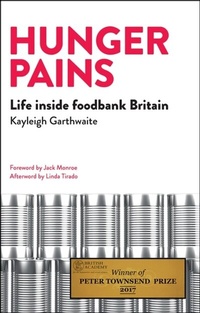
Hunger Pains
Life inside Foodbank Britain
1st Edition
Published on 14. June 2016
176 pages
978-1-4473-2912-1 (ISBN)
Description

WINNER OF THE BRITISH ACADEMY PETER TOWNSEND PRIZE 2017
Welcome to Foodbank Britain, where emergency food provision is an increasingly visible and controversial feature of ongoing austerity. We know the statistics, but what does it feel like to be forced to turn to foodbanks for help? What does it take to get emergency food, and what's in the food parcel?
Kayleigh Garthwaite conducted hundreds of hours of interviews while working in a Trussell Trust foodbank. She spoke to people like Anna and her 11 year old daughter Daisy who were eating out of date food since Anna left her job due to mental health problems. Glen explained the shame he felt using the foodbank having taken on a zero hours contract. Pregnant Jessica walked two miles to the foodbank because she couldn't afford public transport.
This provocative book provides a much needed voice for foodbank users and volunteers in the UK, and a powerful insight into the realities of foodbank use from the inside.
Welcome to Foodbank Britain, where emergency food provision is an increasingly visible and controversial feature of ongoing austerity. We know the statistics, but what does it feel like to be forced to turn to foodbanks for help? What does it take to get emergency food, and what's in the food parcel?
Kayleigh Garthwaite conducted hundreds of hours of interviews while working in a Trussell Trust foodbank. She spoke to people like Anna and her 11 year old daughter Daisy who were eating out of date food since Anna left her job due to mental health problems. Glen explained the shame he felt using the foodbank having taken on a zero hours contract. Pregnant Jessica walked two miles to the foodbank because she couldn't afford public transport.
This provocative book provides a much needed voice for foodbank users and volunteers in the UK, and a powerful insight into the realities of foodbank use from the inside.
Reviews / Votes
"Written with remarkable clarity and compassion, anyone who wants to participate in the converstation about foodbanks, from cabinet ministers to foodbank volunteers, would do well to read this book." Janet Poppendieck, author, Sweet Charity? and Professor Emerita of Sociology, Hunter College, City University of New York, and Senior Fellow, CUNY Urban Food Policy Institute "A fascinating insight into the use and operation of foodbanks. Sadly, this is becoming an important subject for understanding modern British life, and this book paints a detailed and sympathetic picture of how they work and the social problems they address." David Griffiths, University of Stirling "There were no foodbanks in the UK in the 1970s - we had no need of them. Kayleigh Garthwaite carefully describes a tragic disaster that was entirely avoidable and which could be ended within just a few years." Danny Dorling, Oxford University "An accessible account of food poverty and foodbanks in the UK which should be taken forward to address UK food poverty." Antipode "informative, engaging and heartfelt...a crucial stepping stone in ending the stigma surrounding foodbanks, and I urge everyone to read it." The Student "A good book to recommend to people who have little awareness or who are sceptical about the reality of food poverty in Britain today." Urban Bulletin "Open[s] our eyes to what the benefits system is doing to us...rooted in high quality research; and [engages] our minds and our emotions." Citizen's Income Trust "[Garthwaite] poses a serious challenge to contemporary thinking about the factors that drive people to use foodbanks, dispelling the myths that people are seeking emergency help because of their chaotic life styles and the irresponsible life choices they make." Counterfire "In this accessible and powerful book, Kayleigh Garthwaite gives voice to the people behind the data, explaining in a precise and well-informed way the very human tragedy that our current crisis of poverty represents." Julia Unwin, CBE, Joseph Rowntree Foundation "Written with passion and compassion this is a searingly honest reflection on Garthwaite's experience of being a volunteer, and others' experience of being in dire need." Elizabeth Dowler, University of Warwick "Providing an invaluable window on the use of foodbanks, including compelling accounts of the people who come for help, this book is essential reading for anyone wanting to get beyond the political rhetoric." Valerie Tarasuk, University of Toronto "Powerfully brings the voices of those who need the support of food banks to the fore and places them at the heart of debates about why the need for food banks has grown." Peter Kelly at Poverty Alliance "A powerful account of a year in the life of one foodbank in Stockton on Tees that challenges many of the media myths that surround the huge growth in foodbanks over recent years." Niall Cooper, Director of Church Action on Poverty "Engaging, passionately political, and highly accessible." - People, Place and Policy "A compelling though disquieting read showing the unblemished reality of living in Food Bank Britain today" Isabella, Dole Animators "Written with intelligence and insight, this is a potent and essential addition to the literature on austerity." Mary O'Hara, Journalist and author of Austerity Bites "We'll only truly understand UK hunger when we listen to the people experiencing it. This book paints a moving picture of the stark realities of food poverty. It's an important read." David McAuley, CEO of the Trussell Trust "Provides real insight into what it means to have to rely on a food bank to avoid hunger. The book is both an important piece of research and an urgent call to tackle the underlying structural factors that have led to the normalisation of food banks." Baroness Ruth ListerMore details
Edition
First Edition
Language
English
Place of publication
Bristol
United Kingdom
Publishing group
Bristol University Press
Target group
Professional and scholarly
Illustrations
Not illustrated
ISBN-13
978-1-4473-2912-1 (9781447329121)
Copyright in bibliographic data and cover images is held by Nielsen Book Services Limited or by the publishers or by their respective licensors: all rights reserved.
Schweitzer Classification
Other editions
Additional editions
E-Book
06/2016
1st Edition
Policy Press
€31.49
Available for download
Book
06/2016
1st Edition
Policy Press
€25.90
Shipment within 15-20 days
Person
Dr Kayleigh Garthwaite is a Birmingham Fellow in the School of Social Policy, Sociology and Criminology, University of Birmingham, UK. Kayleigh explores issues of poverty, stigma and welfare reform through qualitative and ethnographic research. She is author of Hunger Pains: life inside foodbank Britain (Policy Press, 2016) and co-author of Poverty and insecurity: Life in 'low-pay, no-pay' Britain (Policy Press, 2012), winners of the Peter Townsend Prize 2017 and 2013 respectively. She can be followed on Twitter @KA_Garthwaite
Content
Foreword Jack Monroe
Introduction
Researching foodbank use
Foodbanks: what do they do?
The politics of foodbank use in the UK
Why do people use a foodbank?
All work, low pay: finding, keeping, and doing precarious jobs
'Doing the best I can with what I've got': food and health on a low income
Stigma, shame and 'people like us'
Is foodbank Britain here to stay?
Afterword Linda Tirado
Introduction
Researching foodbank use
Foodbanks: what do they do?
The politics of foodbank use in the UK
Why do people use a foodbank?
All work, low pay: finding, keeping, and doing precarious jobs
'Doing the best I can with what I've got': food and health on a low income
Stigma, shame and 'people like us'
Is foodbank Britain here to stay?
Afterword Linda Tirado
