

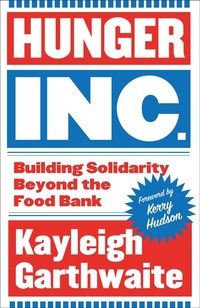
Hunger Inc.
Building Solidarity Beyond the Food Bank
1st Edition
Published on 20. December 2025
978-0-7453-5018-9 (ISBN)
Description

Since 2020, we have seen a huge increase in the demand for charitable food aid, due to multiple political and economic crises. Initially seen as an emergency measure, corporate-backed food aid programs are now entrenched 'solutions' to hunger. But who really benefits from them?
Kayleigh Garthwaite travelled across Britain, North America and Europe, working with food banks, co-ops, urban farms and food justice organisations. She documents the limitations of these programs, and how institutionalising charitable food aid absolves governments of their responsibility to ensure that people have a right to food. As hunger and inequality continue to rise within advanced capitalist countries, this issue is more urgent than ever.
Kayleigh Garthwaite proposes radical key policies for governments and explores alternative community-led responses grounded in solidarity, not charity, to end the need for food aid before the indignity of food banks becomes completely normalised.
Kayleigh Garthwaite travelled across Britain, North America and Europe, working with food banks, co-ops, urban farms and food justice organisations. She documents the limitations of these programs, and how institutionalising charitable food aid absolves governments of their responsibility to ensure that people have a right to food. As hunger and inequality continue to rise within advanced capitalist countries, this issue is more urgent than ever.
Kayleigh Garthwaite proposes radical key policies for governments and explores alternative community-led responses grounded in solidarity, not charity, to end the need for food aid before the indignity of food banks becomes completely normalised.
Reviews / Votes
'How do you close a food bank - a beacon of what is wrong? By turning it into a shop - preferably a co-op. Kayleigh Garthwaite's ground-breaking work explains why food banks prolong hunger and what must be done' -- Danny Dorling, School of Geography and the Environment, University of Oxford 'This is the book we need right now, as inequality rages and people across the 'wealthy West' turn in ever greater numbers to food banks and other types of food support. Crucially, it gives us something to hang on to: solutions. An absolute must read not just for policymakers, but for everyone' -- Mary O'Hara, author of <i>Austerity Bites 10 Years On: A Journey to the Sharp End of Cuts in the UK</i> 'How do you close a food bank - a beacon of what is wrong? By turning it into a shop - preferably a co-op. Kayleigh Garthwaite's ground-breaking work explains why food banks prolong hunger and what must be done' -- Danny Dorling, School of Geography and the Environment, University of Oxford 'This is the book we need right now, as inequality rages and people across the 'wealthy West' turn in ever greater numbers to food banks and other types of food support. Crucially, it gives us something to hang on to: solutions. An absolute must read not just for policymakers, but for everyone' -- Mary O'Hara, author of <i>Austerity Bites 10 Years On: A Journey to the Sharp End of Cuts in the UK</i>More details
Edition
1. Auflage
Language
English
Place of publication
London
United Kingdom
Illustrations
1 Figures
File size
0,86 MB
ISBN-13
978-0-7453-5018-9 (9780745350189)
Copyright in bibliographic data and cover images is held by Nielsen Book Services Limited or by the publishers or by their respective licensors: all rights reserved.
Schweitzer Classification
Other editions
Additional editions

Book
12/2025
Pluto Press
€21.50
Available immediately
Persons
Kayleigh Garthwaite is Associate Professor in Social Policy at the University of Birmingham, UK. She is the author of the British Academy Peter Townsend Prize-winning Hunger Pains: Life Inside Foodbank Britain. She co-founded the Global Solidarity Alliance for Food, Health, and Social Justice (GSA), an international collaboration between scholars, NGOs, and grassroots campaigners.
Content
Foreword - by Kerry Hudson
Introduction
Part I. The Problems of Charitable Food Aid
1. The Past and Present of Charitable Food Aid
2. Food Surplus and the Growth of the Hunger Industrial Complex
3. The Problems of Charitable Food Aid under a Permanent State of 'Emergency'
4. Labour Exploitation and Burnout in the Charitable Food Aid System
Part II. Dignity, Rights and Solidarity
5. The Right to Food
6. Reducing Stigma, Promoting Dignity, Nurturing Solidarity
7. Mechanisms for Ending Charitable Food Aid
8. Advocating for Change and the Importance of Solidarity
Conclusion
Notes
Acknowledgements
Index
Introduction
Part I. The Problems of Charitable Food Aid
1. The Past and Present of Charitable Food Aid
2. Food Surplus and the Growth of the Hunger Industrial Complex
3. The Problems of Charitable Food Aid under a Permanent State of 'Emergency'
4. Labour Exploitation and Burnout in the Charitable Food Aid System
Part II. Dignity, Rights and Solidarity
5. The Right to Food
6. Reducing Stigma, Promoting Dignity, Nurturing Solidarity
7. Mechanisms for Ending Charitable Food Aid
8. Advocating for Change and the Importance of Solidarity
Conclusion
Notes
Acknowledgements
Index
