

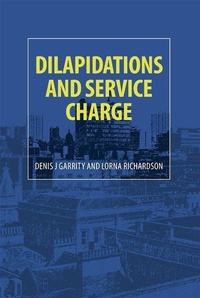
Dilapidations and Service Charge
1st Edition
Published on 5. December 2019
152 pages
978-1-4744-7544-0 (ISBN)
Description

This clear and practical book gives a thorough exposition of the law governing dilapidations in Scotland. It covers the underlying common law; interpretation of the lease; remedies for breach of repairing obligation; common parts and service charge; and dispute resolution.
More details
Other editions
Additional editions
Denis J. Garrity | Lorna Richardson
Dilapidations and Service Charge
Book
10/2019
Edinburgh University Press
€84.48
Shipment within 15-20 days
Content
- Intro
- Dilapidations and Service Charge
- Copyright
- Contents
- Preface
- Table of Cases
- Table of Statutes
- Table of Orders, Rules and Regulations
- Chapter 1 Introduction
- 1.1 Commercial property, the common law and "urban leases"
- 1.2 Investment in commercial property
- 1.3 The repairing obligation in context
- 1.4 The commercial relevance of lease duration
- 1.5 Treatment of "repairs" towards expiry of the lease
- 1.6 Single-occupancy and multi-occupancy buildings
- Chapter 2 Defining "the Premises" and "the Common Parts"
- 2.1 Introduction
- 2.2 Single-occupancy buildings
- 2.3 Multiple-occupancy buildings
- 2.4 "The premises" and "the common parts"
- 2.5 Fixtures - general
- 2.6 What is a fixture?
- 2.7 The role of intention in accession
- 2.8 Trade fixtures
- 2.9 Severance of items from the premises by agreement
- Chapter 3 The Underlying Common Law
- 3.1 Introduction
- 3.2 The landlord's implied warranty at lease commencement - that the premises let are fit for purpose
- 3.3 The landlord's common law repairing obligation
- 3.4 Ordinary and extraordinary repairs
- 3.5 The tenant's duty to take reasonable care
- 3.6 The absent repairing obligation
- Chapter 4 The Tenant's Repairing Obligations: Reading the Lease and Other Documents
- 4.1 Introduction
- 4.2 Principles of interpretation
- 4.3 The FRI repairing clause
- 4.4 The repairing obligation in detail
- 4.5 Where the premises are not in good condition at lease commencement
- 4.6 Notice of wants of repair and schedules of dilapidations
- 4.7 Exclusions from the tenant's repairing obligations
- 4.8 "Hidden" repairing obligations
- 4.9 Sub-leases
- Chapter 5 Remedies for Breach of the Repairing Obligation
- 5.1 Introduction
- 5.2 Serving a schedule of dilapidations
- 5.3 Remedies available at common law for breach of the lease
- 5.4 Remedies specifically provided for in the lease
- 5.5 Effect of tenant's breach of repairing obligation on rights the tenant has under the lease
- 5.6 Tenant's remedies for breach of the landlord's obligations in relation to the condition of the property
- Chapter 6 Common Parts and Service Charge
- 6.1 Introduction
- 6.2 What is typically a common part and why?
- 6.3 Obligations in relation to common parts and services
- 6.4 Factors to take into account regarding works to common parts or services
- 6.5 The tenant's obligation to pay service charge
- 6.6 Reserve or sinking funds
- 6.7 Tenant's remedies for the landlord's breach of the lease
- 6.8 Landlord's remedies for the tenant's breach of the lease
- Chapter 7 Dispute Resolution
- 7.1 Introduction
- 7.2 Nature of the dispute and remedy sought
- 7.3 When and how are dilapidations identified?
- 7.4 When to consider dispute resolution - specific implement and damages
- 7.5 Dispute resolution options
- Index
