

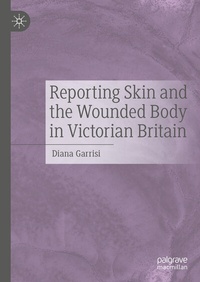
Reporting Skin and the Wounded Body in Victorian Britain
Description

Drawing on a wide range of primary sources, this book explains what made skin newsworthy in Victorian Britain. It represents a unique contribution to the media history of the human body by delving into the cultural and historical underpinnings of wound representation in Western culture. Employing a case study approach, the book provides a comprehensive exploration of the interplay between dermatology and the Victorian press. This work suggests that there was a mutually constitutive relationship between skin reporting and the formal evolution of news discourse during the nineteenth century. Narratives related to skin, such as wounds caused by corporal punishment, plagues resulting from neglect in workhouses, and occupational skin diseases, emerged as defining features of Victorian newspapers. Notably, media coverage of wounded skin assumed a central rhetorical position in debates pertaining to discipline, abuse, poverty, labour, and social norms, a legacy still discernible in contemporary journalism. Analysing the mediation of the wounded body in Victorian Britain offers a unique insight into the foundations of modern journalism. It sheds light on the impossibility of maintaining an objective framework when observing and reporting on bodies in pain. Paradoxically, news writers and commentators of that era navigated this challenge by encapsulating such narratives within rhetorical constructs that provided a template for the evolution of contemporary news values.
Reviews / Votes
"Garrisi's Reporting Skin and the Wounded Body in Victorian Britain is one of the most provocative - and important - books I've read in many years: strikingly original, immaculately researched, elegantly argued, and profoundly compassionate. By taking us on a deep dive into the world of Victorian Britain's fascination with skin - exploring real-life tales of violence to the flesh and disfigurement - she reveals how journalists used such stories to illustrate nineteenth century debates about poverty, injustice, crime and social malaise. In doing so, Garrisi deploys her command of rhetoric to challenge some of our easy assumptions about the culture of the Victorians and ends up giving us a completely new perspective on the birth of modern newspaper practice." (David Hendy, Emeritus Professor of Media and Cultural History, University of Sussex)
"Skin is a sensitive matter. It separates our vulnerable body from the environment, shaping our capacity to navigate and experience the world. Diana Garrisi's brilliant book unveils how skin came to signify and embody key trajectories of the burgeoning journalistic culture of Victorian Britain. Bringing together materiality and imagination, medical humanities and Victorian studies, media history and journalism, the book is an impressively good demonstration on how a single and apparently banal theme, if investigated in depth, provides essential insights into cultural and media inquiry." (Simone Natale, Associate Professor of Media History, University of Turin)
"Diana Garrisi's outstanding book is thus a first of its kind. By focusing on how skin was portrayed in Victorian newspapers and periodicals, she is able to glean from them a code of skin meanings that is still relevant today, since it continues to shape our views and to influence everything from social movements to body-image canons of beauty, as it did in Victorian society. This is fascinating reading, and should be read by everyone since we are all affected by the unconscious, surreptitious meanings built into skin by society. The great accomplishment of Garrisi's book is to have brought these out into the open, not in an opinionated way, but by examining how they coalesced at one period of time, continuing to affect us to this day." (Marcel Danesi, Professor Emeritus of Anthropology, University of Toronto)
"
Reporting Skin and the Wounded Body in Victorian Britain
represents an intriguing story of the English view of skin and the diseases that can afflict the body's outer covering. The author presents well-researched chapters on various subjects from the point of view of how the skin may be involved as the human body's largest organ. Highlights of this monograph range from the story of the intervention against the army by Sir Erasmus Wilson, the noted Victorian dermatologist, in the flogging of Private White for not acceding to the standards of the military, to the abuse of children forced to work in the nineteenth-century coal mines. The author's extensive research has unearthed information often lost for decades. For instance, she has discovered details about bedsores that should be more widely available in medical literature. This is a highly informative book recommended for a wide range of readers, including the lay audience, media scholars, medical historians, and also dermatologists, due to its presentation of little-known details and insightful discussions." (Lawrence Charles Parish MD, MD (Hon), FRCP (Edin), Clinical Professor of Dermatology and Cutaneous Biology, Director of the Jefferson Center for International Dermatology Sidney Kimmel Medical College at Thomas Jefferson University Philadelphia, Pennsylvania, Editor-in-Chief, "Clinics in Dermatology", Editor-in-Chief, "SKINmed"")
More details
Other editions
Additional editions
Person
Diana Garrisi is a lecturer in journalism at the School of Journalism, Media and Culture (JOMEC), Cardiff University. She is co-editor of Disability, Media and Representations: Other Bodies (2020) and Journalism Pedagogy in Transitional Countries (2022). In 2015, she received the Samuel J. Zakon Award in the History of Dermatology.
Content
Chapter 1: Dermatology and the Making of News in Victorian Britain.- Chapter 2: Skin as a Medium: Historical and Cultural Perspectives.- Chapter 3: Skin as Antithesis: The Lure of Newspapers for Opposites.- Chapter 4: Skin as Forensic Evidence: The Times Coverage of the Flogging of Private White.- Chapter 5: Skin in Pieces: the Fragment as a Narrative Device.- Chapter 6: Skin as an Epistemic Tool: Wound Care and Social Reform.- Chapter 7: The Body as Utensil: Framing Occupational Skin Diseases.- Chapter 8: Skin as a Canvas: The Origins of Facial Disfigurement.- Chapter 9: Media Histories of Skin.
