

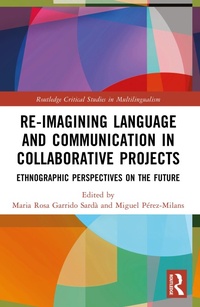
Re-imagining Language and Communication in Collaborative Projects
Ethnographic Perspectives on the Future
1st Edition
Published on 16. June 2025
284 pages
978-1-040-36859-6 (ISBN)
Description

This collection re-imagines language and communication through an ethnographic sociolinguistic lens, foregrounding perspectives on collective projects that grapple with the relationship between past, present, and future towards confronting structural inequalities.
Bringing together work from critical sociolinguistics as well as related scholarship in literary studies, social theory, and anthropology, the volume features contributions from established and emerging scholars which showcase collective initiatives whereby people reckon with the semiotic and multilingual practices that contribute to social difference while seeking to envision a radically better future. Chapters feature analyses of narratives, audiovisual artefacts, and everyday discourse in "projects of re-imagination" within such spaces as educational institutions, religious organizations, NGOs, community groups, and urban development initiatives. In focusing on social groups that are mobilized into action by reimagining the present through narratives and linguistic practices, the book highlights the disciplinary implications for sociolinguistics as a field more broadly.
This innovative volume will be of interest to scholars in sociolinguistics, applied linguistics, and linguistic anthropology, as well as related disciplines such as sociology, political science, and educational studies.
Bringing together work from critical sociolinguistics as well as related scholarship in literary studies, social theory, and anthropology, the volume features contributions from established and emerging scholars which showcase collective initiatives whereby people reckon with the semiotic and multilingual practices that contribute to social difference while seeking to envision a radically better future. Chapters feature analyses of narratives, audiovisual artefacts, and everyday discourse in "projects of re-imagination" within such spaces as educational institutions, religious organizations, NGOs, community groups, and urban development initiatives. In focusing on social groups that are mobilized into action by reimagining the present through narratives and linguistic practices, the book highlights the disciplinary implications for sociolinguistics as a field more broadly.
This innovative volume will be of interest to scholars in sociolinguistics, applied linguistics, and linguistic anthropology, as well as related disciplines such as sociology, political science, and educational studies.
More details
Series
Edition
1. Auflage
Language
English
Place of publication
London
United Kingdom
Publishing group
Taylor & Francis Ltd
Target group
College/higher education
Illustrations
8 Tables, black and white; 1 Line drawings, black and white; 15 Halftones, black and white; 16 Illustrations, black and white
File size
2,65 MB
ISBN-13
978-1-040-36859-6 (9781040368596)
Copyright in bibliographic data and cover images is held by Nielsen Book Services Limited or by the publishers or by their respective licensors: all rights reserved.
Schweitzer Classification
Other editions
Additional editions
Maria Rosa Garrido Sarda | Miguel Perez-Milans
Re-imagining Language and Communication in Collaborative Projects
Ethnographic Perspectives on the Future
Book
06/2025
1st Edition
Routledge
€206.70
Shipment within 10-20 days
Persons
Maria Rosa Garrido Sarda is Associate Professor of English Language and Linguistics in the Department of English and German at the Autonomous University of Barcelona (Catalonia, Spain). She authored Community, Solidarity and Multilingualism in a Social Movement: A Critical Sociolinguistic Ethnography of Emmaus (Routledge, 2021).
Miguel Perez-Milans is Professor of Language, Discourse, and Communication in the UCL Institute of Education at University College London, UK. His previous publications include Urban Schools and English Language Education in Late Modern China (Routledge, 2013) and co-editor of The Oxford Handbook of Language Policy and Planning (2018).
Miguel Perez-Milans is Professor of Language, Discourse, and Communication in the UCL Institute of Education at University College London, UK. His previous publications include Urban Schools and English Language Education in Late Modern China (Routledge, 2013) and co-editor of The Oxford Handbook of Language Policy and Planning (2018).
Content
List of Contributors
Acknowledgements
Chapter 1.
The politics of future re-imagination: Sociolinguistic approaches.
Miguel Perez-Milans and Maria Rosa Garrido
PART I. Better future(s) and Non-profit Associations under the Neoliberal Nation-state
Chapter 2.
Appropriating "solidarity" in hopeful narratives of an alternative future in a social movement.
Maria Rosa Garrido
Chapter 3.
Religion, social memory and future re-imagination: Utopian narratives through an ethnographic lens.
Miguel Perez-Milans and Xiaoyan (Grace) Guo
Chapter 4.
"La vida es una repeticion hasta que nosotros cambiemos": Imagining and materialising the future of Rionegro, Colombia with English.
Peter Browning
PART II. Activism and the Colonial Politics Of Race, Class, And Gender.
Chapter 5.
"This is how we managed not to die in Complexo do Alemao": The pedagogy of hope in Rio de Janeiro's favelas.
Daniel N. Silva
Chapter 6.
Negras villeras y marronas. Emerging feminist subjectivities haunting Argentina's invisibilized racial heritage.
Veronica Pajaro
PART III. Re-imagination of Diasporic Togetherness as Resistance to Colonial Temporalities (and Spatialities)
Chapter 7.
Narratives of refusal towards "lusofonia:" Postcolonial orders of (im)possibilities and (im)mobilities in lusophone terrains.
Bernardino Tavares
Chapter 8.
Transnational Indigenous Sovereignty across Time and Space: Disrupting Multicultural Education "Days".
Patricia Baquedano-Lopez and Nate Gong
PART IV. Future, Sociolinguistics and the Re-Imagining of Ways of Knowing.
Chapter 9.
Sociolinguistic prefiguration, future nostalgia and the ethics of possibility.
Rodrigo Borba
Index
Acknowledgements
Chapter 1.
The politics of future re-imagination: Sociolinguistic approaches.
Miguel Perez-Milans and Maria Rosa Garrido
PART I. Better future(s) and Non-profit Associations under the Neoliberal Nation-state
Chapter 2.
Appropriating "solidarity" in hopeful narratives of an alternative future in a social movement.
Maria Rosa Garrido
Chapter 3.
Religion, social memory and future re-imagination: Utopian narratives through an ethnographic lens.
Miguel Perez-Milans and Xiaoyan (Grace) Guo
Chapter 4.
"La vida es una repeticion hasta que nosotros cambiemos": Imagining and materialising the future of Rionegro, Colombia with English.
Peter Browning
PART II. Activism and the Colonial Politics Of Race, Class, And Gender.
Chapter 5.
"This is how we managed not to die in Complexo do Alemao": The pedagogy of hope in Rio de Janeiro's favelas.
Daniel N. Silva
Chapter 6.
Negras villeras y marronas. Emerging feminist subjectivities haunting Argentina's invisibilized racial heritage.
Veronica Pajaro
PART III. Re-imagination of Diasporic Togetherness as Resistance to Colonial Temporalities (and Spatialities)
Chapter 7.
Narratives of refusal towards "lusofonia:" Postcolonial orders of (im)possibilities and (im)mobilities in lusophone terrains.
Bernardino Tavares
Chapter 8.
Transnational Indigenous Sovereignty across Time and Space: Disrupting Multicultural Education "Days".
Patricia Baquedano-Lopez and Nate Gong
PART IV. Future, Sociolinguistics and the Re-Imagining of Ways of Knowing.
Chapter 9.
Sociolinguistic prefiguration, future nostalgia and the ethics of possibility.
Rodrigo Borba
Index
