

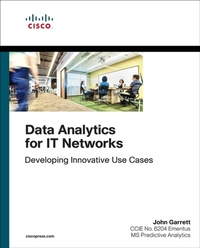
Data Analytics for IT Networks
Developing Innovative Use Cases
1st Edition
Published on 24. October 2018
300 pages
978-0-13-518344-1 (ISBN)
Description

Use data analytics to drive innovation and value throughout your network infrastructure
Network and IT professionals capture immense amounts of data from their networks. Buried in this data are multiple opportunities to solve and avoid problems, strengthen security, and improve network performance. To achieve these goals, IT networking experts need a solid understanding of data science, and data scientists need a firm grasp of modern networking concepts. Data Analytics for IT Networks fills these knowledge gaps, allowing both groups to drive unprecedented value from telemetry, event analytics, network infrastructure metadata, and other network data sources.
Drawing on his pioneering experience applying data science to large-scale Cisco networks, John Garrett introduces the specific data science methodologies and algorithms network and IT professionals need, and helps data scientists understand contemporary network technologies, applications, and data sources.
After establishing this shared understanding, Garrett shows how to uncover innovative use cases that integrate data science algorithms with network data. He concludes with several hands-on, Python-based case studies reflecting Cisco Customer Experience (CX) engineers' supporting its largest customers. These are designed to serve as templates for developing custom solutions ranging from advanced troubleshooting to service assurance.
Understand the data analytics landscape and its opportunities in Networking
See how elements of an analytics solution come together in the practical use cases
Explore and access network data sources, and choose the right data for your problem
Innovate more successfully by understanding mental models and cognitive biases
Walk through common analytics use cases from many industries, and adapt them to your environment
Uncover new data science use cases for optimizing large networks
Master proven algorithms, models, and methodologies for solving network problems
Adapt use cases built with traditional statistical methods
Use data science to improve network infrastructure analysisAnalyze control and data planes with greater sophistication
Fully leverage your existing Cisco tools to collect, analyze, and visualize data
Network and IT professionals capture immense amounts of data from their networks. Buried in this data are multiple opportunities to solve and avoid problems, strengthen security, and improve network performance. To achieve these goals, IT networking experts need a solid understanding of data science, and data scientists need a firm grasp of modern networking concepts. Data Analytics for IT Networks fills these knowledge gaps, allowing both groups to drive unprecedented value from telemetry, event analytics, network infrastructure metadata, and other network data sources.
Drawing on his pioneering experience applying data science to large-scale Cisco networks, John Garrett introduces the specific data science methodologies and algorithms network and IT professionals need, and helps data scientists understand contemporary network technologies, applications, and data sources.
After establishing this shared understanding, Garrett shows how to uncover innovative use cases that integrate data science algorithms with network data. He concludes with several hands-on, Python-based case studies reflecting Cisco Customer Experience (CX) engineers' supporting its largest customers. These are designed to serve as templates for developing custom solutions ranging from advanced troubleshooting to service assurance.
Understand the data analytics landscape and its opportunities in Networking
See how elements of an analytics solution come together in the practical use cases
Explore and access network data sources, and choose the right data for your problem
Innovate more successfully by understanding mental models and cognitive biases
Walk through common analytics use cases from many industries, and adapt them to your environment
Uncover new data science use cases for optimizing large networks
Master proven algorithms, models, and methodologies for solving network problems
Adapt use cases built with traditional statistical methods
Use data science to improve network infrastructure analysisAnalyze control and data planes with greater sophistication
Fully leverage your existing Cisco tools to collect, analyze, and visualize data
All prices
More details
Series
Edition
1. Auflage
Language
English
Place of publication
Indianapolis
United States
Publishing group
Pearson Education (US)
Target group
Professional and scholarly
File size
23,04 MB
ISBN-13
978-0-13-518344-1 (9780135183441)
Copyright in bibliographic data and cover images is held by Nielsen Book Services Limited or by the publishers or by their respective licensors: all rights reserved.
Schweitzer Classification
Other editions
Additional editions
Book
01/2019
Cisco Press
€56.00
Shipment within 3-4 weeks
Person
John Garrett is CCIE Emeritus (6204) and Splunk Certified. He earned an M.S. in predictive analytics from Northwestern University, and has a patent pending related to analysis of network devices with data science techniques. John has architected, designed, and implemented LAN, WAN, wireless, and data center solutions for some of the largest Cisco customers. As a secondary role, John has worked with teams in the Cisco Services organization to innovate on some of the most widely used tools and methodologies at Customer Experience over the past 12 years.
For the past 7 years, John's journey has moved through server virtualization, network virtualization, OpenStack and cloud, network functions virtualization (NFV), service assurance, and data science. The realization that analytics and data science play roles in all these brought John full circle back to developing innovative tools and techniques for Cisco Services. John's most recent role is as an Analytics Technical Lead, developing use cases to benefit Cisco Services customers as part of Business Critical Services for Cisco. John lives with his wife and children in Raleigh, North Carolina.
For the past 7 years, John's journey has moved through server virtualization, network virtualization, OpenStack and cloud, network functions virtualization (NFV), service assurance, and data science. The realization that analytics and data science play roles in all these brought John full circle back to developing innovative tools and techniques for Cisco Services. John's most recent role is as an Analytics Technical Lead, developing use cases to benefit Cisco Services customers as part of Business Critical Services for Cisco. John lives with his wife and children in Raleigh, North Carolina.
Content
Chapter 1 Getting Started with Analytics
Chapter 2 Approaches for Analytics and Data Science
Chapter 3 Understanding Networking Data Sources
Chapter 4 Accessing Data from Network Components
Chapter 5 Mental Models and Cognitive Bias
Chapter 6 Innovative Thinking Techniques
Chapter 7 Analytics Use Cases and the Intuition Behind Them
Chapter 8 Analytics Algorithms and the Intuition Behind Them
Chapter 9 Building Analytics Use Cases
Chapter 10 Developing Real Use Cases: The Power of Statistics
Chapter 11 Developing Real Use Cases: Network Infrastructure Analytics
Chapter 12 Developing Real Use Cases: Control Plane Analytics Using Syslog Telemetry
Chapter 13 Developing Real Use Cases: Data Plane Analytics
Chapter 14 Cisco Analytics
Chapter 15 Book Summary
Appendix A Function for Parsing Packets from pcap Files
Chapter 2 Approaches for Analytics and Data Science
Chapter 3 Understanding Networking Data Sources
Chapter 4 Accessing Data from Network Components
Chapter 5 Mental Models and Cognitive Bias
Chapter 6 Innovative Thinking Techniques
Chapter 7 Analytics Use Cases and the Intuition Behind Them
Chapter 8 Analytics Algorithms and the Intuition Behind Them
Chapter 9 Building Analytics Use Cases
Chapter 10 Developing Real Use Cases: The Power of Statistics
Chapter 11 Developing Real Use Cases: Network Infrastructure Analytics
Chapter 12 Developing Real Use Cases: Control Plane Analytics Using Syslog Telemetry
Chapter 13 Developing Real Use Cases: Data Plane Analytics
Chapter 14 Cisco Analytics
Chapter 15 Book Summary
Appendix A Function for Parsing Packets from pcap Files
