

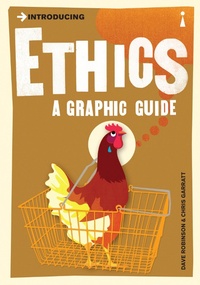
Introducing Ethics
A Graphic Guide
Published on 5. June 2014
176 pages
978-1-84831-767-3 (ISBN)
Description

What is the place of individual choice and consequence in a post-Holocaust world of continuing genocidal ethnic cleansing? Is "identity" now a last-ditch cultural defence of ethnic nationalisms and competing fundamentalisms? In a climate of instant information, free markets and possible ecological disaster, how do we define "rights", self-interest and civic duties? What are the acceptable limits of scientific investigation and genetic engineering, the rights and wrongs of animal rights, euthanasia and civil disobedience?"Introducing Ethics" confronts these dilemmas, tracing the arguments of the great moral thinkers, including Socrates, Plato, Aristotle, Hobbes and Kant, and brings us up to date with postmodern critics.
More details
Other editions
Additional editions
Book
09/2008
Icon Books
€11.50
Article not available at the moment
Persons
Dave Robinson has taught philosophy for many years and is the author of numerous Introducing titles. Chris Garratt is the cartoonist behind the legendary Biff comic strip in the Guardian.
Content
- Intro
- Cover
- Title Page
- Copyright
- Contents
- Moral Questions
- Social Beings
- Communitarians or Individualists?
- Setting the Stage Ten Central Questions
- The Social Origins of Belief Systems
- Morality and Religion
- Morality and Human Nature
- Genetics
- Do We Have Any Choice?
- Is Society to Blame?
- Moral Relativism
- Ethical Absolutism
- Relativism versus Absolutism
- Another Absolutist Reply
- Are They Both Wrong?
- The Problem of Moral Knowledge
- A Brief History of Ethics The Greek City State
- Democracy
- Greeks and Philosophy
- Slavery
- The Socratic Method
- Socratic Ethics: Know Thyself
- Plato's Republic
- Plato versus the Sophists
- The World of Forms
- A Closed Society
- Aristotle and Commonsense Ethics
- The Teleological View and the "Mean"
- A Dull but Good Person
- Hellenistic Ethics
- The Advent of Christianity
- Medieval and Scholastic Ethics
- The Rise of Humanism
- Machiavelii
- Brutes or Innocents?
- The Social Contract
- Is It True?
- Romantic Innocence
- The Noble Savage
- Mutual Aiders or Sociobiology
- The Social Gene
- Symbolic Animals
- Marx and Economic Determinism
- False Consciousness
- Utilitarianism
- The Law and Morality
- Happiness Sums
- A Practical Example
- Consequences not Motives
- Mill's Ideas
- Rule Utilitarians
- Mill's Pluralism
- What is Happiness?
- Is It Really Scientific?
- The Moral Law of Duty
- Practical Reason
- Duty versus Inclination
- The Parable of the Rich Young Man
- The Universability Test
- Inflexible Rules
- Moral Imagination
- Ethical Doctrines Contrasted
- Hume's Radical Scepticism
- Beliefs are Psychological
- Is the "Is-Ought Gap" True?
- Subjectivists and Objectivists
- Moral Language is Nonsense
- The Importance of the Imagination
- Choosing To Be: Existentialism
- The Student Who Couldn't Decide
- The Road to Postmodernism
- What Is This Thing Called "Human Nature"?
- Freud's Model of the Psyche
- The Unconscious and Moral Autonomy
- Lacan: the Fiction of the "Self"
- The Holocaust and the Betrayal of the Enlightenment
- The Dangers of "Reason"
- Postmodernist Scepticism
- Human, All Too Human
- Postmodernist Visions: Supermarket Slavery
- Post-Marxist Critical Theory
- Nietzschean Dandyism
- The Evils of Modernism
- Moral Philosophers and Legislators
- Postmodernist Societies
- The Postmodernist Moral Agent
- A Postmodern Hope: Neo-Tribes
- Social Ethics
- The Future Community: a New Social Contract
- Social Justice
- Bring Back Aristotle
- Why Has Ethics Become a Mess?
- Hope in Traditions
- What Are the Virtues?
- And Where is Postmodernism Going?
- Time for a New Feminist Ethics
- Private and Public Spheres
- Sensible Jake and Sensitive Amy
- Different Moral Priorities
- S.H.E.
- Environmental Ethics
- Anthropocentric Ethics
- The Newbury Case
- Does it Matter?
- We Are Not Outsiders
- ETHICS AND ANIMALS The Libellous Philosophers
- Animal Rights
- Can We Prove That Animals Have Rights?
- The Utilitarian Argument
- Animals and Pain
- Animal Experiments
- The Persons Argument
- Are Chimpanzees Persons?
- ETHICS AND EUTHANASIA The Case of Dr Cox and Mrs Boyes
- The Trial
- Is Euthanasia Acceptable?
- Arguments Against Euthanasia
- Counter Arguments
- The Coma Patient
- Let Nature Take Its Course
- Let The Patient Decide
- What Do The Philosophers Say?
- The Utilitarians
- Virtue Theory Again
- What Do We Conclude?
- Further Reading
- Acknowledgements
- Index
