

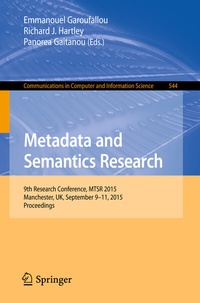
Metadata and Semantics Research
9th Research Conference, MTSR 2015, Manchester, UK, September 9-11, 2015, Proceedings
Published on 3. September 2015
XIX, 462 pages
978-3-319-24129-6 (ISBN)
Description

This book constitutes the refereed proceedings of the 9th Metadata and Semantics Research Conference, MTSR 2015, held in Manchester, UK, in September 2015.The 35 full papers and 3 short papers presented together with 2 poster papers were carefully reviewed and selected from 76 submissions. The papers are organized in several sessions and tracks: general track on ontology evolution, engineering, and frameworks, semantic Web and metadata extraction, modelling, interoperability and exploratory search, data analysis, reuse and visualization; track on digital libraries, information retrieval, linked and social data; track on metadata and semantics for open repositories, research information systems and data infrastructure; track on metadata and semantics for agriculture, food and environment; track on metadata and semantics for cultural collections and applications; track on European and national projects.
More details
Series
Edition
1st ed. 2015
Language
English
Place of publication
Cham
Switzerland
Publishing group
Springer International Publishing
Target group
Professional and scholarly
Illustrations
XIX, 462 p. 143 illus. in color.
File size
23,77 MB
ISBN-13
978-3-319-24129-6 (9783319241296)
DOI
10.1007/978-3-319-24129-6
Schweitzer Classification
Other editions
Additional editions
Emmanouel Garoufallou | Richard J. Hartley | Panorea Gaitanou
Metadata and Semantics Research
9th Research Conference, MTSR 2015, Manchester, UK, September 9-11, 2015, Proceedings
Book
09/2015
Springer
€53.49
Shipment within 10-15 days
Content
- Intro
- Preface
- Organization
- Contents
- Ontology Evolution, Engineering, and Frameworks
- An Orchestration Framework for Linguistic Task Ontologies
- 1 Introduction
- 2 Orchestration Framework Architecture
- 3 Applying the Framework to Bantu Noun Class System Ontologies
- 3.1 Overview of Bantu Noun Class System
- 3.2 Methodology for NCS Ontologies Development
- 3.3 NCS Ontologies Design and Implementation
- 3.4 Overview of the NCS Ontology
- 3.5 Application of the Framework
- 3.6 Using the Ontologies
- 4 Related Work
- 5 Discussion and Conclusions
- References
- On the Preservation of Evolving Digital Content - The Continuum Approach and Relevant Metadata Models
- 1 Introduction
- 2 Continuum Versus Lifecycle Approaches to Digital Preservation
- 2.1 Lifecycle Models
- 2.2 Continuum Approaches
- 2.3 Example: Software -Based Art
- 3 Metadata Models for the Continuum Approach
- 3.1 PERICLES Linked Resource Model
- 3.2 Australian Governm ment Recordkeeping Metadata Standard
- 3.3 On the Relation of the AGRkMS to the PERICLES LRM
- 4 Conclusions
- References
- Challenges for Ontological Engineering in the Humanities -- A Case Study of Philosophy
- 1 Introduction
- 2 Main Paradigms in Ontological Engineering for Philosophy
- 2.1 Indiana Philosophy Ontology Project
- 2.2 PhiloSurfical Ontology
- 2.3 Philospace Ontology
- 2.4 A Faceted Typology of Engineering Ontologies for Philosophy
- 3 Towards A New Paradigm
- 4 Implementation
- 5 Further Work
- References
- Threshold Determination and Engaging Materials Scientists in Ontology Design
- 1 Introduction
- 2 Materials Science and Engineering: Nanocrystalline Materials
- 3 The Materials Genome Initiative and the Case for Shared Semantics
- 4 Research Objectives
- 5 Methods
- 6 Sample and Procedures
- 6.1 Algorithm Implementation
- 6.2 Term Evaluation
- 6.3 Term Sorting
- 7 Results
- 7.1 Algorithm Comparison
- 7.2 Term Extraction and Evaluation
- 7.3 Term Sorting
- 8 Discussion: Thr reshold Determination
- 9 Conclusion
- References
- What are Information Security Ontologies Useful for?
- 1 Introduction
- 2 Main Categories
- 2.1 Security Requirement Engineering
- 2.2 Reference Ontologies
- 2.3 Specification and Matching of Security Policies and Access Control
- 2.4 Vulnerability Analysis
- 2.5 Attack Detection
- 2.6 Information Extraction
- 2.7 Preparation for Machine Learning
- 3 Assessment of Current Practice
- 3.1 Levels of Analysis
- 3.2 Readiness for Practice
- 3.3 Ontology Population
- 4 Conclusions and outlook
- References
- Semantic Web and Metadata Extraction, Modelling, Interoperability and Exploratory Search
- Interoperable Multimedia Annotation and Retrieval for the Tourism Sector
- 1 Introduction
- 1.1 Problem Definition and Challenges
- 1.2 Related Work
- 2 Atlas Metadata System
- 2.1 Goals and Systems Specification
- 2.2 AMS Metadata Schema
- 2.3 Vocabularies Reused
- 2.4 Graph Relationships
- 2.5 Implementation
- 3 Demonstration
- 3.1 Experimental Setup
- 3.2 Simple Queries with Cypher
- 3.3 Open Querying Endpoints via Plugins
- 3.4 Advanced Recommendations
- 4 Conclusions and Future Work
- References
- Species Identification Through Preference-Enriched Faceted Search
- 1 Introduction
- 2 Related Work and Background
- 2.1 Species Identification
- 2.2 The Preference-Enriched Faceted Search (PFS)
- 2.3 The Hippalus System
- 3 A PFS-Based Approach for Species Identification
- 3.1 The Interaction By Example
- 3.2 Larger and Richer Dataset
- 3.3 Comparison of Species Identification Methods
- 4 Concluding Remarks
- References
- An Expert System for Water Quality Monitoring Based on Ontology
- 1 Introduction
- 2 Background
- 3 System Architecture
- 4 Implementation
- 4.1 The Pollutants Ont tology
- 4.2 Implementation of the Scenario
- 5 Challenges and Discussion
- 5.1 Continuous Rules
- 5.2 Logic Foundation
- 5.3 Forward/Backward-Chaining and Rete Algorithm
- 5.4 Hybrid and Homogeny Stream Data Approaches
- 6 Conclusion and Future Work
- References
- Discovering the Topical Evolution of the Digital Library Evaluation Community
- 1 Introduction
- 2 Literature Review
- 3 Methodology
- 3.1 Corpus Selection and Preparation
- 3.2 Implementation Tools and Processes
- 4 Results and Analysis
- 4.1 Topics' Rationale and Interpretation
- 4.2 Topic Relations
- 4.3 Topic Trends
- 5 Conclusions
- References
- Application of Metadata Standards for Interoperability Between Species Distribution Models
- 1 Introduction
- 2 Metadata Standards for Species Distribution Modeling
- 3 Application of Metadata Standard for Interoperability Between SDM Tools.
- 4 Conclusion
- References
- Data Analysis, Reuse and Visualization
- Majority Voting Re-ranking Algorithm for Content Based-Image Retrieval
- 1 Introduction
- 2 Related Works
- 3 The Proposed Algorithm
- 4 Experimental Results
- 5 Conclusion
- References
- Narrative Analysis for HyperGraph Ontology of Movies Using Plot Units
- 1 Introduction and Related Work
- 2 Automatic Generation of Plot Units for Movies
- 2.1 Movie Script Parsing
- 2.2 Automatic Plot Unit Generation
- 3 Results and Analysis of Automatically Generated Plot Units
- 3.1 Character Analysis Using Automatically Generated Plot Units
- 3.2 Related Events Detection Using Automatically Generated Plot Units
- 3.3 Video Summarization Using Automatically Generated Plot Units
- 4 HyperGraph Ba ased Ontology for Movies
- 4.1 Formal Representation of HyperGraph Based Ontology of Movies
- 4.2 Modeling of Plot Units Using the HyperGraph Ontology
- 4.3 CinemaScope
- 5 Conclusions
- References
- Track on Digital Libraries, Information Retrieval, Linked and Social Data Models, Frameworks and Applications
- RDA Element Sets and RDA Value Vocabularies: Vocabularies for Resource Description in the Semantic Web
- 1 Introduction
- 2 RDF Data Model in Resource Description
- 3 Vocabularies
- 4 Vocabularies Created from RDA
- 5 RDA Element Sets
- 5.1 Vocabularies of Classes
- 5.2 Vocabularies of Pro operties Restricted to FRBR
- 5.3 Unconstrained Prop perties
- 6 RDA Value Voc cabularies
- 7 Conclusions
- References
- Metadata for Scientific Audiovisual Media: Current Practices and Perspectives of the TIB|AV-Portal
- 1 Introduction
- 2 TIB|AV-Portal
- 3 Automatic Video Analysis of the TIB|AV-Portal
- 4 Metadata and Retrieval of the TIB|AV-Portal
- 4.1 Manual Metadata
- 4.2 Automatic Metadata
- 5 Ontologies of the TIB|AV-Portal
- 5.1 Semantic Indexing Based on the GND
- 5.2 Ontology-Based Semantic Search of the TIB|AV-Portal
- 5.3 Ontology Mapping for the Establishment of a Cross-Lingual Retrieval
- 6 Conclusions
- 7 Future Work: Publishing Metadata of the TIB|AV-Portal as Linked Open Data
- References
- Metadata Interoperability and Ingestion of Learning Resources into a Modern LMS
- 1 Introduction
- 2 Metadata Interoperability in Open eClass
- 2.1 Mapping to LOM and Other Standards
- 2.2 Mapping External Collections
- 3 Importing Learning Objects
- 3.1 Design and Architecture
- 3.2 Implementation and Features
- 3.3 Alignment Procedure
- 4 A Usage Scenario
- 5 Conclusions and Future Work
- References
- Clustering Learning Objects for Improving Their Recommendation via Collaborative Filtering Algorithms
- 1 Introduction
- 2 Related Work
- 2.1 Recommender Systems in TEL
- 2.2 Recommender Systems and Clustering Methods
- 3 Goals and Methodology
- 3.1 Goals
- 3.2 Data Description
- 3.3 Generating Clusters and Recommendations
- 4 Results and Discussion
- 4.1 User-Space Coverage
- 4.2 Inside the Clusters
- 5 Final Remarks
- References
- Conceptualization of Personalized Privacy Preserving Algorithms
- 1 Introduction
- 2 Related Work
- 3 Personalized Privacy Preserving Algorithms Model
- 4 Conclusion and Future Work
- References
- Data Quality and Evaluation Studies
- Evaluation of Metadata in Research Data Repositories: The Case of the DC.Subject Element
- Introduction
- 2 Background
- 2.1 The DRYAD Repository
- 2.2 Previous Work
- 2.3 DC.Subject
- 3 Methodology
- 3.1 Pre-processing: Preparing the DC.Subject for Analysis
- 4 Results
- 4.1 General Results for Packages and Files
- 4.2 Subject
- 4.3 Subject distribution by author
- 4.4 Data Quality Issues
- 5 Conclusions
- References
- Software Applications Ecosystem for Authority Control
- 1 Introduction
- 2 Related Work
- 2.1 Authority Control
- 2.2 AUTHORIS
- 2.3 Semantic Web
- 2.4 Linked Open Data
- 2.5 OpenLink Virtuoso
- 2.6 VIVO
- 3 Applications Ecosystem
- 3.1 Preprocessing Tool
- 3.2 AUCTORITAS Interface
- 3.3 Querying VIVO
- 4 Evaluation
- 5 Conclusions and Future Work
- References
- Digital Libraries Evaluation: Measuring Europeana's Usability
- 1 Introduction
- 2 Literature Review
- 3 Europeana
- 4 Methodology
- 5 Results
- 6 Conclusion
- References
- Usability Testing of an Annotation Tool in a Cultural Heritage Context
- 1 Introduction
- 2 Background
- 2.1 Usability Fundamentals
- 2.2 Usability Testing
- 2.3 Usability Testing of Annotation Tools
- 3 The Annotation Tool
- 4 Usability Testing of the TORCH Annotation Tool
- 5 Results
- 5.1 The Data Collected
- 5.2 Participant Demographics
- 5.3 Observed Usability Problems
- 5.4 Quality of Annotations
- 5.5 Participant Feedback
- 6 Summary and Concluding Remarks
- References
- An Exploration of Users' Needs for Multilingual Information Retrieval and Access
- 1 Introduction
- 2 Literature Review
- 3 Methodology
- 4 Findings
- 5 Discussion and Conclusions
- References
- 6 Appendix
- Track on Metadata and Semantics for Open Repositories, Research Information Systems and Data Infrastructure
- Mapping Large Scale Research Metadata to Linked Data: A Performance Comparison of HBase, CSV and XML
- 1 Introduction
- 2 Input Data
- 2.1 HBase
- 2.2 CSV
- 2.3 XML
- 3 Implementing the OpenAIRE Data Model in RDF
- 4 Requirements
- 5 Technical State of the Art
- 6 Implementation
- 7 Evaluation
- 7.1 Comparison Metrics
- 7.2 Evaluation Setup
- 7.3 Measurements and Observations
- 8 Related Work
- 9 Conclusion and Future Work
- Contextual and Provenance Metadata in the Oxford University Research Archive (ORA)
- 1 Introduction
- 2 Open Access and the Oxford University Research Archive
- 2.1 Open Access at Oxford
- 2.2 Oxford University Research Archive (ORA)
- 3 Context and Provenance of Research Materials
- 4 Oxford University Research Archive Data Model
- 4.1 Description of the Scholarly Output
- 4.2 Rights and Relationships of the Data Objects
- 4.3 ORA System Workflow Description
- 5 Contextual and Provenance Metadata in RDF
- 5.1 Relationships in Context
- 5.2 Activity-Based Data Model
- 5.3 PROV Provenance Data Model
- 6 Discussion and Future Work
- References
- Labman: A Research Information System to Foster Insight Discovery Through Visualizations
- 1 Introduction
- 2 Related Work
- 3 Labman
- 3.1 Modelling a Research Centre
- 3.2 Publishing as Linked Open Data
- 3.3 Management Tasks
- 4 Visualising Research Data
- 4.1 Historical Role Distribution
- 4.2 Projects Timeline
- 4.3 Research Topics
- 4.4 Place Distribution in Authored Publications
- 4.5 People Collaboration Networks
- 5 Conclusions and Future Work
- References
- Repositories for Open Science: The SciRepo Reference Model
- 1 Introduction
- 2 Science 2.0 Repositories in a Nutshell
- 3 Reference Model
- 3.1 The SciRepo End-Users Perspective
- 3.2 The SciRepo Administrator Perspective
- 3.3 The RI Application Developer Perspective
- 4 Conclusions and Future Works
- References
- On-Demand Integration and Linking of Open Data Information
- 1 Introduction
- 2 Related Work
- 3 Preliminaries
- 3.1 Data Portals
- 3.2 DALI
- 4 Use Case Description
- 5 Monitoring Open Data Portals
- 5.1 Architecture
- 5.2 Semantic Search Terms Expansion
- 5.3 Connection to DALI
- 6 Conclusion
- References
- On Bridging Data Centers and Publishers: The Data-Literature Interlinking Service
- 1 Introduction
- 2 The Need for a Data-Literature Interlinking Service
- 2.1 Modus Operandi
- 2.2 Related Work
- 3 The Data-Literature Interlinking Service
- 3.1 Functional Requirements
- 3.2 Data Model
- 4 The Prototype
- 4.1 Content Aggregatio on System
- 4.2 Content Provision System
- 4.3 Forthcoming ns Action
- 5 Conclusions
- References
- Historical Records and Digitization Factors in Biodiversity Communities of Practice
- 1 Introduction
- 1.1 Biodiversity Informatics
- 1.2 Communities of Practice
- 2 Setting and Methods
- 2.1 Ethnographic Action Research
- 2.2 Data
- 3 Discussion
- 3.1 Changes Over Time
- 3.2 The Human Element: Implications for Biodiversity Infrastructure
- 3.3 Summary and Future Work
- 4 Conclusion
- References
- Ontologies for Research Data Description: A Design Process Applied to Vehicle Simulation
- 1 Introduction
- 2 Data Management Workflow
- 3 The Modelling Process
- 4 The Vehicle Simulation Case Study
- 5 Conclusions
- References
- Track on Metadata and Semantics for Agriculture, Food and Environment
- Setting up a Global Linked Data Catalog of Datasets for Agriculture
- 1 Introduction
- 1.1 Related Work
- 1.2 Challenges
- 2 Semantics for the RING Linked Data
- 2.1 Data Model and Metadata Vocabularies
- 2.2 Value Vocabularies
- 3 LOD Publication Approach for the RING Linked Data
- 4 Examples of Data Re-use
- 4.1 Example 1: Data Aggregators Using the RING as Their Collection Database
- 4.2 Example 2: Data Processing Applications Retrieving Suitable Datasets from the RING
- 5 Discussion and Further Work
- References
- Improving Access to Big Data in Agriculture and Forestry Using Semantic Technologies
- 1 Problem Statement
- 2 The Trees4Future Project: Semantic Access to Agro-Forestry Data for Research
- 2.1 Improving Metada ta to Support Agro-Environmental Research
- 2.2 Improving Metadata Capabilities of Forestry Resources
- 2.3 An Ontology for Structuring and Annotation of Scientific Metadata
- 2.4 Exploiting Metadata Semantics to Improve Discoverability
- 3 Future Extensions Towards Semantic Reasoning Over Data
- 4 Discussion and Conclusions
- References
- A Semantic Mediator for Handling Heterogeneity of Spatio-Temporal Environment Data
- 1 Introduction
- 1.1 Spatio-Temporal Environment Data
- 1.2 The Need of Spatio-Temporal Analysis
- 2 Spatio-Temporal Ontology
- 2.1 Ontology of Time and Ontology of Fluent
- 2.2 A Spatio-Temporal Ontology for Environment
- 2.3 Spatio-Temporal Reasoning
- 3 A Framework for Spatio-Temporal Data Analysis
- 4 Data Analysis
- 5 Conclusion
- References
- Ontology Evolution for Experimental Data in Food
- 1 Introduction
- 2 Related Work
- 3 naRyQ Model and Its Coherence
- 3.1 naRyQ Model
- 3.2 naRyQ CC-Coherence
- Structural Constraints.
- Logical Constraints.
- User-Defined Constraints.
- 4 Coherent Evolution of naRyQ
- 4.1 Change Representation
- 4.2 Selection of a Change That Maintains CC-Coherence
- Kit of Changes.
- Evolution Strategies.
- 5 Implementation and Evaluation
- 5.1 Implementation
- 5.2 Evaluation of DynArOnto Plugin
- 6 Conclusion
- References
- Graph Patterns as Representation of Rules Extracted from Decision Trees for Coffee Rust Detection
- 1 Introduction
- 2 Rules Extraction
- 2.1 Data Preparation
- 2.2 Modeling and Evaluation
- 3 Rules as Graph Patterns
- 4 Discussion and Conclusions
- References
- Track on Metadata and Semantics for Cultural Collections and Applications
- Aggregating Cultural Heritage Data for Research Use: The Humanities Networked Infrastructure (HuNI)
- 1 Introduction
- 2 Data Aggregation
- 3 Technologies
- 4 Using the Data
- 5 Conclusion
- References
- Historical Context Ontology (HiCO): A Conceptual Model for Describing Context Information of Cultural Heritage Objects
- 1 Introduction
- 2 Related Works
- 3 Identifying Cultural Heritage Objects and Interpretations
- 4 Describing an Interpretation Act
- 4.1 Conceptualizing an Interpretation
- 4.2 Representing Information as RDF Statements
- 4.3 A Focus on Historical Context
- 5 Diachronic and Synchronous Relations Among Interpretations
- 6 Defining Rules for Authoritative Interpretations
- 7 Conclusions and Future Prospects
- References
- Track on European and National Projects
- Standardizing NDT& E Techniques and Conservation Metadata for Cultural Artifacts
- 1 Introduction
- 2 Non-destructive Testing Techniques Standardization
- 3 NDT&E Techniques Output Data Analysis and Process
- 3.1 The FORS-Based Classifier
- 3.2 The XRF-Based Classifier
- 4 The Metadata Scheme Outline
- 5 Management Information System for NDTs
- 6 Conclusions - Future Work
- References
- Poster Papers
- ALIADA, an Open Source Tool for Automatic Publication of Linked Data from Libraries and Museums
- 1 Introduction
- 2 Project Goal and Objectives
- 3 ALIADA, a Linked Data Publisher for Libraries and Museums
- 4 Results
- References
- Resource Classification as the Basis for a Visualization Pipeline in LOD Scenarios
- 1 Introduction
- 2 Resource Classification
- 2.1 Metadata Based Statistics
- 2.2 Primitive Datatype Inference
- 3 Evaluation
- 4 Conclusions and Future Work
- References
- Author Index
