

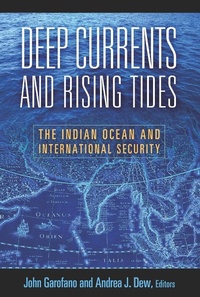
Deep Currents and Rising Tides
Description

The Indian Ocean region has rapidly emerged as a hinge point in the changing global balance of power and the geographic nexus of economic and security issues with vital global consequences. The security of energy supplies, persistent poverty and its contribution to political extremism, piracy, and related threats to seaborne trade, competing nuclear powers, and possibly the scene of future clashes between rising great powers India and China-all are dangers in the waters or in the littoral states of the Indian Ocean region.
This volume, one of the first attempts to treat the Indian Ocean Region in a coherent fashion, captures the spectrum of cooperation and competition in the Indian Ocean Region. Contributors discuss points of cooperation and competition in a region that stretches from East Africa, to Singapore, to Australia, and assess the regional interests of China, India, Pakistan, and the United States. Chapters review possible "red lines" for Chinese security in the region, India's naval ambitions, Pakistan's maritime security, and threats from non-state actors-terrorists, pirates, and criminal groups-who challenge security on the ocean for all states.
This volume will interest academics, professionals, and researchers with interests in international relations, Asian security, and maritime studies.
More details
Other editions
Additional editions
Persons
John Garofano is dean of academic affairs, US Naval War College, Newport, Rhode Island. Previously he held the Capt. Jerome Levy Chair of Economic Geography in the Strategy and Policy Department, US Naval War College.
Andrea J. Dew is the codirector of the Center on Irregular Warfare & Armed Groups, and an associate professor in the Strategy and Policy Department at the US Naval War College.
Content
Introduction
John Garofano and Andrea J. Dew
Part I: Energy, Piracy, Terror, and Access
1. The Indian Ocean: Geographic Center of the Global Oil Market
Sarah A. Emerson and Vivek S. Mathur
2. Maritime Piracy in the Indian Ocean: A Statistical Analysis of Reported Incidents, 1994-2011
John Martin
3. Horn of Troubles: Understanding and addressing the Somali "Piracy" Phenomenon
Clive Schofield and Robin Warner
4. Armed Groups at Sea: Maritime Terrorism in the Indian Ocean Region
Michael Richardson and Andrea J. Dew
Part II: Emerging Rivalries and Possible Triggers
5. India: Dominance, Balance, or Predominance in the Indian Ocean?
Andrew C. Winner
6. Pakistan's View of Security in the Indian Ocean
Moeed Yusuf
7. China and the Indian Ocean: New Departures in Regional Balancing
Jingdong Yuan
8. Redlines for Sino-Indian Naval Rivalry
James R. Holmes and Toshi Yoshihara
Part III: Third Powers and the Way Forward
9. International Law and the Future of Indian Ocean Security
James Kraska
10. A Merlion at the Edge of an Afrasian Sea: Singapore's Strategic Involvement in the Indian Ocean
Emrys Chew
11. The Indian Ocean and US National Security Interests
Timothy D. Hoyt
12. Conclusion: Access and Security in the Indian Ocean Region
John Garofano and Andrea J. Dew
List of Contributors
Index
