

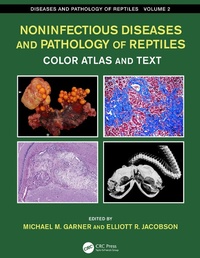
Noninfectious Diseases and Pathology of Reptiles
Color Atlas and Text, Diseases and Pathology of Reptiles, Volume 2
1st Edition
Published on 3. September 2020
534 pages
978-0-429-53232-0 (ISBN)
Description

This book accompanies Infectious Diseases and Pathology of Reptiles, Second Edition to cover noninfectious diseases of reptiles, meeting the need for a similar, authoritative single-source reference. The volume features color photos of normal anatomy and histology, as well as gross, light, and electron microscopic imagery of diseases.
Subjects range from neoplasia, nutrition, and metabolic disease, and deposition disorders to developmental anomalies, trauma, and physical diseases, and the unique contribution of paleopathology and diseases of bone. Each chapter is supported by numerous figures, many of which are unique and cannot be found in the published literature. Readers will note that some of the chapters are based on organ system, a trend that will continue into the next edition to encompass all of the basic organ systems.
This book holds the most information ever accrued into one publication on noninfectious diseases and pathology of this class of animals, providing information on every aspect of the anatomy, pathophysiology, and differential diagnosis. With up-to-the-minute data, a never-before-seen collection of images, and a stellar panel of contributors, Noninfectious Diseases and Pathology of Reptiles is the definitive resource for veterinarians, biologists, and researchers involved in the study of reptile diseases.
Subjects range from neoplasia, nutrition, and metabolic disease, and deposition disorders to developmental anomalies, trauma, and physical diseases, and the unique contribution of paleopathology and diseases of bone. Each chapter is supported by numerous figures, many of which are unique and cannot be found in the published literature. Readers will note that some of the chapters are based on organ system, a trend that will continue into the next edition to encompass all of the basic organ systems.
This book holds the most information ever accrued into one publication on noninfectious diseases and pathology of this class of animals, providing information on every aspect of the anatomy, pathophysiology, and differential diagnosis. With up-to-the-minute data, a never-before-seen collection of images, and a stellar panel of contributors, Noninfectious Diseases and Pathology of Reptiles is the definitive resource for veterinarians, biologists, and researchers involved in the study of reptile diseases.
Reviews / Votes
This two-volume set, Diseases and Pathology of Reptiles: Color Atlas and Text, takes the understanding of reptilian diagnostics to a new level. Never has a book covered biology, diagnostics, infectious and noninfectious diseases in such a comprehensive, in depth approach. Whether studying for advanced certification, needing information for research or investigating clinical cases, this publication is a must have.-- Douglas Mader, MS, DVM, DABVP (C/F, R/A), DECZM (Herpetology), Marathon Veterinary Hospital
Elliott Jacobson and Michael Garner...these two legends in reptile biology, disease, and medicine have at long last come together to produce a two-volume reference that is not only unparalleled in its depth and the combined experience of its editors and contributing authors, but is also an absolute must-have for anyone interested in any aspect of herpetological science and medicine.
-- Bruce Williams, DVM, Dipl. ACVP, Senior Pathologist, Veterinary Service, Joint Pathology Center
Pathologists have always been central to herpetological medicine and surgery. Originally because they were the only ones that actually knew what was going on...although admittedly following death and necropsy. I remember John Cooper telling me that Edward Elkan (a notable father of reptile pathology) would refuse to have anything to do with a sick reptile until after it had died. Times have changed and with increasing ante-mortem diagnostics, we are so much better at diagnosing and treating this group of vertebrates. However, the importance of the pathologist has never been greater, and the complexity of their discipline continues to increase. There has to be a symbiotic relationship between clinician and pathologist. This book will be a pillar for the specialty, and essential to both clinicians and pathologist alike.
-- Stephen J. Divers, BVetMed, DZooMed, DECZM(Herp), DECZM(ZHM), DACZM, FRCVS
More details
Edition
1. Auflage
Language
English
Place of publication
London
United Kingdom
Publishing group
Taylor & Francis Ltd
Target group
Professional and scholarly
College/higher education
Product notice
Reflowable
Illustrations
11 Tables, black and white; 850 Illustrations, color; 34 Illustrations, black and white
ISBN-13
978-0-429-53232-0 (9780429532320)
Copyright in bibliographic data and cover images is held by Nielsen Book Services Limited or by the publishers or by their respective licensors: all rights reserved.
Schweitzer Classification
Other editions
Additional editions
Michael M. Garner | Elliott R. Jacobson
Noninfectious Diseases and Pathology of Reptiles
Color Atlas and Text, Diseases and Pathology of Reptiles, Volume 2
Book
08/2022
1st Edition
CRC Press
€61.89
The article will not be published
Michael M. Garner | Elliott R. Jacobson
Noninfectious Diseases and Pathology of Reptiles
Color Atlas and Text, Diseases and Pathology of Reptiles, Volume 2
Book
09/2020
1st Edition
CRC Press
€237.70
Shipment within 15-20 days
Persons
Michael Garner, DVM is a renowned veterinary pathologist who specializes in zoological and wildlife diseases. In 1994, Dr. Garner founded the consulting firm, Northwest ZooPath. Since that time he has worked with numerous zoos, wildlife centers, universities, and veterinary clinics in the United States and abroad. He has authored or co-authored more than 200 papers and book chapters. Dr. Garner is also an enthusiastic teacher and is committed to training veterinary pathologists and residents. He established an outreach training program for foreign pathologists in 1999, and currently has housed and trained 22 externs and residents. A sought-after speaker, Dr. Garner has given hundreds of presentations and seminars at national and international meetings and veterinary colleges, including Washington State University where he has held an adjunct faculty appointment since 1998.
Elliott R. Jacobson, DVM, PhD, DACZM was born in Brooklyn, NY. He attended Brooklyn College of the City University of New York, and in 1967 he earned his BS degree in Biology. Next, he earned a M.S. Degree at New Mexico State University in 1969 working on physiological ecology of snakes. He enrolled in graduate school and veterinary school at the University of Missouri and earned his DVM and PhD in Zoology in 1975. He was a wildlife veterinarian for the state of Maryland from 1975 to 1977. He arrived in the College of Veterinary Medicine, University of Florida in 1977, where he was a resident in Wildlife and Laboratory Animal Medicine. In 1979 he was appointed Assistant Professor and helped develop the Zoological Medicine Service. In 1986 he became a Diplomate of the American College of Zoological Medicine. He moved up through the ranks of full professor in 1989. During his career he advised 31 residents and advised or served on the committee of 18 graduate students. Over the last 41 years he has worked on health problems of a wide variety of amphibians, reptiles, birds, and mammals.
Elliott R. Jacobson, DVM, PhD, DACZM was born in Brooklyn, NY. He attended Brooklyn College of the City University of New York, and in 1967 he earned his BS degree in Biology. Next, he earned a M.S. Degree at New Mexico State University in 1969 working on physiological ecology of snakes. He enrolled in graduate school and veterinary school at the University of Missouri and earned his DVM and PhD in Zoology in 1975. He was a wildlife veterinarian for the state of Maryland from 1975 to 1977. He arrived in the College of Veterinary Medicine, University of Florida in 1977, where he was a resident in Wildlife and Laboratory Animal Medicine. In 1979 he was appointed Assistant Professor and helped develop the Zoological Medicine Service. In 1986 he became a Diplomate of the American College of Zoological Medicine. He moved up through the ranks of full professor in 1989. During his career he advised 31 residents and advised or served on the committee of 18 graduate students. Over the last 41 years he has worked on health problems of a wide variety of amphibians, reptiles, birds, and mammals.
Content
Reptile Neoplasia. Nutritional and Metabolic Diseases. Depositional Diseases. Normal and Abnormal Reptile Development. Degenerative Diseases. Trauma and Physical Diseases. Environmental and Miscellaneous Toxicoses in Reptiles. Physiology and Diseases of the Reproductive System. Reptile Cardiovascular System. Bone Alteration by Disease: Its Appearance, Phylogeny, and Penetrance through Geologic Time.
