

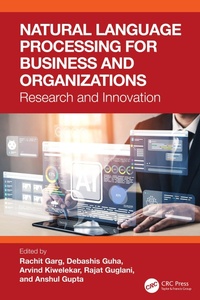
Natural Language Processing for Business and Organizations
Research and Innovation
1st Edition
Will be published approx. on 2. July 2026
206 pages
978-1-040-50108-5 (ISBN)
Description

This book offers a comprehensive and application-oriented exploration of Artificial Intelligence (AI) and Natural Language Processing (NLP), addressing both foundational principles and modern, data-driven methodologies. It is designed to equip readers with a deep understanding of how intelligent systems learn from data, interpret human language, and support automated decision-making across real-world contexts.
Natural Language Processing for Business and Organizations: Research and Innovation covers key areas such as machine learning, deep learning, text representation, language modeling, information extraction, sentiment analysis, and AI-driven analytics, while also discussing system design considerations for deploying NLP solutions at scale. Through carefully structured chapters, the book integrates theoretical insights with practical examples, case studies, and applied workflows, enabling readers to translate algorithms and models into effective AI applications. Written by a team of academic researchers and industry practitioners, the book emphasizes responsible and value-driven AI, including ethical considerations, data quality, and model evaluation.
This book is written for advanced undergraduate and postgraduate students, researchers, and professionals seeking to build, evaluate, and apply AI and NLP systems in academic, enterprise, and societal domains.
Natural Language Processing for Business and Organizations: Research and Innovation covers key areas such as machine learning, deep learning, text representation, language modeling, information extraction, sentiment analysis, and AI-driven analytics, while also discussing system design considerations for deploying NLP solutions at scale. Through carefully structured chapters, the book integrates theoretical insights with practical examples, case studies, and applied workflows, enabling readers to translate algorithms and models into effective AI applications. Written by a team of academic researchers and industry practitioners, the book emphasizes responsible and value-driven AI, including ethical considerations, data quality, and model evaluation.
This book is written for advanced undergraduate and postgraduate students, researchers, and professionals seeking to build, evaluate, and apply AI and NLP systems in academic, enterprise, and societal domains.
More details
Edition
1. Auflage
Language
English
Place of publication
London
United Kingdom
Publishing group
Taylor & Francis Ltd
Target group
Professional and scholarly
College/higher education
Illustrations
34 Tables, black and white; 37 Line drawings, black and white; 9 Halftones, black and white; 46 Illustrations, black and white
File size
20,27 MB
ISBN-13
978-1-040-50108-5 (9781040501085)
Copyright in bibliographic data and cover images is held by Nielsen Book Services Limited or by the publishers or by their respective licensors: all rights reserved.
Schweitzer Classification
Other editions
Additional editions
Rachit Garg | Debashis Guha | Arvind Kiwelekar
Natural Language Processing for Business and Organizations
Research and Innovation
Book
approx. 07/2026
1st Edition
CRC Press
€191.50
Not yet published
Persons
Rachit Garg is an Assistant Professor in the AI and Data Science Department at SP Jain School of Global Management, UAE. He is an experienced specialist in Artificial Intelligence and Information Technology with a strong track record across academic, research, and applied technology initiatives. His work spans core areas of Computer Science and AI, with a particular emphasis on bridging research, innovation, and real-world implementation. He holds a master's degree in Computer Science Engineering and completed his PhD with research conducted in collaboration with a multinational logistics organization. He holds patents in Artificial Intelligence and allied technologies and actively contributes to the scholarly community as a peer reviewer for reputed journals. Beyond academia, he is engaged with non-profit initiatives, reflecting a commitment to ethical, inclusive, and socially responsible use of technology. His research interests include developing impactful AI-driven systems, advancing research-led pedagogy, and fostering student-centric innovation.
Anshul Gupta is a faculty member in the Data Science Department at SP Jain School of Global Management, UAE. He is an experienced Data Scientist, consultant, and corporate trainer with a strong background in solving real-world business problems across diverse domains. His expertise includes Artificial Intelligence, Machine Learning, Business Analytics, e-commerce, and technology-enabled transformation, with a focus on driving measurable business outcomes through analytics. Dr. Gupta is actively engaged in research and scholarly service, serving as a journal reviewer and has been an invited speaker at prominent forums. He is also a lifetime member of several professional and technical societies, reflecting sustained engagement with the evolving AI and analytics community. His research interests include Artificial Intelligence, Machine Learning, and Business Analytics.
Debashis Guha is an Associate Professor and Director of the Master of Artificial Intelligence in Business (MAIB) program at SP Jain School of Global Management, Australia. He brings an interdisciplinary perspective to AI education, particularly at the intersection of analytics, decision-making, and business value creation. Dr. Guha earned his PhD from Columbia University, New York, USA, and completed an MA from Texas Christian University, Fort Worth, USA. He also holds a BTech (Honours) degree from the Indian Institute of Technology (IIT), Kharagpur, India. His professional experience spans both academia and industry, including affiliations with Columbia University, University of Texas at Dallas, Texas Christian University, Big Sky Quantitative Research LLP (India), and Alphanomics LLC (USA). His profile reflects a balance of research rigor, industry relevance, and leadership in AI program design and delivery. His research interests encompass Artificial Intelligence, Machine Learning, Marketing analytics, and Microcredit demand.
Arvind W. Kiwelekar is a Professor in the Department of Computer Engineering at Dr. Babasaheb Ambedkar Technological University (DBATU), India. With over three decades of experience in teaching and research, he has played a pivotal role in advancing engineering education, research culture, and institutional capacity building. Dr. Kiwelekar has published extensively in reputed international venues and has earned his PhD from the Indian Institute of Technology (IIT) Bombay. He has received prestigious research fellowships supported by the Indian Academy of Sciences, the Ministry of Education (Government of India), and IBM. In recognition of his long-standing dedication to teaching and mentorship, the alumni of the Department of Computer Engineering at DBATU instituted an award in his honor. His research interests include Artificial Intelligence, Blockchain Technology, ICT for Sustainable Development, Learning Analytics, Ontology Engineering, and Software Architecture.
Rajat Guglani is a Technology Lead at Infosys Limited, USA, with over 15 years of experience in the global technology industry. His expertise spans core Computer Science domains and modern enterprise technologies, including software development, cybersecurity, artificial intelligence, and cloud computing. He is recognized for combining strong engineering fundamentals with a solution-oriented mindset, enabling him to deliver scalable and impactful technology solutions. Mr. Guglani's professional approach is characterized by continuous learning, adaptability, and leadership in fast-evolving technical environments. His research interests include Artificial Intelligence, cybersecurity, and cloud computing.
Anshul Gupta is a faculty member in the Data Science Department at SP Jain School of Global Management, UAE. He is an experienced Data Scientist, consultant, and corporate trainer with a strong background in solving real-world business problems across diverse domains. His expertise includes Artificial Intelligence, Machine Learning, Business Analytics, e-commerce, and technology-enabled transformation, with a focus on driving measurable business outcomes through analytics. Dr. Gupta is actively engaged in research and scholarly service, serving as a journal reviewer and has been an invited speaker at prominent forums. He is also a lifetime member of several professional and technical societies, reflecting sustained engagement with the evolving AI and analytics community. His research interests include Artificial Intelligence, Machine Learning, and Business Analytics.
Debashis Guha is an Associate Professor and Director of the Master of Artificial Intelligence in Business (MAIB) program at SP Jain School of Global Management, Australia. He brings an interdisciplinary perspective to AI education, particularly at the intersection of analytics, decision-making, and business value creation. Dr. Guha earned his PhD from Columbia University, New York, USA, and completed an MA from Texas Christian University, Fort Worth, USA. He also holds a BTech (Honours) degree from the Indian Institute of Technology (IIT), Kharagpur, India. His professional experience spans both academia and industry, including affiliations with Columbia University, University of Texas at Dallas, Texas Christian University, Big Sky Quantitative Research LLP (India), and Alphanomics LLC (USA). His profile reflects a balance of research rigor, industry relevance, and leadership in AI program design and delivery. His research interests encompass Artificial Intelligence, Machine Learning, Marketing analytics, and Microcredit demand.
Arvind W. Kiwelekar is a Professor in the Department of Computer Engineering at Dr. Babasaheb Ambedkar Technological University (DBATU), India. With over three decades of experience in teaching and research, he has played a pivotal role in advancing engineering education, research culture, and institutional capacity building. Dr. Kiwelekar has published extensively in reputed international venues and has earned his PhD from the Indian Institute of Technology (IIT) Bombay. He has received prestigious research fellowships supported by the Indian Academy of Sciences, the Ministry of Education (Government of India), and IBM. In recognition of his long-standing dedication to teaching and mentorship, the alumni of the Department of Computer Engineering at DBATU instituted an award in his honor. His research interests include Artificial Intelligence, Blockchain Technology, ICT for Sustainable Development, Learning Analytics, Ontology Engineering, and Software Architecture.
Rajat Guglani is a Technology Lead at Infosys Limited, USA, with over 15 years of experience in the global technology industry. His expertise spans core Computer Science domains and modern enterprise technologies, including software development, cybersecurity, artificial intelligence, and cloud computing. He is recognized for combining strong engineering fundamentals with a solution-oriented mindset, enabling him to deliver scalable and impactful technology solutions. Mr. Guglani's professional approach is characterized by continuous learning, adaptability, and leadership in fast-evolving technical environments. His research interests include Artificial Intelligence, cybersecurity, and cloud computing.
Content
1. NLP's Strategic Role in Business Transformation: Foundations, Impact, and Integration 2. Next-Gen Customer Intelligence: NLP for Voice of Customer (VoC) & CX Analytics 3. Deal Desk Acceleration: Contract Analytics, Redlining, and Compliance Automation 4. Financial Narrative Intelligence: Natural Language Processing Applications in Earnings Call Analysis, ESG Disclosure Mining and 10-K Filings 5. Real-time Competitive Intelligence: Market Sentiment, News Streams & M&A Surveillance 6. The Future of AI Chatbots in Education and Business: Towards More Intelligent and Inclusive Real-World Systems 7. Empowering Natural Language Processing through Big Data Analytics and Cloud Platforms 8. Leveraging LLM for Business Intelligence: Summarization, Chatbots, and Performance Evaluation 9. Operational NLP in Capital Markets: Engineering, MLOps, and Explainability on Earnings Calls, ESG, and Workflows - Systems, Governance and Evaluation 10. Intelligent Document Workflows: NLP for Invoice Processing, AP Automation & E-Discovery 11. Multimodal Enterprise Knowledge Graphs: Business Ontologies and Insights Mining 12. Generative AI in the Enterprise: Autonomous Agents for Business Process Automation
