

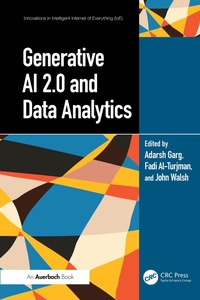
Generative AI 2.0 and Data Analytics
1st Edition
Will be published approx. on 23. June 2026
248 pages
978-1-040-67381-2 (ISBN)
Description

Data analytics and generative AI (GenAI) are transformative technologies that play a critical role in modern decision-making and innovation. Data analytics enables organizations to extract actionable insights from vast amounts of structured and unstructured data, driving efficiency, improving customer experiences, and identifying trends. Generative AI, on the other hand, enhances creativity and problem-solving by producing new content, such as text, images, and designs, based on learned patterns. Together, they empower people and organizations to make data-driven decisions, automate complex processes, and unlock new opportunities for growth and innovation.
Generative AI 2.0 and Data Analytics explores the intersection between GenAI and data analytics and addresses its profound effects on industries and organizations across the globe. Highlights of the book include:
Deep learning architectures for generative models in business data management
Optimizing human-AI collaboration for strategic decision-making in business practises
Benchmarking practices and evaluation metrics for generative AI in business data analytics
Not only covering the fundamental concepts and techniques of generative AI and their practical application, the book also investigates how these techniques foster innovation and improve the quality of data in various business domains. It examines a broad range of topics from artificial data generation, security analytics, anomaly detection, reinforcement management, ethical consideration, challenges, and future scenarios. The book also features expert opinions and case studies to provide practical direction and valuable insight.
Generative AI 2.0 and Data Analytics explores the intersection between GenAI and data analytics and addresses its profound effects on industries and organizations across the globe. Highlights of the book include:
Deep learning architectures for generative models in business data management
Optimizing human-AI collaboration for strategic decision-making in business practises
Benchmarking practices and evaluation metrics for generative AI in business data analytics
Not only covering the fundamental concepts and techniques of generative AI and their practical application, the book also investigates how these techniques foster innovation and improve the quality of data in various business domains. It examines a broad range of topics from artificial data generation, security analytics, anomaly detection, reinforcement management, ethical consideration, challenges, and future scenarios. The book also features expert opinions and case studies to provide practical direction and valuable insight.
More details
Series
Edition
1. Auflage
Language
English
Place of publication
London
United Kingdom
Publishing group
Taylor & Francis Ltd
Target group
College/higher education
Professional and scholarly
Product notice
Reflowable
Illustrations
45 Tables, black and white; 18 Line drawings, color; 4 Line drawings, black and white; 12 Halftones, color; 1 Halftones, black and white; 30 Illustrations, color; 5 Illustrations, black and white
File size
11,70 MB
ISBN-13
978-1-040-67381-2 (9781040673812)
Copyright in bibliographic data and cover images is held by Nielsen Book Services Limited or by the publishers or by their respective licensors: all rights reserved.
Schweitzer Classification
Other editions
Additional editions
Adarsh Garg | Fadi Al-Turjman | John Walsh
Generative AI 2.0 and Data Analytics
Book
approx. 06/2026
1st Edition
Auerbach
€197.50
Not yet published
Persons
A researcher and academician, Dr. Adarsh Garg has 24 years of teaching, research, consultancy, and administrative experience. She received her PhD degree in information technology from GGSIP University, Delhi. She is currently working as Professor of Data Analytics and IT at GL Bajaj Institute of Management and Research, Gautam Buddh Nagar, Greater Noida, and as a Visiting Professor at Delhi Technical University, Delhi. Prior to joining GLBIMR, she worked with organizations like Galgotias University, WIPRO Tech, GE, IMT Ghaziabad, and Punjabi University, Patiala. She is currently supervising eight PhDs. She has published more than 70 research papers and edited five books.
Dr. Fadi Al-Turjman received his Ph.D. in computer science from Queen's University, Canada, in 2011. He is a professor and the associate dean for research and the founding director of the International Research Center for AI and IoT at Near East University, Nicosia, Cyprus. Prof. Al-Turjman is the head of Artificial Intelligence Engineering Dept., and a leading authority in the areas of smart/intelligent IoT systems, wireless, and mobile networks' architectures, protocols, deployments, and performance evaluation in Artificial Intelligence of Things (AIoT).
Prof. John Walsh is the Associate Dean and Director, International College, Krirk University, Thailand. He received his doctorate from Oxford University in 1997 for a thesis concerning international market entry strategy and the success of UK firms in Korea, Japan and Taiwan. He has lived and worked in Sudan, Greece, Korea, Australia, the United Arab Emirates, Thailand and Vietnam, as well as his native UK. He has also taught courses at undergraduate, graduate and PhD level in a number of countries and led the campus at Mandalay and Kathmandu for a previous position, during which time he has taught courses in international business, marketing, management, entrepreneurialism, human resources, and finance.
Dr. Fadi Al-Turjman received his Ph.D. in computer science from Queen's University, Canada, in 2011. He is a professor and the associate dean for research and the founding director of the International Research Center for AI and IoT at Near East University, Nicosia, Cyprus. Prof. Al-Turjman is the head of Artificial Intelligence Engineering Dept., and a leading authority in the areas of smart/intelligent IoT systems, wireless, and mobile networks' architectures, protocols, deployments, and performance evaluation in Artificial Intelligence of Things (AIoT).
Prof. John Walsh is the Associate Dean and Director, International College, Krirk University, Thailand. He received his doctorate from Oxford University in 1997 for a thesis concerning international market entry strategy and the success of UK firms in Korea, Japan and Taiwan. He has lived and worked in Sudan, Greece, Korea, Australia, the United Arab Emirates, Thailand and Vietnam, as well as his native UK. He has also taught courses at undergraduate, graduate and PhD level in a number of countries and led the campus at Mandalay and Kathmandu for a previous position, during which time he has taught courses in international business, marketing, management, entrepreneurialism, human resources, and finance.
Content
1. Exploring Inventive Potential of Generative AI and the Next Generation: Theory and Techniques 2. AI In Education 3. Integrating Artificial Intelligence in K-12 Education: A Systematic Review of Strategies, Outcomes, and Applications (2021-2024) 4. Precise and Computation Efficient Face Recognition Based Real Time Attendance System 5. The Role of Chatbots in Student Interaction: EFL Speaking and Cognitive Load Theory Management 6. Where You Live Matters: Decoding the Geographic Factors Influencing Data Scientist Salaries Through Machine Learning 7. Perception of Fairness: The Role of Explainable and Trustworthy Artificial Intelligence 8. Prosthetic Hand with Expended Gestures Using Sequential Artificial Intelligence Models 9. Generative Adversarial Networks (GANs) for Brain Tumor Imaging Applications: A Systematic Review 10. Machine Learning and Deep Learning for Colon Cancer Classification with Gene Expression and Histological Image Datasets 11. Transfer Learning-Machine Learning Hybrid Approach for Binary Classification of Breast Cancer Using Bilateral Filtering 12. Analyzing the Agricultural as well as Environmental Data to Address Predicting the Crop Yields for Achieving Zero Hunger (UN SDG 2: Zero Hunger) 13. Smart Homes and Beyond: A Review of IoT Applications Transforming Daily Life 14. AI-Powered CrossFit Coach: Integrating Local Small Language Model and Geospatial Technology for Enhanced Fitness Training 15. Deep Learning Architectures for Generative Models in Business Data Management 16. Optimizing Human-AI Collaboration for Strategic Decision-Making in Business Practices 17. Benchmarking Practices and Evaluation Metrics for Generative AI in Business Data Analytics
