

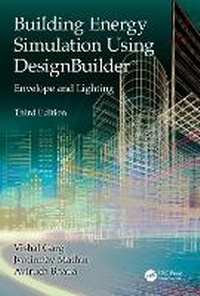
Building Energy Simulation Using DesignBuilder (TM)
Envelope and Lighting
3rd Edition
Will be published approx. on 30. October 2026
304 pages
E-Book
978-1-040-69181-6 (ISBN)
Description

Building Energy Simulation: A Workbook Using DesignBuilder is a comprehensive, tutorial-based training guide designed to teach energy simulation through hands-on practice. This first volume of the two-part series concentrates on fundamental building performance elements, including building envelope design, passive strategies like shading and insulation systems, cool and green roof technologies, and daylighting optimization. It also covers interior lighting simulation with advanced control strategies. A newly added chapter on Life Cycle Analysis (LCA) introduces a quantitative approach to sustainability strategy, supporting informed design decisions. LCA simulations are now also important in earning green building certification credits. The daylighting section has been enhanced to include dynamic shading for internal windows and spatial daylight autonomy (sDA) simulations.
Features:
Focuses on learning building energy simulation while being interactive through examples and exercises.
Explains the building physics and the science behind the energy performance of buildings.
Encourages an integrated design approach by explaining the interactions between various building systems and their effect on energy performance of building.
Discusses a how-to model for building energy code compliance.
Provides hands-on training of building energy simulation tools: DesignBuilder (TM) and EnergyPlus.
This book is intended for students and researchers in building energy courses, energy simulation professionals, and architects.
Features:
Focuses on learning building energy simulation while being interactive through examples and exercises.
Explains the building physics and the science behind the energy performance of buildings.
Encourages an integrated design approach by explaining the interactions between various building systems and their effect on energy performance of building.
Discusses a how-to model for building energy code compliance.
Provides hands-on training of building energy simulation tools: DesignBuilder (TM) and EnergyPlus.
This book is intended for students and researchers in building energy courses, energy simulation professionals, and architects.
More details
Edition
3rd edition
Language
English
Place of publication
London
United Kingdom
Publishing group
Taylor & Francis Ltd
Target group
College/higher education
Professional and scholarly
Product notice
Reflowable
Illustrations
104 Tables, black and white; 43 Line drawings, black and white; 507 Halftones, black and white; 550 Illustrations, black and white
ISBN-13
978-1-040-69181-6 (9781040691816)
Copyright in bibliographic data and cover images is held by Nielsen Book Services Limited or by the publishers or by their respective licensors: all rights reserved.
Schweitzer Classification
Other editions
Additional editions
Vishal Garg | Jyotirmay Mathur | Aviruch Bhatia
Building Energy Simulation Using DesignBuilder (TM)
Envelope and Lighting
Book
approx. 10/2026
3rd Edition
CRC Press
€339.50
Not yet published
Vishal Garg | Jyotirmay Mathur | Aviruch Bhatia
Building Energy Simulation Using DesignBuilder (TM)
Envelope and Lighting
Book
approx. 10/2026
3rd Edition
CRC Press
€148.50
Not yet published
Persons
Vishal Garg is the University Chair Professor and Director of the Indorama Ventures Center for Clean Energy at Plaksha University. His research interests are in the areas of building energy simulations, smart energy homes, and cool roofs. He was awarded the inaugural Dr. Arthur Rosenfeld Urban Cooling Achievement Award and is a Fellow of the International Building Performance Simulation Association (IBPSA). He holds a Bachelor of Civil Engineering from MBM Engineering College, Jodhpur, and a Ph.D. from IIT Delhi.
Jyotirmay Mathur is a professor of mechanical engineering and the founding head of the Centre for Energy and Environment at Malaviya National Institute of Technology, Jaipur, India. He has done postgraduate work in energy studies at the Indian Institute of Technology, Delhi, India, and has received a doctorate in energy systems from the University of Essen, Germany. Dr. Mathur has published 100 research papers in refereed international journals and has presented more than 160 papers and talks at international seminars and conferences, besides writing five books. Dr. Mathur works in the field of energy modelling, codes and standards, energy conservation in buildings, passive cooling, adaptive thermal comfort and building integrated photovoltaic systems.
Aviruch Bhatia is a senior research scientist at Plaksha University, Mohali, India. Before joining Plaksha, he served as an Assistant Professor at the TERI School of Advanced Studies in New Delhi. He holds a PhD from the International Institute of Information Technology, Hyderabad. His research interests lie at the intersection of building physics, building performance simulation and analysis, and sustainable architecture. Earlier in his career, he worked for three years as an Assistant Manager with the Sustainability Group at Spectral Consultants Pvt. Ltd. (an AECOM company), where he was involved in a range of green building projects.
Jyotirmay Mathur is a professor of mechanical engineering and the founding head of the Centre for Energy and Environment at Malaviya National Institute of Technology, Jaipur, India. He has done postgraduate work in energy studies at the Indian Institute of Technology, Delhi, India, and has received a doctorate in energy systems from the University of Essen, Germany. Dr. Mathur has published 100 research papers in refereed international journals and has presented more than 160 papers and talks at international seminars and conferences, besides writing five books. Dr. Mathur works in the field of energy modelling, codes and standards, energy conservation in buildings, passive cooling, adaptive thermal comfort and building integrated photovoltaic systems.
Aviruch Bhatia is a senior research scientist at Plaksha University, Mohali, India. Before joining Plaksha, he served as an Assistant Professor at the TERI School of Advanced Studies in New Delhi. He holds a PhD from the International Institute of Information Technology, Hyderabad. His research interests lie at the intersection of building physics, building performance simulation and analysis, and sustainable architecture. Earlier in his career, he worked for three years as an Assistant Manager with the Sustainability Group at Spectral Consultants Pvt. Ltd. (an AECOM company), where he was involved in a range of green building projects.
Content
Chapter 1 Getting Started with Energy Simulation
Chapter 2 Geometry of Buildings
Chapter 3 Material and Construction
Chapter 4 Openings and Shading
Chapter 5 Lighting and Controls
Chapter 6 Natural Ventilation
Chapter 7 Building Energy Code Compliance
Chapter 8 Life Cycle Analysis
Chapter 2 Geometry of Buildings
Chapter 3 Material and Construction
Chapter 4 Openings and Shading
Chapter 5 Lighting and Controls
Chapter 6 Natural Ventilation
Chapter 7 Building Energy Code Compliance
Chapter 8 Life Cycle Analysis
