

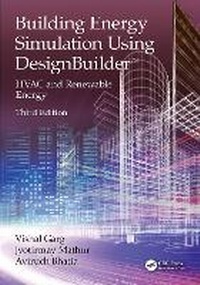
Building Energy Simulation Using DesignBuilder (TM)
HVAC and Renewable Energy
3rd Edition
Will be published approx. on 31. August 2026
320 pages
E-Book
978-1-040-69069-7 (ISBN)
Description

Building Energy Simulation: A Workbook Using DesignBuilder concludes with this second volume of the comprehensive, tutorial-based energy simulation training series. This advanced volume focuses on mechanical systems and economic analysis, covering air-conditioning design, photovoltaic integration, and project costing methodologies. It includes topics on simulating HVAC components such as chillers, boilers, air handling units, heat recovery systems, and HVAC controls. This volume also addresses advanced topics like integrating thermal storage for demand response, renewable energy integration, cost-benefit evaluations, sensitivity and uncertainty analysis.
Features:
Focuses on learning building energy simulation while being interactive through examples and exercises.
Explains the building physics and the science behind the energy performance of buildings.
Encourages an integrated design approach by explaining the interactions between various building systems and their effect on energy performance of building.
Discusses a how-to model for building energy code compliance.
Provides hands-on training of building energy simulation tools: DesignBuilder (TM) and EnergyPlus.
This book is intended for students and researchers in building energy courses, energy simulation professionals, and architects.
Features:
Focuses on learning building energy simulation while being interactive through examples and exercises.
Explains the building physics and the science behind the energy performance of buildings.
Encourages an integrated design approach by explaining the interactions between various building systems and their effect on energy performance of building.
Discusses a how-to model for building energy code compliance.
Provides hands-on training of building energy simulation tools: DesignBuilder (TM) and EnergyPlus.
This book is intended for students and researchers in building energy courses, energy simulation professionals, and architects.
More details
Edition
3rd edition
Language
English
Place of publication
London
United Kingdom
Publishing group
Taylor & Francis Ltd
Target group
College/higher education
Professional and scholarly
Product notice
Reflowable
Illustrations
139 Tables, black and white; 54 Line drawings, black and white; 545 Halftones, black and white; 599 Illustrations, black and white
ISBN-13
978-1-040-69069-7 (9781040690697)
Copyright in bibliographic data and cover images is held by Nielsen Book Services Limited or by the publishers or by their respective licensors: all rights reserved.
Schweitzer Classification
Other editions
Additional editions
Vishal Garg | Jyotirmay Mathur | Aviruch Bhatia
Building Energy Simulation Using DesignBuilder (TM)
HVAC and Renewable Energy
Book
approx. 08/2026
3rd Edition
CRC Press
€339.50
Not yet published
Vishal Garg | Jyotirmay Mathur | Aviruch Bhatia
Building Energy Simulation Using DesignBuilder (TM)
HVAC and Renewable Energy
Book
approx. 08/2026
3rd Edition
CRC Press
€148.50
Not yet published
Persons
Vishal Garg is Associate Professor and Head, Center for IT in Building Science at IIIT Hyderabad. His current research interests are in the areas of energy simulation and cool roofs. He teaches Building Automation & Controls, Green Buildings, Energy Simulation and Lighting Design & Technology. He has conducted several national and international workshops on Intelligent Buildings, Green Buildings and Energy Simulation. He holds a B.Tech. (Hons.) degree in Civil Engineering from MBM Engineering College, Jodhpur and a Ph.D. from the IIT Delhi. Dr. Garg is actively involved with green building movement, development of e-tools and educational platforms for advancing energy efficiency in buildings, energy efficiency building code and its implementation. He was the founding present for Indian chapter of International Building Performance Simulation Association (IBPSA) and currently chairing the organizing committee of international conference for Building Simulation -2015.
Dr.-Ing. Jyotirmay Mathur is the Professor in Mechanical Engineering and Head of Centre for Energy and Environment at Malaviya National Institute of Technology, Jaipur (India). He has done post-graduation in energy studies from the Indian Institute of Technology, New Delhi (India) and doctorate in energy systems from University of Essen (Germany). Dr. Mathur has published 52 research papers in referred international journals and has presented more than 100 papers/talks international seminars/conference, besides authoring 5 books. Dr. Mathur works in the field of energy modeling, codes and standards, energy conservation in buildings, passive cooling, adaptive thermal comfort and building integrated Photovoltaic systems.
Aviruch Bhatia is an Energy Engineer. He is currently pursuing his Ph.D. from International Institute of Information Technology - Hyderabad. He holds a M.Tech. in Energy Engineering from Malaviya National Institute of Information Technology, Jaipur and M.Sc. and M.Phil. in Physics from University of Rajasthan. His area of interest lies in the field of building physics, calibrated energy simulation and fault detection and diagnostics HVAC systems. Prior to joining IIITH, he worked for three years as Assistant Manager at Sustainability Group of Spectral Consultant Pvt. Ltd. (An AECOM Company)
Dr.-Ing. Jyotirmay Mathur is the Professor in Mechanical Engineering and Head of Centre for Energy and Environment at Malaviya National Institute of Technology, Jaipur (India). He has done post-graduation in energy studies from the Indian Institute of Technology, New Delhi (India) and doctorate in energy systems from University of Essen (Germany). Dr. Mathur has published 52 research papers in referred international journals and has presented more than 100 papers/talks international seminars/conference, besides authoring 5 books. Dr. Mathur works in the field of energy modeling, codes and standards, energy conservation in buildings, passive cooling, adaptive thermal comfort and building integrated Photovoltaic systems.
Aviruch Bhatia is an Energy Engineer. He is currently pursuing his Ph.D. from International Institute of Information Technology - Hyderabad. He holds a M.Tech. in Energy Engineering from Malaviya National Institute of Information Technology, Jaipur and M.Sc. and M.Phil. in Physics from University of Rajasthan. His area of interest lies in the field of building physics, calibrated energy simulation and fault detection and diagnostics HVAC systems. Prior to joining IIITH, he worked for three years as Assistant Manager at Sustainability Group of Spectral Consultant Pvt. Ltd. (An AECOM Company)
Content
1. Heating and Cooling Design 2. Unitary HVAC Systems 3. Heating, Ventilation and Air Conditioning: Central Water Side 4. Heating, Ventilation and Air Conditioning: Central Air Side 5. Renewable Energy System 6. Costing, Sensitivity and Uncertainty Analysis 7. Building Energy Code Compliance (HVAC) 8. Simulation Parameters 9. Simulation projects. Project Files. Appendices
