

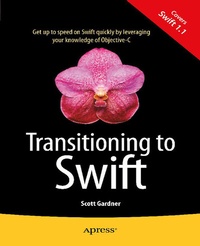
Transitioning to Swift
Description

Developing apps for Apple's broadening platform of devices is an exciting topic these days. Apple created the Swift programming language to build state-of-the-art apps using the latest Apple technologies.
In this 200-page book, author Scott Gardner articulates the similarities and differences between traditional Objective-C based programming and Swift, revealing what you need to know from syntax changes to emerging best practices and paradigm shifts, to write powerful, expressive, and flexible code in Swift.
Written at a brisk pace and in a methodical style, you'll learn how to apply your Objective-C skills to successfully transition to programming in Swift.
In this book, you'll learn:
What is Swift and how does it compare to Objective-C
How to become proficient in Swift by leveraging your existing Objective-C skills
How to take advantage of new capabilities in Swift
What are the emerging best practices in Swift programming
Transitioning to Swift reaches out to all developers who are interested in creating state-of-the-art apps for Apple's broadening platform of devices for both consumers and enterprise. Apple's introduction of the new Swift programming language raises many questions. This book addresses those questions directly, and prepares developers for building the next generation of apps in Swift to surprise and delight users the world over.
More details
Other editions
Additional editions
Person
Content
1. Getting Started
2. Declaring Variables and Constants
3. Working with Strings and Collections
4. Performing Operations
5. Controlling Program Flow
6. Creating Functions
7. Constructing Classes, Structures, and Enumerations
8. Defining and Adopting Protocols
9. Subclassing and Extending
10. Controlling Access
11. Programming in Generics
