

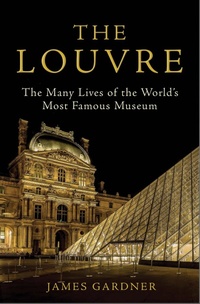
The Louvre
The Many Lives of the World's Most Famous Museum
Published on 7. May 2020
416 pages
978-1-61185-476-3 (ISBN)
Description

Almost nine million people from all over the world flock to the Louvre in Paris every year to see its incomparable art collection. Yet few, if any, are aware of the remarkable history of that location and of the buildings themselves, and how they chronicle the history of Paris itself-a fascinating story that historian James Gardner elegantly tells for the first time.
Before the Louvre was a museum, it was a palace, and before that a fortress. But much earlier still, it was a place called le Louvre for reasons unknown. People had inhabited that spot for more than 6,000 years before King Philippe Auguste of France constructed a fortress there in 1191 to protect against English soldiers stationed in Normandy. Two centuries later, Charles V converted the fortress to one of his numerous royal palaces. After Louis XIV moved the royal residence to Versailles in 1682, the Louvre inherited the royal art collection, which then included the Mona Lisa, given to Francis by Leonardo da Vinci; just over a century later, during the French Revolution, the National Assembly established the Louvre as a museum to display the nation's treasures. Subsequent leaders of France, from Napoleon to Napoleon III to Francois Mitterand, put their stamp on the museum, expanding it into the extraordinary institution it has become.
With expert detail and keen admiration, James Gardner links the Louvre's past to its glorious present, and vibrantly portrays how it has been a witness to French history - through the Napoleonic era, the Commune, two World Wars, to this day - and home to a legendary collection whose diverse origins and back stories create a spectacular narrative that rivals the building's legendary stature.
Before the Louvre was a museum, it was a palace, and before that a fortress. But much earlier still, it was a place called le Louvre for reasons unknown. People had inhabited that spot for more than 6,000 years before King Philippe Auguste of France constructed a fortress there in 1191 to protect against English soldiers stationed in Normandy. Two centuries later, Charles V converted the fortress to one of his numerous royal palaces. After Louis XIV moved the royal residence to Versailles in 1682, the Louvre inherited the royal art collection, which then included the Mona Lisa, given to Francis by Leonardo da Vinci; just over a century later, during the French Revolution, the National Assembly established the Louvre as a museum to display the nation's treasures. Subsequent leaders of France, from Napoleon to Napoleon III to Francois Mitterand, put their stamp on the museum, expanding it into the extraordinary institution it has become.
With expert detail and keen admiration, James Gardner links the Louvre's past to its glorious present, and vibrantly portrays how it has been a witness to French history - through the Napoleonic era, the Commune, two World Wars, to this day - and home to a legendary collection whose diverse origins and back stories create a spectacular narrative that rivals the building's legendary stature.
Reviews / Votes
In his fluent and fact-rich account of the building's many stages James Gardner...deftly combines the niceties of bricks, mortar and changing architectural styles with telling anecdotes and the broader historical context...with his eye for colour as well as architectural detail * Sunday Times * In his courageous and erudite new book, critic James Gardner is bold to take in, and take on, what few mortals have the chance or the stamina to do. Think of reading this book as the full experience you are temporarily denied today, or may never have had the energy to undertake. . .Open the book and enjoy the visit. * Washington Post * Mysterious in effect, the Louvre is delightfully mysterious in history, too, as James Gardner shows in The Louvre . . . Gardner's muscular, impatiently expert prose recalls Robert Hughes in his city books. -- Adam Gopnik * The New Yorker * I hadn't realized just how mythically resonant a museum could be until I read James Gardner's eloquent encomium to the Louvre . . . This history is told with all the great verve, insight, and eye for detail that Mr. Gardner's criticism is noted for . . . [His] passion also invites us to share his affection - and to plan a visit. * Wall Street Journal * With its fast-moving and rich narrative, this truly excellent book needed to be written: the fascinating and turbulent story of the Louvre as a royal palace has been largely eclipsed by its much shorter and more famous life as a museum. Here both parts of its long history have been splendidly recounted. -- Philippe de Montebello, Director Emeritus, The Metropolitan Museum of Art The perfect balance of architectural and social history, full of fascinating and unexpected detail, and salted with delightfully sly wit. -- Jacky Colliss Harvey, author of RED: A Natural History of the Redhead James Gardner makes the walls talk. He traces the many metamorphoses of the Louvre, revealing how from its humble origins as a fortress it has come to occupy the heart of Paris and the centre of French - and indeed world - culture. His remarkable achievement is to show us how the building is every bit as spectacular and as fascinating as the treasures it holds. -- Ross King, author of BRUNELLESCHI'S DOMEMore details
Edition
Main
Language
English
Place of publication
New York
United States
Illustrations
1x8pp colour plates
File size
14,14 MB
ISBN-13
978-1-61185-476-3 (9781611854763)
Copyright in bibliographic data and cover images is held by Nielsen Book Services Limited or by the publishers or by their respective licensors: all rights reserved.
Schweitzer Classification
Other editions
Additional editions
Book
11/2021
Grove Press / Atlantic Monthly Press
€16.50
Shipment within 3-4 weeks
Book
05/2020
Grove Press / Atlantic Monthly Press
€44.80
Article exhausted; check different version
Person
James Gardner is an art historian and art critic at the Weekly Standard. He has written regularly on Old Master Painting for the Wall Street Journal and Antiques magazine, where he is a contributing editor. He has been architecture critic for the New York Observer and New York Sun.
Content
1: The Origins of the Louvre 2: The Louvre in the Renaissance 3: The Louvre of the Early Bourbons 4: The Louvre and the Sun King 5: The Louvre Abandoned 6: The Louvre and Napoleon 7: The Louvre under the Restoration 8: The Nouveau Louvre of Napoleon III 9: The Louvre in Modern Times 10: The Creation of the Contemporary Louvre
