

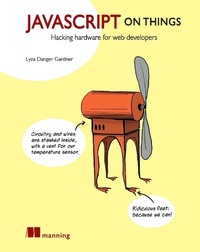
JavaScript on Things
Hacking hardware for web developers
1st Edition
Published on 22. February 2018
448 pages
978-1-63835-587-8 (ISBN)
Description

Summary
JavaScript on Things is your first step into the exciting and downright entertaining world of programming for small electronics. If you know enough JavaScript to hack a website together, you'll be making things go bleep, blink, and spin faster than you can say "nodebot."
Purchase of the print book includes a free eBook in PDF, Kindle, and ePub formats from Manning Publications.
About the Technology
Are you ready to make things move? If you can build a web app, you can create robots, weather stations, and other funky gadgets! In this incredibly fun, project-based guide, JavaScript hardware hacker Lyza Danger Gardner takes you on an incredible journey from your first flashing LED through atmospheric sensors, motorized rovers, Bluetooth doorbells, and more. With JavaScript, some easy-to-get hardware, and a bit of creativity, you'll be beeping, spinning, and glowing in no time.
About the Book
JavaScript on Things introduces the exciting world of programming small electronics! You'll start building things immediately, beginning with basic blinking on Arduino. This fully illustrated, hands-on book surveys JavaScript toolkits like Johnny-Five along with platforms including Raspberry Pi, Tessel, and BeagleBone. As you build project after interesting project, you'll learn to wire in sensors, hook up motors, transmit data, and handle user input. So be warned: once you start, you won't want to stop.
What's Inside
About the Reader
Written for readers with intermediate JavaScript and Node.js skills. No experience with electronics required.
About the Author
Lyza Danger Gardner has been a web developer for over 20 years. She's part of the NodeBots community and a contributor to the Johnny-Five Node.js library.
Table of Contents
JavaScript on Things is your first step into the exciting and downright entertaining world of programming for small electronics. If you know enough JavaScript to hack a website together, you'll be making things go bleep, blink, and spin faster than you can say "nodebot."
Purchase of the print book includes a free eBook in PDF, Kindle, and ePub formats from Manning Publications.
About the Technology
Are you ready to make things move? If you can build a web app, you can create robots, weather stations, and other funky gadgets! In this incredibly fun, project-based guide, JavaScript hardware hacker Lyza Danger Gardner takes you on an incredible journey from your first flashing LED through atmospheric sensors, motorized rovers, Bluetooth doorbells, and more. With JavaScript, some easy-to-get hardware, and a bit of creativity, you'll be beeping, spinning, and glowing in no time.
About the Book
JavaScript on Things introduces the exciting world of programming small electronics! You'll start building things immediately, beginning with basic blinking on Arduino. This fully illustrated, hands-on book surveys JavaScript toolkits like Johnny-Five along with platforms including Raspberry Pi, Tessel, and BeagleBone. As you build project after interesting project, you'll learn to wire in sensors, hook up motors, transmit data, and handle user input. So be warned: once you start, you won't want to stop.
What's Inside
- Controlling hardware with JavaScripti
- Designing and assembling robots and gadgets
- A crash course in electronics
- Over a dozen hands-on projects!
About the Reader
Written for readers with intermediate JavaScript and Node.js skills. No experience with electronics required.
About the Author
Lyza Danger Gardner has been a web developer for over 20 years. She's part of the NodeBots community and a contributor to the Johnny-Five Node.js library.
Table of Contents
PART 1 - A JAVASCRIPTER'S INTRODUCTION TO HARDWARE
- Bringing JavaScript and hardware together
- Embarking on hardware with Arduino
- How to build circuits
PART 2 - PROJECT BASICS: INPUT AND OUTPUT WITH JOHNNY-FIVE
- Sensors and input
- Output: making things happen
- Output: making things move
PART 3 - MORE SOPHISTICATED PROJECTS
- Serial communication
- Projects without wires
- Building your own thing
PART 4 - USING JAVASCRIPT WITH HARDWARE IN OTHER ENVIRONMENTS
- JavaScript and constrained hardware
- Building with Node.js and tiny computers
- In the cloud, in the browser, and beyond
More details
Other editions
Additional editions
Book
06/2018
Manning Publications
€37.50
Shipment within 10-20 days
Person
Lyza Danger Gardner has been a web developer for over 20 years. She's part of the NodeBots community and a contributor to the Johnny-Five Node.js library.
Content
- Intro
- Copyright
- Brief Table of Contents
- Table of Contents
- Preface
- Acknowledgments
- About this Book
- Part 1. A JavaScripter's introduction to hardware
- Chapter 1. Bringing JavaScript and hardware together
- Chapter 2. Embarking on hardware with Arduino
- Chapter 3. How to build circuits
- Part 2. Project basics: input and output with Johnny-Five
- Chapter 4. Sensors and input
- Chapter 5. Output: making things happen
- Chapter 6. Output: making things move
- Part 3. More sophisticated projects
- Chapter 7. Serial communication
- Chapter 8. Projects without wires
- Chapter 9. Building your own thing
- Part 4. Using JavaScript with hardware in other environments
- Chapter 10. JavaScript and constrained hardware
- Chapter 11. Building with Node.js and tiny computers
- Chapter 12. In the cloud, in the browser, and beyond
- Index
- List of Figures
- List of Tables
- List of Listings
