

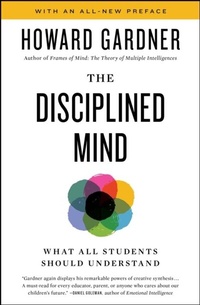
Disciplined Mind
What All Students Should Understand
1st Edition
Published on 26. January 2021
288 pages
978-1-9821-7695-2 (ISBN)
Description

This brilliant and revolutionary theory of multiple intelligences reexamines the goals of education to support a more educated society for future generations.
Howard Gardner's concept of multiple intelligences has been hailed as perhaps the most profound insight into education since the work of Jerome Bruner, Jean Piaget, and even John Dewey. Here, in The Disciplined Mind, Garner pulls together the threads of his previous works and looks beyond such issues as charters, vouchers, unions, and affirmative action in order to explore the larger questions of what constitutes an educated person and how this can be achieved for all students. Gardner eloquently argues that the purpose of K?12 education should be to enhance students' deep understanding of the truth (and falsity), beauty (and ugliness), and goodness (and evil) as defined by their various cultures.
By exploring the theory of evolution, the music of Mozart, and the lessons of the Holocaust as a set of examples that illuminates the nature of truth, beauty, and morality, The Disciplined Mind envisions how younger generations will rise to the challenges of the future?while preserving the traditional goals of a "humane" education. Gardner's ultimate goal is the creation of an educated generation that understands the physical, biological, and societal world in their own personal context as well as in a broader world view.
But even as Gardner persuasively argues the merits of his approach, he recognizes the difficulty of developing one universal, ideal form of education. In an effort to reconcile conflicting educational viewpoints, he proposes the creation of six different educational pathways that, when taken together, can satisfy people's concern for student learning and their widely divergent views about knowledge and understanding overall.
Howard Gardner's concept of multiple intelligences has been hailed as perhaps the most profound insight into education since the work of Jerome Bruner, Jean Piaget, and even John Dewey. Here, in The Disciplined Mind, Garner pulls together the threads of his previous works and looks beyond such issues as charters, vouchers, unions, and affirmative action in order to explore the larger questions of what constitutes an educated person and how this can be achieved for all students. Gardner eloquently argues that the purpose of K?12 education should be to enhance students' deep understanding of the truth (and falsity), beauty (and ugliness), and goodness (and evil) as defined by their various cultures.
By exploring the theory of evolution, the music of Mozart, and the lessons of the Holocaust as a set of examples that illuminates the nature of truth, beauty, and morality, The Disciplined Mind envisions how younger generations will rise to the challenges of the future?while preserving the traditional goals of a "humane" education. Gardner's ultimate goal is the creation of an educated generation that understands the physical, biological, and societal world in their own personal context as well as in a broader world view.
But even as Gardner persuasively argues the merits of his approach, he recognizes the difficulty of developing one universal, ideal form of education. In an effort to reconcile conflicting educational viewpoints, he proposes the creation of six different educational pathways that, when taken together, can satisfy people's concern for student learning and their widely divergent views about knowledge and understanding overall.
More details
Other editions
Additional editions
Book
01/2021
Simon & Schuster
€25.50
Shipment within 10-20 days
Person
Howard Gardner is the John H. and Elisabeth A. Hobbs Professor of Cognition and Education at the Harvard Graduate School of Education and Senior Director of Harvard Project Zero. Among numerous honors, Gardner received a MacArthur Prize Fellowship in 1981. In 2005 and again in 2008, he was selected by Foreign Policy and The American Prospect magazines as one of the 100 most influential public intellectuals in the world. Most recently, Gardner received the 2011 Prince of Asturias Award for Social Sciences. The author of twenty-eight books translated into thirty-two languages, and several hundred articles, Gardner is best known in educational circles for his theory of multiple intelligences, a critique of the notion that there exists but a single human intelligence that can be adequately assessed by standard psychometric instruments.
Content
- Intro
- Title Page
- Dedication
- Acknowledgments
- Preface
- Chapter 1: A Personal Introduction: An Education for all Human Beings
- From the Parochial to the Universal
- An Uncluttered Perspective: The True, the Beautiful, and the Good
- About this Book
- Signposts
- Chapter 2: Educational Constants
- An Educational Montage: The Transmission of Roles and Values
- Formal Schooling: Mastering Notations and Disciplines in a Remote Setting
- A Virtue-Filled Education in the Disciplines
- Perennial Choices
- Chapter 3: Education in the Future
- An Understandably Conservative Institution
- Six Forces That Will Remake Schools
- An Educational Crossroad
- Chapter 4: Perspectives of Mind and Brain
- Scientific Knowledge and Value Judgments
- In Olden Days: Inborn Traits and Well-Shaped Behaviors
- The Cognitive Revolution
- From the Study of the Mind to the Study of the Brain
- Education and the Brain
- The Considerable Distance Between Science and Practice
- Chapter 5: How Cultures Educate
- The Best Preschools in the World
- The Cultural Turn
- Insights from Studies of Culture
- The Cultural Perspective Applied to Education
- Beyond Reggio: Other Effective Schools
- Preschools
- Primary Schools
- Secondary Schools
- A School Vision
- Chapter 6: Designing Education for Understanding
- A Classroom Perspective
- False Starts
- Teaching for Understanding: A Formal Introduction
- Difficulties of Understanding
- Obstacles to Understanding
- Disciplinary Expertise
- Four Approaches to Understanding
- Other Players
- Chapter 7: Disciplined Approaches
- Three Puzzles
- Vantage Points: From Puzzles to Concepts
- The Disciplines. and Beyond
- The Patterns of the Scientist. and the Mathematician
- The Beauty of the Artist
- The Accounts of the Historian
- In the Shopping Mall of the Disciplines
- Chapter 8: Close Looks
- Exploring Three Icebergs
- Evolution
- The Music of Mozart
- The Holocaust
- Aliments for Informed Citizens
- Chapter 9: "Multiple Intelligences" Approaches to Understanding
- Three Uses of Intelligences
- Multiple Entry Points to Rich Topics
- Powerful Analogies and Metaphors
- Multiple Representations of the Core Ideas: Introducing the "Model Language"
- Remaining Issues
- Orchestrating the Three Approaches
- The Rest of the Curriculum: Possibilities and Limits
- Chapter 10: Getting There
- A Tale of Two Scripts
- A K-12 Pathway to Understanding
- The Power and the Perils of Disciplinary and Interdisciplinary Study
- A National Standard or National Standards?
- Multiple Pathways
- Unum Out of Pluribus?
- Leadership Challenges
- Battle Scars and Occasional Medals
- "Scaling Up": Three Helpful Ingredients
- The Roles of Business
- Finding an Appropriate Niche
- Chapter 11: In Closing
- One Hundred Years of Education. and of World History
- Once More, My Vision
- A World Worth Striving For
- Connecting
- Appendix: "The Trio of Colliding Agendas"
- About the Author
- References
- Name Index
- Subject Index
- Copyright
