

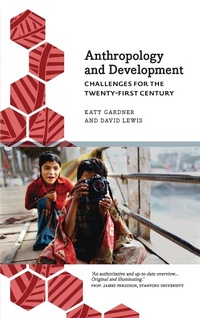
Anthropology and Development
Challenges for the Twenty-First Century
2nd Edition
Published on 20. February 2015
240 pages
978-1-78371-276-2 (ISBN)
Description

Western aid is in decline. Non-traditional development actors from the developing countries and elsewhere are in the ascendant. A new set of global economic and political processes are shaping the twenty-first century.
This book engages with nearly two decades of continuity and change in the development industry. In particular, it argues that while the world of international development has expanded since the 1990s, it has become more rigidly technocratic. The authors insist on a focus upon the core anthropological issues surrounding poverty and inequality, and thus sharply criticise what are perceived as problems in the field.
Anthropology and Development is a completely rewritten edition of the best-selling and critically acclaimed Anthropology, Development and the Post-Modern Challenge (1996). It serves as both an innovative reformulation of the field, as well as a textbook for many undergraduate and graduate courses at leading international universities.
This book engages with nearly two decades of continuity and change in the development industry. In particular, it argues that while the world of international development has expanded since the 1990s, it has become more rigidly technocratic. The authors insist on a focus upon the core anthropological issues surrounding poverty and inequality, and thus sharply criticise what are perceived as problems in the field.
Anthropology and Development is a completely rewritten edition of the best-selling and critically acclaimed Anthropology, Development and the Post-Modern Challenge (1996). It serves as both an innovative reformulation of the field, as well as a textbook for many undergraduate and graduate courses at leading international universities.
Reviews / Votes
'Ameliorates the despair which students of development often feel once they come to understand the complexity, and the vested interests, of the aid industry' -- LSE Magazine 'An authoritative and up to date overview that combines accurate and insightful overviews of the major contributions in the field with their own original and illuminating arguments' -- Professor James Ferguson, Department of Anthropology, Stanford University 'Essential reading for all involved with anthropology or development - and essential proof that they should engage their perspectives with each other more deeply and more often' -- Professor Melissa Leach, Anthropologist and Director, Institute of Development Studies 'The already impressive state of arts of the first book has been extended to most of the rapidly expanding literature of the last twenty years. This book is essential for anyone interested by debates concerning the relation between anthropology and development' -- Jean-Pierre Olivier de Sardan, Professor of Anthropology at the Ecole des Hautes Etudes en Sciences Sociales, Marseilles 'This carefully reworked volume by two of development's most accomplished scholars reinvigorates, like no other treatise in the field, the connection between research, critique, and action in inspired and practical ways' -- Arturo Escobar, Kenan Distinguished Professor of Anthropology, University of North Carolina, Chapel Hill 'A valuable addition to the history and heritage of anthropologyof/in development' -- Community Development JournalMore details
Series
Edition
Second Edition
Language
English
Place of publication
London
United Kingdom
Target group
Professional and scholarly
Edition type
New edition
Illustrations
1 b&w figure
File size
0,68 MB
ISBN-13
978-1-78371-276-2 (9781783712762)
Copyright in bibliographic data and cover images is held by Nielsen Book Services Limited or by the publishers or by their respective licensors: all rights reserved.
Schweitzer Classification
Other editions
Additional editions

Book
02/2015
2nd Edition
Pluto Press
€118.00
Article not available at the moment
Book
02/2015
2nd Edition
Pluto Press
€41.10
Shipment within 10-20 days
Persons
Katy Gardner is Professor of Anthropology at the London School of Economics and the author of Global Migrants, Local Lives (Oxford University Press, 1995), Discordant Development (Pluto, 2012) and Anthropology and Development (Pluto, 2015).
David Lewis is Professor of Social Policy and Development in the Department of Social Policy, London School of Economics. He is the author of Bangladesh: Politics, Economy and Civil Society (CUP, 2012), co-author of Anthropology and Development (Pluto, 2015) and co-editor of The Aid Effect (Pluto, 2005).
David Lewis is Professor of Social Policy and Development in the Department of Social Policy, London School of Economics. He is the author of Bangladesh: Politics, Economy and Civil Society (CUP, 2012), co-author of Anthropology and Development (Pluto, 2015) and co-editor of The Aid Effect (Pluto, 2005).
Content
Series Preface
Preface
Acknowledgements
Glossary
Acronyms
Prelude: Development, Post-Development and More Development?
1. Understanding Development: Theory and Practice into the Twenty-First Century
2. Applying Anthropology
3. The Anthropology of Development
4. Anthropologists in Development: Access, Effects and Control
5. When Good Ideas Turn Bad: The Dominant Discourse Bites Back
Conclusion: Anthropology, Development and Twenty-First Century Challenges
Notes
Bibliography
Index
Preface
Acknowledgements
Glossary
Acronyms
Prelude: Development, Post-Development and More Development?
1. Understanding Development: Theory and Practice into the Twenty-First Century
2. Applying Anthropology
3. The Anthropology of Development
4. Anthropologists in Development: Access, Effects and Control
5. When Good Ideas Turn Bad: The Dominant Discourse Bites Back
Conclusion: Anthropology, Development and Twenty-First Century Challenges
Notes
Bibliography
Index
