

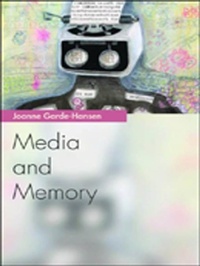
Media and Memory
Description

How do we rely on media for remembering?
In exploring the complex ways that media converge to support our desire to capture, store and retrieve memories, this textbook offers analyses of representations of memorable events, media tools for remembering and forgetting, media technologies for archiving and the role of media producers in making memories.
Theories of memory and media are covered alongside an accessible range of case studies focusing on memory in relation to radio, television, pop music, celebrity, digital media and mobile phones. Ethnographic and production culture research, including interviews with members of the public and industry professionals, is also included.
Offering a comprehensive introduction to the connections and disconnections in the study of media and memory, this is the perfect textbook for media studies students.
Key Features
- Presents a thorough and detailed overview of key writers, theories and debates
- Case studies enrich the text, offering innovative approaches and insights on methodology
- Covers a range of ''old'' and ''new'' media including radio, television, film, photography, digital media, mobile phones and popular music
- Explores discourses, forms and practices of media and memory with active learning exercises that engage readers
More details
Other editions
Additional editions
Content
- Cover
- Copyright
- Contents
- Acknowledgements
- Preface
- Introduction: Mediating the Past
- Part 1 Theoretical Background
- 1 Memory Studies and Media Studies
- 2 Personal, Collective, Mediated and New Memory Discourses
- 3 Using Media to Make Memories: Institutions, Forms and Practices
- 4 Digital Memories: The Democratisation of Archives
- Part 2 Case Studies
- 5 Voicing the Past: BBC Radio 4 and the Aberfan Disaster of 1963
- 6 (Re)Media Events: Remixing War on YouTube
- 7 The Madonna Archive: Celebrity, Ageing and Fan Nostalgia
- 8 Towards a Concept of Connected Memory: The Photo Album Goes Mobile
- Bibliography
- Index
