

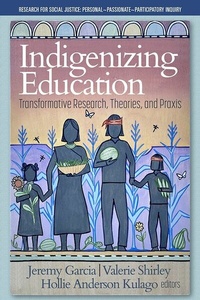
Indigenizing Education
Transformative Research, Theories, and Praxis
1st Edition
Published on 15. January 2022
341 pages
978-1-64802-692-8 (ISBN)
Description

Indigenizing Education: Transformative Research, Theories, and Praxis brings various scholars, educators, and community voices together in ways that reimagines and recenters learning processes that embody Indigenous education rooted in critical Indigenous theories and pedagogies. The contributing scholar-educators speak to the resilience and strength embedded in Indigenous knowledges and highlight the intersection between research, theories, and praxis in Indigenous education. Each of the contributors share ways they engaged in transformative praxis by activating a critical Indigenous consciousness with diverse Indigenous youth, educators, families, and community members. The authors provide pathways to reconceptualize and sustain goals to activate agency, social change, and advocacy with and for Indigenous peoples as they enact sovereignty, selfeducation, and Native nation-building.
The chapters are organized across four sections, entitled Indigenizing Curriculum and Pedagogy, Revitalizing and Sustaining Indigenous Languages, Engaging Families and Communities in Indigenous Education, and Indigenizing Teaching and Teacher Education. Across the chapters, you will observe dialogues between the scholar-educators as they enacted various theories, shared stories, indigenized various curriculum and teaching practices, and reflected on the process of engaging in critical dialogues that generates a (re)new(ed) spirit of hope and commitment to intellectual and spiritual sovereignty. The book makes significant contributions to the fields of critical Indigenous studies, critical and culturally sustaining pedagogy, and decolonization.
The chapters are organized across four sections, entitled Indigenizing Curriculum and Pedagogy, Revitalizing and Sustaining Indigenous Languages, Engaging Families and Communities in Indigenous Education, and Indigenizing Teaching and Teacher Education. Across the chapters, you will observe dialogues between the scholar-educators as they enacted various theories, shared stories, indigenized various curriculum and teaching practices, and reflected on the process of engaging in critical dialogues that generates a (re)new(ed) spirit of hope and commitment to intellectual and spiritual sovereignty. The book makes significant contributions to the fields of critical Indigenous studies, critical and culturally sustaining pedagogy, and decolonization.
More details
Other editions
Additional editions
Jeremy Garcia | Valerie Shirley | Hollie Anderson Kulago
Indigenizing Education
Transformative Research, Theories, and Praxis
Book
01/2022
Information Age Publishing
€123.00
Shipment within 3-4 weeks
Jeremy Garcia | Valerie Shirley | Hollie Anderson Kulago
Indigenizing Education
Transformative Research, Theories, and Praxis
Book
01/2022
Information Age Publishing
€71.00
Shipment within 3-4 weeks
Content
- Cover
- Series page
- Indigenizing Education
- Library of Congress Cataloging-in-Publication Data
- CONTENTS
- LIST OF FIGURES
- LIST OF TABLES
- SERIES FOREWORD
- INTRODUCTION
- ACKNOWLEDGMENTS
- SECTION I: INDIGENIZING CURRICULUM AND PEDAGOGIES
- CHAPTER 1: Native Intellectualism Through Indigenous Social Justice Pedagogy
- CHAPTER 2: Transformative Praxis
- CHAPTER 3: Restorying Lessons Learned From a High School Native American Literature Classroom
- CHAPTER 4: The Hawaiian Culture-Based Education Movement
- CHAPTER 5: Transformative Praxis
- SECTION II: REVITALIZING AND SUSTAINING INDIGENOUS LANGUAGE
- CHAPTER 6: Teaching for Hózhó and Wólakhota
- CHAPTER 7: Transformative Praxis
- CHAPTER 8: Chikashshanompaat Bílli'ya
- CHAPTER 9: Transformative Praxis
- CHAPTER 10: Educational Leaders Centering Yuuyaraq and Asserting Rhetorical Sovereignty to Support Youth Development, Linguistic Survivance, and Climate Change Adaptation
- CHAPTER 11: Hopilavayit aw Naa'aya'tiwqam, Those Who Have Chosen to Attend to the Hopi Language
- SECTION III: ENGAGING FAMILIES AND COMMUNITIES IN INDIGENOUS EDUCATION
- CHAPTER 12: Centering Indigenous Philosophies of Community in Family, Community, and School Engagement
- CHAPTER 13: Engaging Native Families in Co-Creating Meaningful Educational Opportunities as a Community
- CHAPTER 14: Transformative Praxis
- CHAPTER 15: Indigenizing Place-Based Education in Early Learning
- CHAPTER 16: Transformative Praxis
- CHAPTER 17: Community-Centered Digital Storywork to Revitalize Indigenous Knowledges
- CHAPTER 18: Transformative Praxis
- SECTION IV: CLOSING SECTION: INDIGENIZING TEACHING AND TEACHER EDUCATION
- Conclusion
- ABOUT THE EDITORS
