

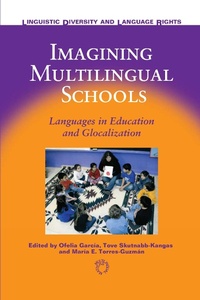
Imagining Multilingual Schools
Languages in Education and Glocalization
1st Edition
Published on 31. July 2006
344 pages
978-1-85359-896-8 (ISBN)
Description

This book brings together visions and realities of multilingual schools throughout the world in order to examine the pedagogical, socioeducational, and sociopolitical issues that impact on their development and success. The chapters describe and analyze pedagogical, instructional, and policy efforts to develop multilingualism through school with different targeted populations -- immigrant students, indigenous peoples, traditional minorities, majorities, and multiethnic/multilingual groups. Each contribution, many written by well-known scholars in the field of bilingual and multilingual education, affirms the desirability of multilingualism as a societal resource and as a right of individuals, while acknowledging the social, economic and political differences that make the acquisition of multilingualism easy for some, and difficult for others. And yet, the book focuses on the school as a place of promise and resistance, having the potential to preserve, recover, and expand the world's linguistic diversity. The introduction, written by the co-editors, identifies the conceptual threads that are developed throughout the chapters. But the chapters themselves remind us of the importance of local conditions, despite the global pressures of the 21st century, in imagining and creating multilingual educational spaces.
Reviews / Votes
We need more books of this type (and our sincere thanks go out to Garcia and her collaborators realizing this need) and owe a huge vote of thanks to the editors, authors and publisher for getting this much overlooked ball rolling at last! More power to them all! -- Joshua Fishman, Emeritus Professor This book clearly offers a space for in-depth thinking about the construction of multilingual schools. For the reader interested in imagining actual possibilities, it also offers a space for witnessing the realities of language diversity and co-existence, of respect to human and language rights, and of recognition of traditionally marginalized peoples. Overall, it offers a space for peace to become reality in our schools and society. -- Laura Alicia Valdiviezo, University of Massachusetts-Amherst * Journal of Peace Education, Volume 6, No. 2 * This book is an inspiration for language policymakers, language education program developers, practitioners and researchers who seek to understand and nurture linguistic diversity on the local and global levels through education. Researchers, policymakers and practitioners will leave this book stimulated by realistic possibilities for promoting multilingualism on the local level. -- Rebecca Freeman Field * Language Policy (2008) 7 * This inspiring book is hope and imagination in full wingspan. This volume is a fine collection of articles by leading scholars in the area of bilingualism. -- John C. Maher, International Christian University, Tokyo * International Journal of Bilingual Education and Bilingualism Vol 11 No. 5, 2008. * In the "glocalized" context of hegemonic forces of assimilation and English (only), this book comes just in time for educators, researchers, parents, and policy makers. It allows us to better understand the factors that contribute to the oppression of minoritized languages and their speakers and the ways these factors have been overcome in different settings. Furthermore, it offers a space to imagine ideal circumstances for multilingual schools across divergent settings, a vital aspect to the vision, hope, and forward movement of those who believe in the strength of a multilingual and multicultural society. The next step is for the reader to imagine and bridge the vision with reality. -- Tatyana Kleyn, City College of New York * Teachers College Record, December 08, 2006 * A priceless contribution to the world to recognize and accept bi/multi-linguality as nature's gift for humanity to nurture! -- Jennifer Marie Bayer, Central Institute of Indian Languages * www.boloji.com *More details
Series
Language
English
Place of publication
Bristol
United Kingdom
Publishing group
Channel View Publications Ltd
Target group
Professional and scholarly
Edition type
Digital original
ISBN-13
978-1-85359-896-8 (9781853598968)
Copyright in bibliographic data and cover images is held by Nielsen Book Services Limited or by the publishers or by their respective licensors: all rights reserved.
Schweitzer Classification
Other editions
Additional editions
Ofelia Garcia | Tove Skutnabb-Kangas | Maria E. Torres-Guzman
Imagining Multilingual Schools
Languages in Education and Glocalization
Book
07/2006
Multilingual Matters
€48.90
Shipment within 10-20 days
Ofelia Garcia | Tove Skutnabb-Kangas | Maria E. Torres-Guzman
Imagining Multilingual Schools
Languages in Education and Glocalization
Book
07/2006
Multilingual Matters
€151.50
Shipment within 10-20 days
Persons
Ofelia Garcia is professor at Teachers College, Columbia University, where she presently serves as coordinator of the Bilingual Education program and co-director of the Center for Multiple Languages and Literacies. Garcia research interests are in the areas of language education policy, sociology of language, immigrant education, in particular the education of US Latinos, and teacher education for urban schools.
Tove Skutnabb-Kangas, University of Roskilde, Denmark, and Abo Akademi University, Finland. Her main research interests: linguistic human rights, multilingual education, subtractive spread of English, and the relationship between linguistic (and cultural) diversity and biodiversity (also in practice, on an ecological smallholding, with her husband Robert Phillipson).
Maria E. Torres-Guzman is associate professor of Bilingual/Bicultural Education in the Department of International and Transcultural Studies at Teachers College, Columbia University. Her recent publications are on dual language education models both in the U.S. and in the Basque Country, as well as pedagogical practices of read-alouds in such programs. She has also published in the area of multicultural education and the preparation of teachers.
Tove Skutnabb-Kangas, University of Roskilde, Denmark, and Abo Akademi University, Finland. Her main research interests: linguistic human rights, multilingual education, subtractive spread of English, and the relationship between linguistic (and cultural) diversity and biodiversity (also in practice, on an ecological smallholding, with her husband Robert Phillipson).
Maria E. Torres-Guzman is associate professor of Bilingual/Bicultural Education in the Department of International and Transcultural Studies at Teachers College, Columbia University. Her recent publications are on dual language education models both in the U.S. and in the Basque Country, as well as pedagogical practices of read-alouds in such programs. She has also published in the area of multicultural education and the preparation of teachers.
Content
I. INTRODUCTION
1. Weaving Spaces and (De)constructing Ways for Multilingual Schools: The Actual and the Imagined - Ofelia Garcia, Tove Skutnabb-Kangas and Maria Torres-Guzman
II. PEDAGOGIES, VALUES AND SCHOOLS
2. Identity Texts: The Imaginative Construction of Self through Multiliteracies Pedagogy - Jim Cummins (OISE, University of Toronto)
3. Imagining Multilingual Education in France: A Language and Cultural Awareness Project at Primary Level - Christine Helot (Institut Universitaire de Formation des Maitres) and Andrea Young (Institut Universitaire de Formation de Maitres)
4. Reclaiming Multilingual America: Lessons from Native American Youth - Teresa L. McCarty (Arizona State University), Mary Eunice Romero (Arizona State University), Ofelia Zepeda (University of Arizona)
5. Attitudes Towards Language Learning in Different Linguistic Models of the Basque Autonomous Community - Feli Etxeberria-Sagastume (Universidad del Pais Vasco/ Euskal Herriko Universitatea)
III. EXTENDING FORMAL INSTRUCTIONAL SPACES
6. Back to Basics: Marketing the Benefits of Bilingualism to Parents - Viv Edwards (University of Reading) and Lynda Pritchard Newcombe
7. Popular Education and Language Rights in Indigenous Mayan Communities: Emergence of New Social Actors and Gendered Voices - Karen Ogulnick (Long Island University)
IV. TENSIONS BETWEEN MULTIPLE REALITIES
8. Imagined Multilingual Schools: How Come We Don't Deliver? - Elana Shohamy (Tel Aviv University)
9. Monolingual Assessment and Emerging Bilinguals: A Case Study in the US - Kathy Escamilla (University of Colorado)
10. The Long Road to Multilingual Schools in Botswana - Lydia Nyati-Ramahobo (University of Botswana)
V. NEGOTIATING POLICIES OF IMPLEMENTATION
11. Nichols to NCLB: Local and Global Perspectives on US Language Education Policy - Nancy Hornberger (University of Pennsylvania)
12. Cultural Diversity, Multilingualism and Indigenous Education - Luis Enrique Lopez (Universidad Mayor de San Simon)
13. Multilingualism of the Unequals and Predicaments of Education in India - Ajit K. Mohanty (Jawaharlal Nehru University)
1. Weaving Spaces and (De)constructing Ways for Multilingual Schools: The Actual and the Imagined - Ofelia Garcia, Tove Skutnabb-Kangas and Maria Torres-Guzman
II. PEDAGOGIES, VALUES AND SCHOOLS
2. Identity Texts: The Imaginative Construction of Self through Multiliteracies Pedagogy - Jim Cummins (OISE, University of Toronto)
3. Imagining Multilingual Education in France: A Language and Cultural Awareness Project at Primary Level - Christine Helot (Institut Universitaire de Formation des Maitres) and Andrea Young (Institut Universitaire de Formation de Maitres)
4. Reclaiming Multilingual America: Lessons from Native American Youth - Teresa L. McCarty (Arizona State University), Mary Eunice Romero (Arizona State University), Ofelia Zepeda (University of Arizona)
5. Attitudes Towards Language Learning in Different Linguistic Models of the Basque Autonomous Community - Feli Etxeberria-Sagastume (Universidad del Pais Vasco/ Euskal Herriko Universitatea)
III. EXTENDING FORMAL INSTRUCTIONAL SPACES
6. Back to Basics: Marketing the Benefits of Bilingualism to Parents - Viv Edwards (University of Reading) and Lynda Pritchard Newcombe
7. Popular Education and Language Rights in Indigenous Mayan Communities: Emergence of New Social Actors and Gendered Voices - Karen Ogulnick (Long Island University)
IV. TENSIONS BETWEEN MULTIPLE REALITIES
8. Imagined Multilingual Schools: How Come We Don't Deliver? - Elana Shohamy (Tel Aviv University)
9. Monolingual Assessment and Emerging Bilinguals: A Case Study in the US - Kathy Escamilla (University of Colorado)
10. The Long Road to Multilingual Schools in Botswana - Lydia Nyati-Ramahobo (University of Botswana)
V. NEGOTIATING POLICIES OF IMPLEMENTATION
11. Nichols to NCLB: Local and Global Perspectives on US Language Education Policy - Nancy Hornberger (University of Pennsylvania)
12. Cultural Diversity, Multilingualism and Indigenous Education - Luis Enrique Lopez (Universidad Mayor de San Simon)
13. Multilingualism of the Unequals and Predicaments of Education in India - Ajit K. Mohanty (Jawaharlal Nehru University)
