

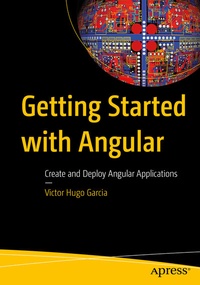
Getting Started with Angular
Description

Immerse yourself in the architecture of an Angular application, starting with an introduction to TypeScript and ES6, and progressing to modules and components used to build complex applications. This book presents a hands-on approach to becoming a proficient Angular developer by building three complete applications.
You'll start with an overview of the Angular framework where TypeScript and ES6 are introduced. Next you'll see how to build an application (RestApp) using the in-memory module to mock an API that communicates with a rest API performing crud operations. This is followed by an application (AuthApp) that uses a third party service to provide authentication and authorization capabilities to handle registrations. You'll then build an application (BlogApp) that communicates with a MongoDB database in six parts.
Part 1 covers MongoDB, how to install bootstrap, login service, and adding the logic of the form. Part 2 covers how to start the project on the server, create the database and AuthService, and save the user in the session. In Parts 3 and 4 you will learn to create the post collection, post component, and sharpen details. In Parts 5 and 6 you will study adding, editing, and deleting posts with testing.
By the end of the book you'll have the necessary knowledge to write and execute automated tests on your applications, and deploy them to a server.
What You'll Learn
- Divide the logic of an application into components
- Communicate with an API
- Release the power of the observables to solve asynchronous programming problems
- Include Bootstrap so that your application looks great on different devices
Who This Book Is For
Web developers with basic knowledge of JavaScript, HTML, and CSS.More details
Other editions
Additional editions
Person
Victor has more than twelve years as a full-stack developer, using different frameworks such as Angular, Laravel, Yii, Zend, Cake, and Vue. He has developed multiple web and mobile applications for various organizations. He has also developed various courses on web development for Udemy. He loves teaching, reading, and writing technical and fantasy books.
Content
Chapter 1: Introduction to Angular Framework.- Chapter 2: Introduction to TypeScript and ES6.- Chapter 3: First Application: RestApp.- Chapter 4: RestApp.- Chapter 5: AuthApp.- Chapter 6: Blog App Part I.- Chapter 7: Blog App Part II.- Chapter 8: Blog App Part III Showing Posts.- Chapter 9: Blog App Part IV Filtering Posts.- Chapter 10: Blog App Part V Adding Posts.- Chapter 11: Blog App Part VI Editing Posts.- Chapter 12: Blog App Part VII Deleting Posts.- Chapter 13: Testing.
