

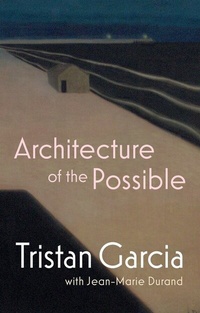
Architecture of the Possible
Description

As a philosopher and a novelist, Tristan Garcia inhabits two worlds, metaphysics and literary fiction, like an amphibious creature moving between the land and the sea, breathing in both air and water. He is drawn to metaphysics because, as he puts it, metaphysics is the edge of the abyss of thought, the unstable frontier of indeterminacy where thinking is no longer constrained by the principles of logic or the law of non-contradiction. Metaphysics seeks to describe the world from outside one's own point of view. It aims at an ecstatic reconstruction of what keeps us locked up in our conditions, in our time and place, here among the living, with our subjectivities and within our situations. It gives us an idea of all constraints from a point of view that posits the possible absence of the constraint of having a point of view.
The ambition of this slender book - which is at the same time a concise introduction to Garcia's work and thought - is to help us grasp and transform the conditions of our existence by paying equal attention to what is ending and what is just beginning, to the dusk and to the dawn. Until we cannot hold our breath any longer.
More details
Other editions
Additional editions
Persons
Content
Philosophical Feeling
Philosophical Orientation
Intensification, Extension, Breaking Point
Literature: Ideas in a Body
Models of Concision and Models of Profusion
Childhood and Irenicism
War
Finding a Viewpoint
Solitude
Activists
Nuanced Minds and Rough Minds
Radicalness
The Enemy
Friends
Progress and Movement
The World After
Thinking Saves
LANGUAGE, THOUGHT, AND FICTION
Starting a conversation when you also want to avoid speaking in a way that's too direct or brutal is not a straightforward affair. While trying to strike a balance between discretion and eagerness, I would like to begin by considering your recent writings and asking you to do something that might be impossible, namely, to describe your writing style and the way that you use language as a material to craft thought and fiction.
Are "philosopher" and "writer" the same thing? How are (de)constructing theories and inventing characters similar, and how are they different? Moreover, why do you feel the need to take up both of those pursuits at the same time?
Because I grew up in a family that had books, what I wanted to make and what I learned how to make were books. From an early age, my passion was centered on the written word, and I put my energy into trying to recreate those printed objects, those bound sheets of paper. They seemed to contain the whole world in miniature. The secret of the universe seemed to lie between their covers, which my mother and father would sometimes wrap in greaseproof butcher's paper.
My environment is made of language in general and writing in particular. My personality took shape in these surroundings.
If I'd been raised in another environment, I might have had a similar character. I might have had the same worldview but expressed it in some other way. I don't have many other skills, but it seems to me that whether I'm writing, thinking, cooking, or even playing sports, I have the same strengths and weaknesses. What if I were a professional sports player? What if I were a cook? Even if these counterfactual thought experiments are illusory, they allow me to imagine reasonably well the possibility of different ways of being that aren't based on thinking of abstract concepts and characters or writing.
For me, philosophy and literature aren't absolutes. They are the surroundings in which I grew up, the environment where my dispositions were developed to varying degrees, with my family's encouragement and at school as well.
I feel like I live and breathe language and the images and ideas that are formed out of words. Another person might find this view abstract or abstruse. But, for me, this is a primordial, enveloping condition, like an amniotic fluid made of signs. Social interactions aren't always easy for me. I love meeting another person, a kindred spirit, and discussing things with them. However, in a group setting, I kind of switch off a bit. Sometimes, I have to push myself. I have to play a role, and that doesn't come naturally to me. After a long period of careful existence in the social realm, the abstractness of words brings me back to a reassuring place where I can, as we say, gather my thoughts, and rediscover the center of who I am. There, within the abstract forms of thought and language, I can breathe easy, I can find my way around, and the world regains an order that comforts me. The chaos of the world's sensations, desires, and contradictory forces isn't altogether banished. Nevertheless, word by word, it becomes a little more livable. I've done the same ever since I was a child, going over lists in my mind and classifying things as a means of organizing what I've perceived, heard, felt, seen, and read. It's like the experience of a child from the country who has to go to the big city every morning. There, the child is jolted by the sights and sounds and jostled by the rushing crowds. Then, when returning home and walking on a path deep in the woods, the child's steps are more assured. Even though that path would surely frighten other children, for this child, it's even and familiar. It's a place to find one's bearings, a place to breathe easy. This doesn't mean that the child no longer wants to go back to the city to play with its friends and discover the wide urban world. It just means that the child still needs to return regularly to its home, a sort of forest within - the protected place where the child grew up. It's there that it can stave off being spread too thin by necessities and obligations. That place also protects it from being dissolved within the infinite mass of all the things that remain to be discovered and explored. It's a refuge from the loves and hates that threaten to tear the child apart. It's a haven from both the intelligence and foolishness of its peers - and from the child's own intelligence and foolishness as well.
Language, my language, has always had this effect on me.
I reflect and write so that I can return to that place as often as possible.
This place that you speak of, is it one uniform space?
Gradually, as I left childhood behind, that familiar place of language divided in two for me.
It split like a cleft tongue. It makes me think of those mythical peoples of long ago who were imagined by medieval troubadours to have spoken the "language of the birds" with their forked tongues. Whether it was naturally divided in two or had been cut that way during a ritual initiation, that tongue was supposed to allow them to speak two languages at once.
One part of my mind's language remains attached to legendary stories and to fiction, to all of the tales that I told myself as a child, to all of the stories that were read to me before I went to sleep, and to a sort of lie as well, to illusions that - as I've since discovered - don't exist in reality, and to imagination in general.
During my adolescence, another part of my language became more attached to ideas rather than to images. This part has a stronger connection to abstractions, general features, the laws of the world, and a kind of scientific approach.
The first language is childlike, and, in my opinion, it seems to speak to the whole world. It's democratic. The second language developed during puberty and is shaped by scientific and political education, by the discovery of the real, by that which offers external resistance, by what there really is. This language enjoys disappointing rather than enchanting. It's a more constrained and aristocratic language. It's a language that's subject to authorities. This language entails requirements governing its utterance, its rhetoric, and its truth. It has norms and laws. It's the language of a young person who makes friends, who then belongs to a generation, and who wants to understand and change its world.
You mentioned understanding the world, but also changing it. Does each of these aspirations require a different kind of story?
The duality of the double language that developed within me became increasingly pronounced. When I began to publish, I thought it was important to respect the clear separation within this language and clearly separate my desire for stories from my desire for theory.
While growing up in France at the end of the twentieth century, I came to distrust heavily theoretical fiction and overly poeticized philosophy. Those combinations were very much in style at the time, but they no longer suited me. That space tied my forked tongue up in knots. During the 1990s, Heideggerian influence was still very strong in French philosophy for my professors and for the intellectuals of that period, in the same way that Blanchot had become the overpowering authority in literary studies. It was like one of Rousseau's thoughts from Essay on the Origin of Languages that Derrida would later discuss: the philosopher was a poet, and the poet was a philosopher. Unfortunately, the philosopher was a failed poet, as we see in Nietzsche. Derrida and some of his disciples seemed to exist in a sort of muddled relationship with language, one that didn't appeal to me. Double meanings, a charming insistence on the central and almost exclusive power of ambiguity in language, the constant evasive maneuvers (and the resulting impossibility of arguing a thesis), rhetorical cunning, the eclipsing of realia (real things) by dicta (spoken things), etc., all of that was very tedious for me. The world was no longer expressed or discussed. I tried to read Nancy, Lacoue-Labarthe (whom I preferred, because he truly was a poet), and even Stiegler, but I always came out at the other end feeling cheated. Questions of value were always eclipsed by questions of meaning, and problems concerning definition were constantly dodged thanks to the continuous slippage of signification. I had the feeling that I was watching the elite of the philosophical word who conserved their power through their seductive and sophomoric scholarly mastery, but who never really had anything much to say. Any call for precision caused them to flee. When the time came to make a decision and reach a conclusion, they would sit on the fence. However, what they wanted more than anything else was to keep possession of the word by constantly batting it back and forth amongst themselves.
I would have to wait until I discovered Wittgenstein and the so-called Anglo-Saxon analytic tradition to find a philosophical language that had been freed from this poetic fixation. Quine was very important for me, as well as some of Austin's short essays and the metaphysics of Lewis, Armstrong, and Plantinga. I never joined that movement or its approach to metaphysics, but it helped me to move past French post-Heideggerian language.
Alongside your distrust of dominant...
