

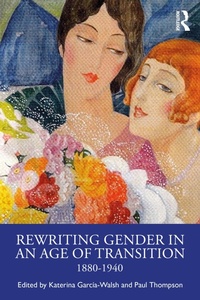
Rewriting Gender in an Age of Transition
1880-1940
1st Edition
Published on 20. March 2026
218 pages
978-1-040-52142-7 (ISBN)
Description

Rewriting Gender in an Age of Transition: 1880-1940 examines shifting discourses on gender and sexuality across the fin-de-siecle and early twentieth century.
This interdisciplinary collection challenges the conventional divide between the nineteenth and twentieth centuries, proposing instead that the period from 1880 to 1940 marks a pivotal era of transition. Through chapters spanning literature, history, art history, and linguistics, the volume explores evolving representations of femininity, masculinity, and queer identity in relation to broader cultural, political, and technological change. It places late nineteenth-century queer activism in dialogue with early twentieth-century media and artistic practices, revealing how anxieties around gender and sexuality shaped-and were shaped by-modernity. Contributions from both established and emerging scholars offer a multifaceted reappraisal of this transformative period.
Rewriting Gender in an Age of Transition: 1880-1940 is ideal for students and researchers in gender studies, media studies, literature, history, and the social sciences interested in identity formation and cultural change.
This interdisciplinary collection challenges the conventional divide between the nineteenth and twentieth centuries, proposing instead that the period from 1880 to 1940 marks a pivotal era of transition. Through chapters spanning literature, history, art history, and linguistics, the volume explores evolving representations of femininity, masculinity, and queer identity in relation to broader cultural, political, and technological change. It places late nineteenth-century queer activism in dialogue with early twentieth-century media and artistic practices, revealing how anxieties around gender and sexuality shaped-and were shaped by-modernity. Contributions from both established and emerging scholars offer a multifaceted reappraisal of this transformative period.
Rewriting Gender in an Age of Transition: 1880-1940 is ideal for students and researchers in gender studies, media studies, literature, history, and the social sciences interested in identity formation and cultural change.
More details
Edition
1. Auflage
Language
English
Place of publication
London
United Kingdom
Publishing group
Taylor & Francis Ltd
Target group
College/higher education
Illustrations
6 Halftones, black and white; 6 Illustrations, black and white
File size
11,25 MB
ISBN-13
978-1-040-52142-7 (9781040521427)
Copyright in bibliographic data and cover images is held by Nielsen Book Services Limited or by the publishers or by their respective licensors: all rights reserved.
Schweitzer Classification
Other editions
Additional editions
Book
approx. 03/2026
1st Edition
Routledge
€212.40
Not yet published
Book
approx. 03/2026
1st Edition
Routledge
€64.90
Not yet published
Persons
Katerina Garcia-Walsh is a Juan de la Cierva National Postdoctoral Fellow at the Complutense University of Madrid, Spain. She completed her PhD at the University of St Andrews, UK.
Paul Thompson completed a PhD at the University of St Andrews, UK, and is now an independent researcher in mid-twentieth century popular American literature.
Paul Thompson completed a PhD at the University of St Andrews, UK, and is now an independent researcher in mid-twentieth century popular American literature.
Content
Introduction Part I: Identity in Transition 1. Michael Field's Transitions 2. A Baltic Antinous: queer affirmation in Carl Robert Egells' Rubi, 1879 3. Queer voyages in Imre: Music and Mobility in the Work of Edward Prime-Stevenson 4. Reimagining the Erased in an Era of Transfixion Part II: Symbols of Self-fashioning 5. Gender, Fashion, and Modernity: The Linguistic Construction of Femininity in the Fashion Content of Early 1920s Harper's Bazaar 6. The Birth of 'Kodak Girl' in China: Creating the Modern Woman in Chinese Advertising in the 1920s and 1930s 7. Queering Normativity: The Poetry and Prose of Amy Levy and John Gambril 8. Masculinity, Sexuality, and Radical Politics: The Entangled Discourses of D.H. Lawrence's Women in Love 9. 'Knickers into nackers': Gender in transition in the autobiographies of Nina Hamnett Afterword: The Value of 'Gender'
