

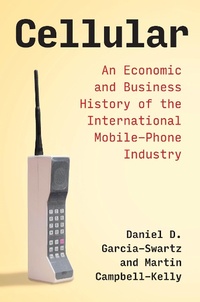
Cellular
An Economic and Business History of the International Mobile-Phone Industry
Published on 18. October 2022
400 pages
978-0-262-37000-4 (ISBN)
Description

Tracks the evolution of the international cellular industry from the late 1970s to the present.
The development of the mobile-phone industry into what we know today required remarkable cooperation between companies, governments, and industrial sectors. Companies developing cellular infrastructure, cellular devices, cellular network services, and eventually software and mobile semiconductors had to cooperate, not simply compete, with each other. In this global history of the mobile-phone industry, Daniel D. Garcia-Swartz and Martin Campbell-Kelly examine its development in the United States, Europe, Japan, and several emerging economies, including China and India. They present the evolution of mobile phones from the perspective of vendors of telephone equipment and network operators, users whose lives have been transformed by mobile phones, and governments that have fostered specific mobile-phone standards. Cellular covers the technical aspects of the cellphone, as well as its social and political impact.
Beginning with the 1980s, the authors trace the development of closed (proprietary) and open (available to all) cellular standards, the impact of network effects as cellular adoption increased, major technological changes affecting mobile phone hardware, and the role of national governments in shaping the industry. The authors also consider the changing roles that cellular phones have played in the everyday lives of people around the world and the implications 5G technology may have for the future. Finally, they offer statistics on how quickly the cellular industry grew in different regions of the world and how firms competed in those various markets.
Cellular is published in the History of Computing Series. This distinguished series has played a major role in defining scholarship in the history of computing. Hallmarks of the series are its technical detail and interpretation of primary source materials.
The development of the mobile-phone industry into what we know today required remarkable cooperation between companies, governments, and industrial sectors. Companies developing cellular infrastructure, cellular devices, cellular network services, and eventually software and mobile semiconductors had to cooperate, not simply compete, with each other. In this global history of the mobile-phone industry, Daniel D. Garcia-Swartz and Martin Campbell-Kelly examine its development in the United States, Europe, Japan, and several emerging economies, including China and India. They present the evolution of mobile phones from the perspective of vendors of telephone equipment and network operators, users whose lives have been transformed by mobile phones, and governments that have fostered specific mobile-phone standards. Cellular covers the technical aspects of the cellphone, as well as its social and political impact.
Beginning with the 1980s, the authors trace the development of closed (proprietary) and open (available to all) cellular standards, the impact of network effects as cellular adoption increased, major technological changes affecting mobile phone hardware, and the role of national governments in shaping the industry. The authors also consider the changing roles that cellular phones have played in the everyday lives of people around the world and the implications 5G technology may have for the future. Finally, they offer statistics on how quickly the cellular industry grew in different regions of the world and how firms competed in those various markets.
Cellular is published in the History of Computing Series. This distinguished series has played a major role in defining scholarship in the history of computing. Hallmarks of the series are its technical detail and interpretation of primary source materials.
More details
Other editions
Additional editions
Daniel D. Garcia-Swartz | Martin Campbell-Kelly
Cellular
An Economic and Business History of the International Mobile-Phone Industry
Book
10/2022
MIT Press
€53.23
Shipment within 10-20 days
Persons
Daniel D. Garcia-Swartz is an economist at Charles River Associates in Chicago. Martin Campbell-Kelly is Professor Emeritus of Computer Science at the University of Warwick. Garcia-Swartz and Campbell-Kelly are coauthors of From Mainframes to Smartphones: A History of the International Computer Industry.
Content
Introduction 1
I The First Generation, the 1980s 11
1 The Long Road to the First Cellular Systems 13
2 The First Cellular Systems: Japan, Europe, and The United States 35
3 Competing in the Early Cellular Markets 65
II The Second Generation, the 1990s 95
4 New Technologies, Standards, Customers, and Markets in the World of 2G 97
5 Cellular Systems in the World of 2G: Britain, The United States, Continental Europe, China, and India 121
6 Competing in 2G Cellular Markets 151
III The Third Generation, the 2000s 175
7 New Technologies, Standards, Customers, and Markets in the World of 3G 177
8 Emergent Digital Markets: New Zealand, Japan, South Korea, the Asia-Pacific Region, Israel, Brazil, and Mexico 205
9 Competing in 3G Cellular Markets 235
IV The Fourth Generation, the 2010s 263
10 New Standards, Operating Systems, Devices, and Markets in the World of 4G 265
11 Cellular Systems in Africa 283
12 Competing in 4G Cellular Markets 313
Conclusions 339
Notes 347
Index 379
I The First Generation, the 1980s 11
1 The Long Road to the First Cellular Systems 13
2 The First Cellular Systems: Japan, Europe, and The United States 35
3 Competing in the Early Cellular Markets 65
II The Second Generation, the 1990s 95
4 New Technologies, Standards, Customers, and Markets in the World of 2G 97
5 Cellular Systems in the World of 2G: Britain, The United States, Continental Europe, China, and India 121
6 Competing in 2G Cellular Markets 151
III The Third Generation, the 2000s 175
7 New Technologies, Standards, Customers, and Markets in the World of 3G 177
8 Emergent Digital Markets: New Zealand, Japan, South Korea, the Asia-Pacific Region, Israel, Brazil, and Mexico 205
9 Competing in 3G Cellular Markets 235
IV The Fourth Generation, the 2010s 263
10 New Standards, Operating Systems, Devices, and Markets in the World of 4G 265
11 Cellular Systems in Africa 283
12 Competing in 4G Cellular Markets 313
Conclusions 339
Notes 347
Index 379
