

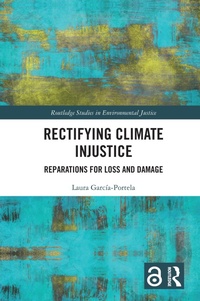
Rectifying Climate Injustice
Reparations for Loss and Damage
1st Edition
Published on 31. October 2024
150 pages
978-1-040-22393-2 (ISBN)
Description

This book provides an account of how rectificatory justice for climate change loss and damage can be realized by bridging the worlds of political philosophy, climate science and climate policy together. The book focuses on three fundamental questions: what kinds of climate impacts should count as loss and damage, how climate science can help us identify them and who should bear the burdens of providing reparations for loss and damage.
Laura Garcia-Portela argues that loss and damage occur after people's capabilities have fallen below a threshold of sufficiency due to the negative impacts of climate change, thereby infringing people's human rights. She argues for a historical responsibility principle for reparations for loss and damage (the Polluter Pays Principle, PPP) grounded in her Continuity Account. According to this account, responsibility for reparations is based on the duty to refrain from emissions-generating activities that would infringe people's human rights. A new duty to provide reparations arises when human rights are infringed by climate change-inducing activities. Importantly, she examines how the latest developments in attribution science can help in developing a rectificatory account for loss and damage, an approach that has not been considered in depth by climate justice scholars so far.
Striving to improve the reader's understanding of loss and damage as outlined by The United Nations Framework Convention on Climate Change, this book will be of great interest to students and scholars of climate justice, environmental justice, and environmental ethics.
Laura Garcia-Portela argues that loss and damage occur after people's capabilities have fallen below a threshold of sufficiency due to the negative impacts of climate change, thereby infringing people's human rights. She argues for a historical responsibility principle for reparations for loss and damage (the Polluter Pays Principle, PPP) grounded in her Continuity Account. According to this account, responsibility for reparations is based on the duty to refrain from emissions-generating activities that would infringe people's human rights. A new duty to provide reparations arises when human rights are infringed by climate change-inducing activities. Importantly, she examines how the latest developments in attribution science can help in developing a rectificatory account for loss and damage, an approach that has not been considered in depth by climate justice scholars so far.
Striving to improve the reader's understanding of loss and damage as outlined by The United Nations Framework Convention on Climate Change, this book will be of great interest to students and scholars of climate justice, environmental justice, and environmental ethics.
More details
Series
Edition
1. Auflage
Language
English
Place of publication
London
United Kingdom
Publishing group
Taylor & Francis Ltd
Target group
College/higher education
Illustrations
3 Tables, black and white; 2 Line drawings, black and white; 2 Illustrations, black and white
ISBN-13
978-1-040-22393-2 (9781040223932)
Copyright in bibliographic data and cover images is held by Nielsen Book Services Limited or by the publishers or by their respective licensors: all rights reserved.
Schweitzer Classification
Other editions
Additional editions
Book
05/2026
1st Edition
Routledge
€57.50
Shipment within 10-20 days

Book
12/2024
Routledge
Unfortunately, price unknown
Available (delivery time upon request)
Book
10/2024
1st Edition
Routledge
€195.60
Shipment within 10-20 days
Person
Laura Garcia-Portela is an assistant professor of philosophy at Erasmus University Rotterdam. Before that, she held postdoctoral positions at the Karlsruhe Institute of Technology (KIT, Germany) and the University of Fribourg (Switzerland). She has also held visiting, research, and teaching positions at University of Valencia (Spain), Keele University (UK), and University of Washington (US). She graduated in summer 2021 from the Department of Philosophy and the Interdisciplinary Doctoral Program in Climate Change, University of Graz. Her dissertation was awarded the Luis Diez del Corral Prize from the Center of Political and Constitutional Studies in Spain (research centered attached to the Spanish Ministry of Presidency) and the Roland Atefie Preis from the Austrian Academy of Science. Her work lies at the intersection between political philosophy, philosophy of climate science, and philosophy of climate law and is published in numerous international journals.
Content
Introduction
1 An international mechanism for loss and damage
1.1 A brief history of loss and damage
1.2 Contributing to an international mechanism for loss and damage
1.3 The contested role of compensation in climate negotiations
2 A terminological note
3 Philosophical methodology
3.1 General methodology: reflective equilibrium
3.2 Climate justice specific methodology
4. Assumptions and limitations
4.1 The scope of justice: recipients and duty-bearers of climate justice
4.2 Sufficientarianism: background theory of distributive justice
5 Summary of chapters
2 A minimal capabilities-based approach
1 Life disruptions as harm and the minimal understanding of loss and damage
2 A minimal capabilities-based account of loss and damage
3 Answering some challenges to an ex post categorization of L&D
4 Conceptual clarifications and types of reparation for loss and damage
4.1 The notions of 'loss' and 'damage' in loss and damage
4.2 Reparations for economic damage, non-economic losses, and non-economic damage
5 Conclusion
3 In search for a justified rectificatory justice principle
1 Two objections against the polluter pays principle
2 The beneficiary pays principle and some intuitive reactions to the objections
3 The causation objection and the beneficiary pays principle
4 The excusable ignorance objection and fairness considerations
4.1 A fresh look at the excusable ignorance objection
4.2 Fairness considerations, the beneficiary pays principle, and replies to some objections
5 Conclusion
4 Reasons awaiting satisfaction
1 The continuity thesis and the continuity account
2 The continuity account and some objections against the polluter pays principle
3 Alternative accounts
3.1 Strict liability
3.2 Counterfactual liability
3.3 Outcome responsibility
4 Conclusion
5 Climate harm and attribution science
1 Attribution methods: the probabilistic and the storyline approach
2 The reaction and criticism of the PEA community toward the storyline approach
3 The storyline approach and the criticism of overstatement
4 On how the probabilistic approach is affected by similar objections
5 Conclusion
6 Toward a rectificatory policy mechanism for loss and damage
1 Toward an adequacy-for-purpose view for attribution methods
2 An adequacy-for-purpose view for rectifying climate injustice
3 Distributing liability and achieving rectificatory justice
4 The political feasibility objection
4.1 Introducing and exploring the feasibility concern
4.2 Motivational and psychological aspects of the political feasibility objection
5 Conclusion
Final conclusions
1 An international mechanism for loss and damage
1.1 A brief history of loss and damage
1.2 Contributing to an international mechanism for loss and damage
1.3 The contested role of compensation in climate negotiations
2 A terminological note
3 Philosophical methodology
3.1 General methodology: reflective equilibrium
3.2 Climate justice specific methodology
4. Assumptions and limitations
4.1 The scope of justice: recipients and duty-bearers of climate justice
4.2 Sufficientarianism: background theory of distributive justice
5 Summary of chapters
2 A minimal capabilities-based approach
1 Life disruptions as harm and the minimal understanding of loss and damage
2 A minimal capabilities-based account of loss and damage
3 Answering some challenges to an ex post categorization of L&D
4 Conceptual clarifications and types of reparation for loss and damage
4.1 The notions of 'loss' and 'damage' in loss and damage
4.2 Reparations for economic damage, non-economic losses, and non-economic damage
5 Conclusion
3 In search for a justified rectificatory justice principle
1 Two objections against the polluter pays principle
2 The beneficiary pays principle and some intuitive reactions to the objections
3 The causation objection and the beneficiary pays principle
4 The excusable ignorance objection and fairness considerations
4.1 A fresh look at the excusable ignorance objection
4.2 Fairness considerations, the beneficiary pays principle, and replies to some objections
5 Conclusion
4 Reasons awaiting satisfaction
1 The continuity thesis and the continuity account
2 The continuity account and some objections against the polluter pays principle
3 Alternative accounts
3.1 Strict liability
3.2 Counterfactual liability
3.3 Outcome responsibility
4 Conclusion
5 Climate harm and attribution science
1 Attribution methods: the probabilistic and the storyline approach
2 The reaction and criticism of the PEA community toward the storyline approach
3 The storyline approach and the criticism of overstatement
4 On how the probabilistic approach is affected by similar objections
5 Conclusion
6 Toward a rectificatory policy mechanism for loss and damage
1 Toward an adequacy-for-purpose view for attribution methods
2 An adequacy-for-purpose view for rectifying climate injustice
3 Distributing liability and achieving rectificatory justice
4 The political feasibility objection
4.1 Introducing and exploring the feasibility concern
4.2 Motivational and psychological aspects of the political feasibility objection
5 Conclusion
Final conclusions
