

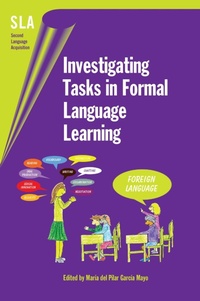
Investigating Tasks in Formal Language Learning
Published on 13. December 2006
280 pages
978-1-78892-036-0 (ISBN)
Description

This book contributes to the growth of interest in task-based language learning and teaching that has been seen in recent years. It brings together research that focuses on various aspects and effects of pedagogic task design and presents work that uses tasks to examine oral interaction, written production, vocabulary and reading, lexical innovation and pragmatics in different formal language learning contexts and in different languages (English as a second/foreign language, French/German/Italian/Spanish as foreign languages). It also provides guidelines for task classification, sequencing and design.
The book is addressed to both professionals and students interested in second language acquisition research. It will also be of use to professionals involved in language pedagogy and curriculum design.
The book is addressed to both professionals and students interested in second language acquisition research. It will also be of use to professionals involved in language pedagogy and curriculum design.
Reviews / Votes
The book provides a much needed examination of options in classifying and sequencing language learning tasks. Framed by Robinson's insightful overview of competing theoretical claims in the area, eleven new data-based studies elucidate relationships between pedogic task types and accuracy, complexity and fluency in L2 speech and writing, and between task types and acquisition. Garcia-Mayo's book advances the international research agenda on task-based language teaching. -- Mike Long, University of Maryland Various aspects of tasks, task features, and task complexity are of key interest to today's second language acquisition researchers, who seek to understand the intricacies of how task-based interaction plays a facilitative role in instructed language development, and how research on tasks can inform task-based syllabus design. This new edited collection provides a rich compendium of work on second language tasks that will be invaluable for researchers and students of task-based language learning alike. The book also provides research-based evidence for second language teachers and educators who want to learn about best practices in task-based formal language instruction. Taken as whole, the text provides a broad and balanced overview of the current state of the art in instructed task research, with an impressive range of chapters from leading researchers in the field. The book deals with an interesting variety of target and source languages, modes, contexts and settings, and a range of aspects of task features from multiple complementary perspectives. It makes an important and timely contribution to the field and will be read with interest and profit by any serious task scholar. -- Alison Mackey, Georgetown University Written for researchers, practitioners, and students of SLA and task-based language learning and teaching, this book provides a wide-ranging collection of research on second language (L2) tasks in formal language instruction, covering both cognitive and sociocultural perspectives, both oral and written modalities, various target languages and features, and learners of different first languages (L1s) and proficiency levels. Notable is the inclusive scope of areas dealt with in the book, including oral interaction, writing, reading comprehension, vocabulary development, learning strategies, pragmatics, and computer-mediated communication. This book provides an excellent up-to-date anthology of L2 task research. It makes successful contribution to the enhancement of our understanding of various aspects of task-based research and is certainly a welcome and important addition to the field. -- Bo-Ram Suh Georgetown University * 30th October 2007 Studies in Second Language Acquisition *More details
Series
Language
English
Place of publication
Clevedon
United Kingdom
Target group
Professional and scholarly
ISBN-13
978-1-78892-036-0 (9781788920360)
Copyright in bibliographic data and cover images is held by Nielsen Book Services Limited or by the publishers or by their respective licensors: all rights reserved.
Schweitzer Classification
Other editions
Additional editions
Maria del Pilar Garcia Mayo
Investigating Tasks in Formal Language Learning
Book
12/2006
Multilingual Matters
€48.20
Shipment within 10-20 days
Maria del Pilar Garcia Mayo
Investigating Tasks in Formal Language Learning
E-Book
12/2006
1st Edition
Multilingual Matters
€24.49
Available for download
Person
Maria del Pilar Garcia Mayo received her M.A. and Ph.D. in Linguistics from the University of Iowa (U.S.A). She is Full Professor of English Language and Linguistics at the University of the Basque Country (Spain). Her research interests are second language acquisition (in particular the acquisition of syntactic aspects of English as a second/foreign language from a generative perspective and input and interaction in formal language learning contexts) and second language research methodology. Her recent publications have focused on the acquisition of syntactic aspects of English as a third language and on issues related to interaction and focus on form in the foreign language classroom.
Content
Introduction - Maria del Pilar Garcia Mayo
1. Criteria for Classifying and Sequencing Pedagogic Tasks - Peter Robinson
2. Information Distribution and Goal Orientation in Second Language Task Design - Craig P. Lambert and Steve Engler
3. The Simultaneous Manipulation of Task Complexity along Planning Time and [+/- Here-and-Now]: Effects on L2 Oral Production - Roger Gilabert
4. Tasks, Negotiation and L2 Learning in a Foreign Language Context - Marisol Fernandez Garcia
5. Attention to Form across Collaborative Tasks by Low-proficiency Learners in an EFL Setting - Ana Alegria de la Colina and Maria del Pilar Garcia Mayo
6. Cognitive Task Complexity and Linguistic Performance in French L2 Writing - Folkert Kuiken and Ineke Vedder
7. The Effect of Manipulating Task Complexity and the [+/- Here-and-Now] Dimension on L2 Written Narrative Discourse - Tomohito Ishikawa
8. Writing Tasks: The Effects of Collaboration - Neomy Storch and Gillian Wigglesworth
9. L2 Vocabulary Acquisition and Reading Comprehension: The Influence of Task Complexity - Elke Peters
10. Task-effect on the Use of Lexical Innovation Strategies in Interlanguage Communication - Elsa Gonzalez Alvarez
11. Fostering EFL Learners' Awareness of Requesting through Explicit and Implicit Consciousness-raising Tasks - Eva Alcon Soler
12. Interactive Task Design: Metachat and the Whole Learner - Marie-Noelle Lamy
Index
1. Criteria for Classifying and Sequencing Pedagogic Tasks - Peter Robinson
2. Information Distribution and Goal Orientation in Second Language Task Design - Craig P. Lambert and Steve Engler
3. The Simultaneous Manipulation of Task Complexity along Planning Time and [+/- Here-and-Now]: Effects on L2 Oral Production - Roger Gilabert
4. Tasks, Negotiation and L2 Learning in a Foreign Language Context - Marisol Fernandez Garcia
5. Attention to Form across Collaborative Tasks by Low-proficiency Learners in an EFL Setting - Ana Alegria de la Colina and Maria del Pilar Garcia Mayo
6. Cognitive Task Complexity and Linguistic Performance in French L2 Writing - Folkert Kuiken and Ineke Vedder
7. The Effect of Manipulating Task Complexity and the [+/- Here-and-Now] Dimension on L2 Written Narrative Discourse - Tomohito Ishikawa
8. Writing Tasks: The Effects of Collaboration - Neomy Storch and Gillian Wigglesworth
9. L2 Vocabulary Acquisition and Reading Comprehension: The Influence of Task Complexity - Elke Peters
10. Task-effect on the Use of Lexical Innovation Strategies in Interlanguage Communication - Elsa Gonzalez Alvarez
11. Fostering EFL Learners' Awareness of Requesting through Explicit and Implicit Consciousness-raising Tasks - Eva Alcon Soler
12. Interactive Task Design: Metachat and the Whole Learner - Marie-Noelle Lamy
Index
