

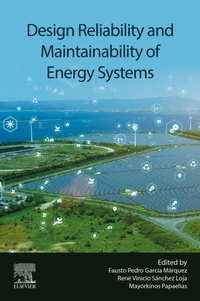
Design Reliability and Maintainability of Energy Systems
Published on 30. April 2026
300 pages
978-0-443-45232-1 (ISBN)
Description

Designing reliable and maintainable energy systems is crucial for ensuring efficiency, longevity, and sustainability in energy production, distribution, and consumption. Reliability focuses on minimizing failures and ensuring continuous operation under varying conditions, while maintainability emphasizes ease of inspection, repair, and upgrades. A well-designed energy system integrates robust components, predictive maintenance strategies, and advanced monitoring technologies to reduce downtime and operational costs. By prioritizing both reliability and maintainability, engineers can develop resilient energy infrastructures that support modern demands while minimizing environmental impact and lifecycle costs.Designing Reliability and Maintainability of Energy Systems is a guide to enhancing the resilience and reliability of modern energy infrastructures. Chapters present fundamental principles of reliability and resilience and new artificial intelligence applications, such as predictive maintenance, advanced analytics, and digital twin technologies for improved efficiency and sustainability in energy systems. Clear chapter objectives, worked problems, and case studies are included to demonstrate real-world applications of these technologies.This book is valuable for researchers, industry professionals, engineers, and advanced undergraduate and graduate students focused on energy grids, power system reliability, and AI-driven solutions for sustainable infrastructure.
- Provides a foundation with the fundamental principles and strategies for reliability and resilience
- Introduces the readers to a toolbox of AI methodologies with a variety of applications
- Leverages clear chapter objectives, worked problems, and detailed case studies to support real-world solution-building
More details
Other editions
Additional editions
Fausto Pedro Garcia Marquez | Rene Vinicio Sanchez Loja | Mayorkinos Papaelias
Design Reliability and Maintainability of Energy Systems
Book
05/2026
Elsevier
€170.50
Shipment within 15-20 days
Content
Introduction1. Application of Electromagnetic Time Reversal for online locating partial discharges in power networks2. Design for Reliability in Induction Heating Applications3. Design considerations for weather- and climate-resilient power systems4. Hybrid Energy Storage System with Uc For PV System: Load Management5. Ambient Backscatter Sensing Networks for Critical Infrastructure Monitoring within Power Systems6. Hardware-In-The-Loop-Based Assessment of Special Protection Schemes for Reliability Enhancement7. Ensuring the Reliability and Resilience of Power Converters for LED Lighting Systems, part I: Capacitors8. Life and Reliability Modelling of High Voltage Cables9. Design of Reliable and Resilient Electric Power Systems for Wide-Body All-Electric Aircraft10. Impact of Remedial Action Schemes on the Reliability and Integrity of Power Electrical Systems11. Ensuring the Reliability and Resilience of Power Converters for LED Lighting Systems, part II: the Role of the PCB, Power Inductors, and Optoelectronics12. Study LVFRT capabilities of microgrids including PV generating units supported by energy storage devices13. The Design for Power Reliability and Resilience on the More Electric Aircraft Systems14. Design for Resilience and Distributed Fixed-Time Control of MTDC Systems Under DoS Attacks15. Signature Reliability Scrutiny of Multiplex Backup Generator Systems Using UGF-with a k-out-of-n:G Configuration16. Measurement methods for the detection and analysis of inter-area oscillations in electrical transmission networks17. System Integrity Protection Deign for Enhanced Transient Stability of Taiwan Power System: A Holistic Approach Involving Reliable Generator Rejection and Multi-Phase Transmission Line Reclosing18. Investigating Load Growth in Distribution Systems for Improved system reliability considering Loadability
