

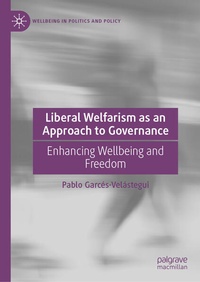
Liberal Welfarism as an Approach to Governance
Description

This book examines whether it is possible for governments to improve the wellbeing of its citizens, whilst simultaneously enhancing individual liberty. It is traditionally argued that these two policy goals are incompatible. Any attempts to improve welfare result in greater government interventions, whilst any gains in individual freedom often involve an absence of restrictions, which have a detrimental effect on wellbeing.
By enhancing the notion of 'liberal welfarism', this book argues that it is possible for governments to simultaneously accommodate both wellbeing and freedom. First, it provides a conceptual overview of 'liberal welfarism', and explains how it originates from combining the theoretical approaches of libertarian paternalism and the capability approach. It then demonstrates how the theory of 'liberal welfarism' can be implemented in practice, and the implications of this for politics and policy-making, especially with regards to social policy, security policy, and environmental policy. Interdisciplinary in nature, the book will appeal to all those interested in public policy, politics, philosophy, and behavioral economics.
More details
Other editions
Additional editions
Person
Pablo Garcés-Velástegui is a Researcher at the Norwegian University of Science and Technology, Norway.
Content
Introduction: enhancing freedom and wellbeing.- Part I: Between liberty and welfare.- 1. Libertarian Paternalism.- 2. The Capability Approach.- Part II: Liberal Welfarism in theory and practice.- 3. Liberal Welfarism: beyond the Capability Approach and Libertarian Paternalism.- 4. Liberal Welfarism and Liberal Welfarist policy-making.- Part III: Liberal Welfarism's politics and policies.- 5. The politics of Liberal Welfarism.- 6. The policies of Liberal Welfarism.- 7. Conclusion: a first step toward Liberal Welfarism.
