

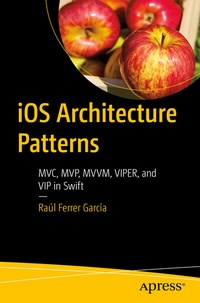
iOS Architecture Patterns
Description

Develop well-structured applications using tested techniques and patterns. When you start to develop an application, you not only have to think about the idea of the finished application, but also about how it will evolve as it is built. This book shows you how to plan for changes, scope creep, and for the possibility of other developers joining in.
Start by learning what architecture patterns for an application are. You'll find out why it's important for your applications to be based on these patterns and which ones are the most common. Then you'll look at the MVC as one of the best known and used patterns. You'll see how and when it can be implemented in your applications, as well as its advantages and disadvantages.
From there, you'll discover the first evolution of the MVC model: the MVP, which introduces a new layer (Presenter) to better manage views. The next evolution after that is the MVVM, which introduces the ViewModel layer and its connection withthe views through Data Binding. With those prominent patterns covered, you'll read about VIPER and VIP, Architecture Patterns that seeks to make applications easily maintainable, modularized, and highly scalable. All of which are hallmarks of Clean Architecture.Architecture patterns have developed and evolved to give your applications solid foundations. Understanding these patterns, you will reduce the problems that may arise when modifying existing functions, adding new ones, or correcting errors that may arise in the development process.
What You'll Learn
-
Code cleanly with solid foundations
-
Start your project ready to adapt and evolve as features and other developers are added
- Find and apply the right patterns for the best results
More details
Other editions
Additional editions
Person
Content
1. Introduction.- 2. MVC: Model-View-Controller.- 3. MVP: Model-View-Presenter.- 4. MVVM: Model-View-ViewModel.- 5. VIPER: View-Interactor-Presenter-Entity-Router.- 6. VIP: View-Interactor-Presenter.- 7. Other Architecture Patterns.- 8. Conclusion.
