

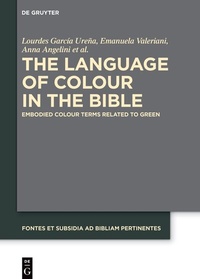
The Language of Colour in the Bible
Description

The Bible is one of the books that has aroused the most interest throughout history to the present day. However, there is one topic that has mostly been neglected and which today constitutes one of the most emblematic elements of the visual culture in which we live immersed: the language of colour. Colour is present in the biblical text from its beginning to its end, but it has hardly been studied, and we appear to have forgotten that the detailed study of the colour terms in the Bible is essential to understanding the use and symbolism that the language of colour has acquired in the literature that has forged European culture and art.
The objective of the present study is to provide the modern reader with the meaning of colour terms of the lexical families related to the green tonality in order to determine whether they denote only color and, if so, what is the coloration expressed, or whether, together with the chromatic denotation, another reality inseparable from colour underlies/along with the chromatic denotation, there is another underlying reality that is inseparable from colour. We will study the symbolism that/which underpins some of these colour terms, and which European culture has inherited.
This lexicographical study requires a methodology that allows us to approach colour not in accordance with our modern and abstract concept of colour, but with the concept of the ancient civilations. This is why the concept of colour that emerges from each of the versions of the Bible is studied and compared with that found in theoretical reflection in both Greek and Latin. Colour thus emerges as a concrete reality, visible on the surface of objects, reflecting in many cases, not an intrinsic quality, but their state. This concept has a reflection in the biblical languages, since the terms of colour always describe an entity (in this sense one can say that they are embodied) and include within them a wide chromatic spectrum, that is, they are mostly polysemic. Structuralism through the componential analysis, although providing interesting contributions, had at the same time serious shortcomings when it came to the study of colour. These were addressed through the theoretical framework provided by cognitive linguistics and some of its tools such as: cognitive domains, metonymy and metaphor. Our study, then, is one of the first to apply some of the contributions of cognitive linguistics to lexicography in general, and particularly with reference to the Hebrew, Greek and Latin versions of the Bible.A further novel contribution of this research is that the meaning is expressed through a definition and not through a list of possible colour terms as happens in dictionaries or in studies referring to colour in antiquity. The definition allows us to delve deeper and discover new nuances that enrich the understanding of colour in the three great civilizations involved in our study: Israel, Greece and Rome.
Reviews / Votes
""It opens up a filed of research not only for the study of colour (we eagerly await a book on red!), but also for other concepts in which culture plays a decisive role." R. Burnet in: Ephemerides Theologicae Lovanienses 4/2023More details
Other editions
Additional editions
Persons
L. García Ureña and M. Salvador Gimeno, Madrid , E. Valeriani, Lausanne , A. Angelini, Zurich , C. Santos Carretero, Cáceres.
Content
- Intro
- Acknowledgements
- Preface
- Contents
- I Colour Terms: object, study and method
- I.1 Understanding colour in the Bible
- II The Hebrew Bible Corpus
- II.1 ??? yereq and its polysemy: 'verdure', 'the colour of grass in the spring'
- II.2 ?? ??? y? raqraq and its polysemy: 'the colour of mould', 'the colour of gold'
- II.3 ???? ya rôq: 'greenery'
- II.4 ????? yer a qôn: 'the colour of fear'
- III The Greek Bible Corpus (LXX and NT)
- III.1 ?????? and its polysemy: 'the colour of vegetation', 'the colour of death', 'greenness'
- III.2 ?????t??: 'the colour of a kind of gold'
- III.3 ???????: 'to turn greenish'
- III.4 ???s????: 'stone as a colour'
- IV The Latin Bible Corpus
- IV.1 Viridis and its polysemy: 'the colour of grass', 'the colour of the almond, poplar and plane trees', 'greenness'
- IV.2 Viriditas: 'greenery'
- IV.3 Viror and its polysemy: 'the colour of calamus and reeds', 'the colour of a type of gold', 'verdure'
- IV.4 Vireo: 'to show the colour of plants'
- IV.5 Viresco: 'to become the colour of a tree or the new fresh grass'
- IV.6 Pallidus: 'the colour of death'
- IV.7 Pallor and its polysemy: 'mould', 'the colour of a type of gold', 'the colour of fear'
- V The language of Colour in the Bible
- V.1 Conclusion
- Abbreviations
- Bibliography
- Index of Ancient Sources
